Court of last resort in the context of "Supreme Court of Finland"

Play Trivia Questions online!

or

Skip to study material about Court of last resort in the context of "Supreme Court of Finland"


⭐ Core Definition: Court of last resort

In most legal jurisdictions, a supreme court, also known as a court of last resort, apex court, high (or final) court of appeal, and court of final appeal, is the highest court within the hierarchy of courts. Broadly speaking, the decisions of a supreme court are binding on all other courts in a nation and are not subject to further review by any other court. Supreme courts typically function primarily as appellate courts, hearing appeals from decisions of lower trial courts, or from intermediate-level appellate courts. A supreme court can also, in certain circumstances, act as a court of original jurisdiction.

Civil law states tend not to have a single highest court. Some federations, such as the United States, also do not have a single highest court. The highest court in some jurisdictions is not named the "Supreme Court", for example, the High Court of Australia. On the other hand, in some places the court named the "Supreme Court" is not in fact the highest court; examples include the New York Supreme Court, the supreme courts of several Canadian provinces/territories, and the former Supreme Court of Judicature of England and Wales and Supreme Court of Judicature of Northern Ireland, which are all subordinate to higher courts of appeal.
↓ Menu

👉 Court of last resort in the context of Supreme Court of Finland

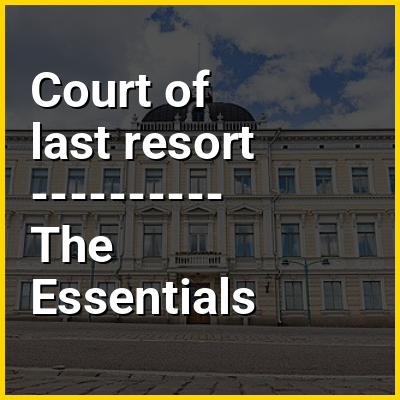
The Supreme Court of Finland (Finnish: korkein oikeus [ˈkorkei̯n ˈoi̯keus], abbreviated as KKO; Swedish: högsta domstolen, abbreviated as HD), located in Helsinki, is the court of last resort for cases within the private law of Finland (that is, civil and criminal cases). The Court's counterpart is the Supreme Administrative Court, which is the court of last resort for cases within the administrative law.

The Supreme Court consists of a President and at minimum 15, currently 18, other Justices, usually working in five-judge panels. The most important function of the Supreme Court is to rule on important points of law in cases which are significant for the entire legal order, guiding the administering of justice in future cases. Decisions of the Courts of Appeal (Finnish: hovioikeudet, Swedish: hovrätter), as well as certain decisions of the Insurance Court may be appealed against to the Supreme Court, provided that it grants leave to appeal. In the rare criminal cases where a Court of Appeal acts as the court of first instance, the leave to appeal is not needed.

↓ Explore More Topics
In this Dossier

Court of last resort in the context of New York Supreme Court

The Supreme Court of the State of New York is the superior court in the Judiciary of New York. It is vested with unlimited civil and criminal jurisdiction, although in many counties outside New York City it acts primarily as a court of civil jurisdiction, with most criminal matters handled in county courts.

New York is the only state where supreme court is a trial court rather than a court of last resort (which in New York is the Court of Appeals). Also, although it is a trial court, the Supreme Court sits as a "single great tribunal of general state-wide jurisdiction, rather than an aggregation of separate courts sitting in the several counties or judicial districts of the state." The Supreme Court is established in each of New York's 62 counties.

↑ Return to Menu

Court of last resort in the context of Judicial functions of the House of Lords

Whilst the House of Lords of the United Kingdom is the upper chamber of Parliament and has government ministers, for many centuries it had a judicial function. It functioned as a court of first instance for the trials of peers and for impeachments, and as a court of last resort in the United Kingdom and prior, the Kingdom of Great Britain and the Kingdom of England.

Appeals were technically not to the House of Lords, but rather to the King-in-Parliament. The Appellate Jurisdiction Act 1876 devolved the appellate functions of the House to an Appellate Committee, composed of Lords of Appeal in Ordinary (informally referred to as Law Lords). They were then appointed by the Lord Chancellor in the same manner as other judges.

↑ Return to Menu

Court of last resort in the context of Massachusetts Supreme Judicial Court

42°21′33″N 71°03′39″W / 42.359297°N 71.060954°W / 42.359297; -71.060954

The Massachusetts Supreme Judicial Court (SJC) is the highest court in the Commonwealth of Massachusetts. Although the claim is disputed by the Supreme Court of Pennsylvania, the SJC claims the distinction of being the oldest continuously functioning appellate court in the Americas, with a recognized history dating to the establishment of the Massachusetts Superior Court of Judicature in 1692 under the charter of the Province of Massachusetts Bay.

↑ Return to Menu