Cosimo Rosselli in the context of "Domenico Ghirlandaio"

Play Trivia Questions online!

or

Skip to study material about Cosimo Rosselli in the context of "Domenico Ghirlandaio"

Ad spacer

⭐ Core Definition: Cosimo Rosselli

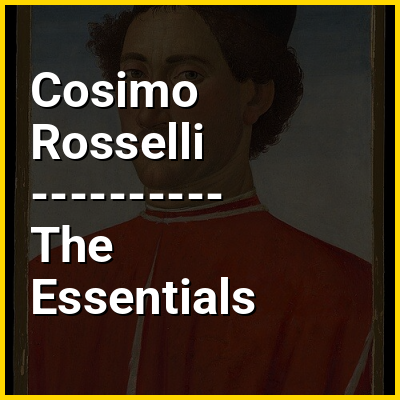
Cosimo Rosselli (Italian: [ˈkɔːzimo rosˈsɛlli]; 1439–1507) was an Italian painter of the Quattrocento, active mainly in his birthplace of Florence, but also in Pisa earlier in his career and in 1481–82 in the Sistine Chapel in Rome, where he painted some of the large frescoes on the side walls.

Though generally regarded as a lesser talent in comparison to Sandro Botticelli, Pietro Perugino, and Domenico Ghirlandaio, who were all also active at the Sistine Chapel, Rosselli was still able to win large and important commission throughout his career, a testament to his high level of activity in his native Florence. Important local commissions include a fresco in the cloister of Santissima Annunziata, Florence and those in the Chapel of the Holy Blood in Sant'Ambrogio, Florence.
↓ Menu

>>>PUT SHARE BUTTONS HERE<<<
In this Dossier

Cosimo Rosselli in the context of Sistine Chapel

The Sistine Chapel (/ˈsɪstn/ SIST-een; Latin: Sacellum Sixtinum; Italian: Cappella Sistina [kapˈpɛlla siˈstiːna]) is a chapel in the Apostolic Palace, the pope's official residence in Vatican City. Originally known as the Cappella Magna ('Great Chapel'), it takes its name from Pope Sixtus IV, who had it built between 1473 and 1481. Since that time, it has served as a place of both religious and functionary papal activity. Today, it is the site of the papal conclave, the process by which a new pope is selected. The chapel's fame lies mainly in the frescoes that decorate its interior, most particularly the Sistine Chapel ceiling and The Last Judgment, both by Michelangelo.

During the reign of Sixtus IV, a team of Renaissance painters including Sandro Botticelli, Pietro Perugino, Pinturicchio, Domenico Ghirlandaio and Cosimo Rosselli, created a series of frescoes depicting the Life of Moses and the Life of Christ, offset by papal portraits above and trompe-l'œil drapery below. They were completed in 1482, and on 15 August 1483 Sixtus IV celebrated the first mass in the Sistine Chapel for the Feast of the Assumption, during which the chapel was consecrated and dedicated to the Virgin Mary.

↑ Return to Menu

Cosimo Rosselli in the context of Portrait of a Woman (Pollaiuolo)

Portrait of a Woman is a c.1475 tempera and oil on panel painting by Antonio or Piero del Pollaiuolo. It has been in the Uffizi in Florence since 1861. Since 1861 it has been misattributed to Piero della Francesca, a young Leonardo da Vinci and Cosimo Rosselli.

It forms part of a group of profile portraits of women which also includes one in Milan, one at the Metropolitan Museum of Art, one in the Isabella Stewart Gardner Museum and another at the Gemäldegalerie, Berlin. Berenson attributes the more accomplished works in the group to Antonio and the others (along with the weaker sections of the better works) to Piero. Other art historians attribute them all to Piero on the grounds that Vasari mentions Antonio only as an engraver and sculptor and not as a painter. A third group attributes all the profiles to Piero and other mythological, action and battle scenes among the Pollaiolo oeuvre to Antonio.

↑ Return to Menu