Coronary circulation in the context of "Coronary arteries"

Play Trivia Questions online!

or

Skip to study material about Coronary circulation in the context of "Coronary arteries"

Ad spacer

>>>PUT SHARE BUTTONS HERE<<<

👉 Coronary circulation in the context of Coronary arteries

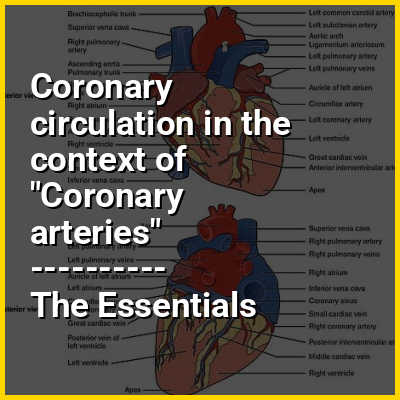
The coronary arteries are the arterial blood vessels of coronary circulation, which transport oxygenated blood to the heart muscle. The heart requires a continuous supply of oxygen to function and survive, much like any other tissue or organ of the body.

The coronary arteries wrap around the entire heart. The two main branches are the left coronary artery and right coronary artery. The arteries can additionally be categorized based on the area of the heart for which they provide circulation. These categories are called epicardial (above the epicardium, or the outermost tissue of the heart) and microvascular (close to the endocardium, or the innermost tissue of the heart).

↓ Explore More Topics
In this Dossier

Coronary circulation in the context of Myocardium

Cardiac muscle (also called heart muscle or myocardium) is one of three types of vertebrate muscle tissues, the others being skeletal muscle and smooth muscle. It is an involuntary, striated muscle that constitutes the main tissue of the wall of the heart. The cardiac muscle (myocardium) forms a thick middle layer between the outer layer of the heart wall (the pericardium) and the inner layer (the endocardium), with blood supplied via the coronary circulation. It is composed of individual cardiac muscle cells joined by intercalated discs, and encased by collagen fibers and other substances that form the extracellular matrix.

Cardiac muscle contracts in a similar manner to skeletal muscle, although with some important differences. Electrical stimulation in the form of a cardiac action potential triggers the release of calcium from the cell's internal calcium store, the sarcoplasmic reticulum. The rise in calcium causes the cell's myofilaments to slide past each other in a process called excitation-contraction coupling.Diseases of the heart muscle known as cardiomyopathies are of major importance. These include ischemic conditions caused by a restricted blood supply to the muscle such as angina, and myocardial infarction.

↑ Return to Menu

Coronary circulation in the context of Cardiac ischemia

Coronary ischemia, myocardial ischemia, or cardiac ischemia, is a medical term for abnormally reduced blood flow in the coronary circulation through the coronary arteries. Coronary ischemia is linked to heart disease, and heart attacks. Coronary arteries deliver oxygen-rich blood to the heart muscle. Reduced blood flow to the heart associated with coronary ischemia can result in inadequate oxygen supply to the heart muscle. When oxygen supply to the heart is unable to keep up with oxygen demand from the muscle, the result is the characteristic symptoms of coronary ischemia, the most common of which is chest pain. Chest pain due to coronary ischemia commonly radiates to the arm or neck. Certain individuals such as women, diabetics, and the elderly may present with more varied symptoms. If blood flow through the coronary arteries is stopped completely, cardiac muscle cells may die, known as a myocardial infarction, or heart attack.

Coronary artery disease (CAD) is the most common cause of coronary ischemia. Coronary ischemia and coronary artery disease are contributors to the development of heart failure over time. Diagnosis of coronary ischemia is achieved by an attaining a medical history and physical examination in addition to other tests such as electrocardiography (ECG), stress testing, and coronary angiography. Treatment is aimed toward preventing future adverse events and relieving symptoms. Beneficial lifestyle modifications include smoking cessation, a heart healthy diet, and regular exercise. Medications such as nitrates and beta-blockers may be useful for reducing the symptoms of coronary ischemia, with beta-blockers also improving long term outcomes in most studies. In refractory cases, invasive procedures such as percutaneous coronary intervention (PCI) or coronary artery bypass graft (CABG) may be performed to relieve coronary ischemia.
↑ Return to Menu

Coronary circulation in the context of Ibn al-Nafis

ʿAlāʾ al-Dīn Abū al-Ḥasan ʿAlī ibn Abī Ḥazm al-Qarashī (Arabic: علاء الدين أبو الحسن عليّ بن أبي حزم القرشي ), known as Ibn al-Nafīs (Arabic: ابن النفيس), was an Arab polymath whose areas of work included medicine, surgery, physiology, anatomy, biology, Islamic studies, jurisprudence, and philosophy. He is known for being the first to describe the pulmonary circulation of the blood. The work of Ibn al-Nafis regarding the right sided (pulmonary) circulation pre-dates the later work (1628) of William Harvey's De motu cordis. Both theories attempt to explain circulation. The 2nd century Greek physician Galen's theory about the physiology of the circulatory system remained unchallenged until the works of Ibn al-Nafis, who has therefore been described as "the father of circulatory physiology".

As an early anatomist, Ibn al-Nafis also performed several human dissections during the course of his work, making several important discoveries in the fields of physiology and anatomy. Besides his famous discovery of the pulmonary circulation, he also gave an early insight of the coronary and capillary circulations. He was also appointed as the chief physician at al-Naseri Hospital founded by Sultan Saladin. Due to his discoveries, he has been described by some as “the second Avicenna”.

↑ Return to Menu