Continental Celtic languages in the context of "Insular Celtic language"

Play Trivia Questions online!

or

Skip to study material about Continental Celtic languages in the context of "Insular Celtic language"


⭐ Core Definition: Continental Celtic languages

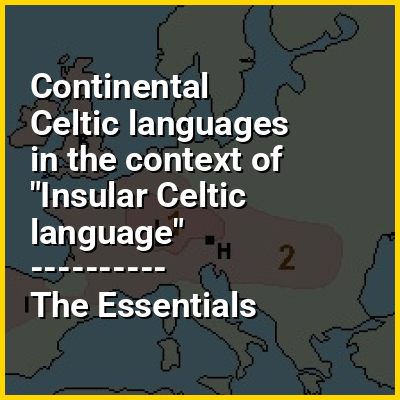
The Continental Celtic languages are the now-extinct group of the Celtic languages that were spoken on the continent of Europe and in central Anatolia, as distinguished from the Insular Celtic languages of the British Isles, Ireland and Brittany. Continental Celtic is a geographic, rather than linguistic, grouping of the ancient Celtic languages.

These languages were spoken by the people known to Roman and Greek writers as the Keltoi, Celtae, Galli, and Galatae. They were spoken in an area arcing from the northern half of Iberia in the west to north of Belgium, and east to the Carpathian basin and the Balkans as Noric, and in inner Anatolia (modern day Turkey) as Galatian.
↓ Menu

👉 Continental Celtic languages in the context of Insular Celtic language

Insular Celtic languages are the group of Celtic languages spoken in Brittany, Great Britain, Ireland, and the Isle of Man. All surviving Celtic languages are in the Insular group, including Breton, which is spoken on continental Europe in Brittany, France. The Continental Celtic languages, although once widely spoken in mainland Europe and in Anatolia, are extinct.

Six Insular Celtic languages are extant (in all cases written and spoken) in two distinct groups:

↓ Explore More Topics
In this Dossier

Continental Celtic languages in the context of Gaulish language

Gaulish is an extinct Celtic language spoken in parts of Continental Europe before and during the period of the Roman Empire. In the narrow sense, Gaulish was the language of the Celts of Gaul (now France, Luxembourg, Belgium, most of Switzerland, Northern Italy, as well as the parts of the Netherlands and Germany on the west bank of the Rhine). In a wider sense, it also comprises varieties of Celtic that were spoken across much of central Europe ("Noric"), parts of the Balkans, and Anatolia ("Galatian"), which are thought to have been closely related. The more divergent Lepontic of Northern Italy has also sometimes been subsumed under Gaulish.

Together with Lepontic and the Celtiberian spoken in the Iberian Peninsula, Gaulish is a member of the geographic group of Continental Celtic languages. The precise linguistic relationships among them, as well as between them and the modern Insular Celtic languages, are uncertain and a matter of ongoing debate because of their sparse attestation.

↑ Return to Menu

Continental Celtic languages in the context of Insular Celts

The Insular Celts were speakers of the Insular Celtic languages in the British Isles and Brittany. The term is mostly used for the Celtic peoples of the isles up until the early Middle Ages, covering the BritishIrish Iron Age, Roman Britain and Sub-Roman Britain. They included the Celtic Britons, the Picts, and the Gaels.

The Insular Celtic languages spread throughout the islands during the Bronze Age or early Iron Age. They are made up of two major groups: Brittonic in the east and Goidelic in the west. While there are records of Continental Celtic languages from the sixth century BC, allowing a confident reconstruction of Proto-Celtic, Insular Celtic languages became attested only during the early first millennium AD. The Insular Celts followed an Ancient Celtic religion overseen by druids. Some of the southern British tribes had strong links with mainland Europe, especially Gaul and Belgica, and minted their own coins.

↑ Return to Menu

Continental Celtic languages in the context of Matres and Matronae

The Matres (Latin for "mothers") and Matronae (Latin for "matrons") were female deities venerated in Northwestern Europe, of whom relics are found dating from the first to the fifth century AD. They are depicted on votive offerings and altars that bear images of goddesses, depicted almost entirely in groups of three, that feature inscriptions (about half of which feature Continental Celtic names and half of which feature Germanic names) and were venerated in regions of Germania, Eastern Gaul, and Northern Italy (with a small distribution elsewhere) that were occupied by the Roman army from the first to the fifth century.

Matres also appear on votive reliefs and inscriptions in other areas occupied by the Roman army, including southeast Gaul, as at Vertillum; in Spain and Portugal, where some twenty inscriptions are known, among them several ones that include local epithets such as a dedication to the Matribus Gallaicis "to the Galician Mothers"; and also in the Romano-Celtic culture of Pannonia in the form of similar reliefs and inscriptions to the Nutrices Augustae, "the august Nurses" found in Roman sites of Ptuj, Lower Styria.

↑ Return to Menu

Continental Celtic languages in the context of Dobra (Kupa)

The Dobra (pronounced [dobra]) is a river located mostly in the Karlovac County in the Republic of Croatia. It is 104.2 kilometres (64.7 mi) long and its basin covers an area of 1,428 square kilometres (551 sq mi). Its name is the feminine form of the Croatian adjective meaning "good" but it is over simplistic folk etymology. The river name probably comes from the Celtic transl. cel – transl. dubrum, dubron meaning 'water', Illyrian δυβρις (dybris) 'deep' or Old Slavonic dъbrь (dubri, debra) also 'deep' or 'valley'.

Dobra rises in Gorski Kotar near Skrad and Ravna Gora, where it flows first to the north and then turns to the east. It flows past Vrbovsko, to the southeast into the city of Ogulin, where it becomes an underground stream. It takes a sharp northward turn and rises back to the surface north of Ogulin. It continues to the northeast, past the Lešće spa and a hydroelectric plant (built and in test operation as of 2010), running in parallel to the Kupa and Mrežnica, and finally flows into the Kupa north of Karlovac.

↑ Return to Menu