Constitution of the Ottoman Empire in the context of "31 March Incident"

Play Trivia Questions online!

or

Skip to study material about Constitution of the Ottoman Empire in the context of "31 March Incident"


⭐ Core Definition: Constitution of the Ottoman Empire

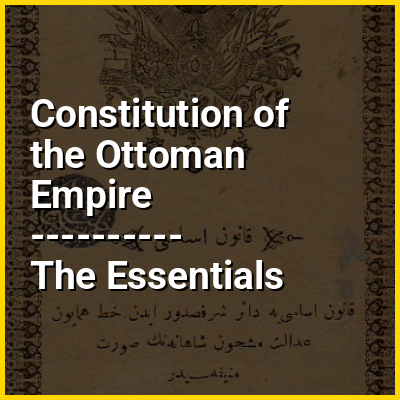
The Constitution of the Ottoman Empire (Ottoman Turkish: قانون أساسي, romanizedKānûn-ı Esâsî, lit.'Basic law'; French: Constitution ottomane) was in effect from 1876 to 1878 in a period known as the First Constitutional Era, and from 1908 to 1922 in the Second Constitutional Era. The first and only constitution of the Ottoman Empire, it was written by members of the Young Ottomans, particularly Midhat Pasha, during the reign of Sultan Abdul Hamid II (r. 1876–1909). After Abdul Hamid's political downfall in the 31 March Incident, the Constitution was amended to transfer more power from the sultan and the appointed Senate to the popularly-elected lower house: the Chamber of Deputies.

In the course of their studies in Europe, some members of the new Ottoman elite concluded that the secret of Europe's success rested not only with its technical achievements but also with its political organizations. Moreover, the process of reform itself had imbued a small segment of the elite with the belief that constitutional government would be a desirable check on autocracy and provide it with a better opportunity to influence policy. Sultan Abdulaziz's chaotic rule led to his deposition in 1876 and, after a few troubled months, to the proclamation of an Ottoman constitution that the new sultan, Abdul Hamid II, pledged to uphold.

↓ Menu

In this Dossier

Constitution of the Ottoman Empire in the context of Turkish War of Independence

The Turkish War of Independence (15 May 1919 – 24 July 1923) was a series of military campaigns and a revolution waged by the Turkish National Movement, after the Ottoman Empire was occupied and partitioned following its defeat in World War I. The conflict was between the Turkish Nationalists against Allied and separatist forces over the application of Wilsonian principles, especially self-determination, in post-World War I Anatolia and eastern Thrace. The revolution concluded the collapse of the Ottoman Empire and the Eastern question, ending the Ottoman sultanate and the Ottoman caliphate, and establishing the Republic of Turkey. This resulted in the transfer of sovereignty from the sultan-caliph to the nation, setting the stage for nationalist revolutionary reform in Republican Turkey.

While World War I ended for the Ottomans with the Armistice of Mudros, the Allies continued occupying land per the Sykes–Picot Agreement, and to facilitate the prosecution of former members of the Committee of Union and Progress and those involved in the Armenian genocide. Ottoman commanders therefore refused orders from the Allies and Ottoman government to disband their forces. In an atmosphere of turmoil, Sultan Mehmed VI dispatched general Mustafa Kemal Pasha (Atatürk), to restore order; however, he became an enabler and leader of Turkish Nationalist resistance. In an attempt to establish control over the power vacuum in Anatolia, the Allies agreed to launch a Greek peacekeeping force and occupy Smyrna (İzmir), inflaming sectarian tensions and beginning the Turkish War of Independence. A nationalist counter government led by Mustafa Kemal was established in Ankara when it became clear the Ottoman government was appeasing the Allies. The Allies pressured the Ottoman "Istanbul government" to suspend the Constitution, Parliament, and sign the Treaty of Sèvres, a treaty unfavorable to Turkish interests that the "Ankara government" declared illegal.

↑ Return to Menu

Constitution of the Ottoman Empire in the context of Committee of Union and Progress

The Ottoman Committee of Union and Progress (CUP, also translated as the Society of Union and Progress; Ottoman Turkish: اتحاد و ترقى جمعيتی, romanizedİttihad ve Terakki Cemiyeti, French: Union et Progrès) was a revolutionary group, secret society, and political party, active between 1889 and 1926 in the Ottoman Empire and in the Republic of Turkey. The foremost faction of the Young Turks, the CUP instigated the 1908 Young Turk Revolution, which ended absolute monarchy and began the Second Constitutional Era. After an ideological transformation, from 1913 to 1918, the CUP ruled the empire as a dictatorship and committed genocides against the Armenian, Greek, and Assyrian peoples as part of a broader policy of ethnic erasure during the late Ottoman period. The CUP and its members have often been referred to as "Young Turks", although the Young Turk movement produced other Ottoman political parties as well. Within the Ottoman Empire its members were known as İttihadcılar ('Unionists') or Komiteciler ('Committeemen').

The organisation began as a liberal reform movement, and the autocratic government of Sultan Abdul Hamid II (r. 1876–1909) persecuted it because of its calls for constitutional government and reform. Most of its members were exiled and arrested after a failed coup-attempt in 1896 which started a period infighting among émigré Young Turk communities in Europe. The CUP's cause revived by 1906 with a new "Macedonian" cadre of bureaucrats and Ottoman army contingents based in Ottoman Macedonia which were fighting ethnic insurgents in the Macedonian Struggle. In 1908 the Unionists revolted in the Young Turk Revolution, and forced Abdul Hamid to re-instate the 1876 Constitution, ushering in an era of political plurality. During the Second Constitutional Era, the CUP at first influenced politics from behind the scenes, and introduced major reforms to continue the modernisation of the Ottoman Empire. The CUP's main rival was the Freedom and Accord Party, a conservative party which called for the decentralisation of the empire, in opposition to the CUP's desire for a centralised and unitary Turkish-dominated state.

↑ Return to Menu

Constitution of the Ottoman Empire in the context of Young Turk Revolution

The Young Turk Revolution (July 1908; Turkish: Jön Türk Devrimi) was a constitutionalist revolution in the Ottoman Empire. Revolutionaries belonging to the Internal Committee of Union and Progress, an organization of the Young Turks movement, forced Sultan Abdul Hamid II to restore the Constitution, recall the parliament, and schedule an election. Thus began the Second Constitutional Era which lasted from 1908–1912 and also the Turkish Revolution, an era of political instability and social change which lasted for more than four decades.

The revolution took place in Ottoman Rumeli in the context of the Macedonian Struggle and the increasing instability of the Hamidian regime. It began with CUP member Ahmed Niyazi's flight into the Albanian highlands. He was soon joined by İsmail Enver, Eyub Sabri, and other Unionist officers. They networked with local Albanians and utilized their connections within the Salonica based Third Army to instigate a large revolt. A string of assassinations by Unionist Fedai also contributed to Abdul Hamid's capitulation. Though the constitutional regime established after the revolution eventually succumbed to Unionist dictatorship by 1913, the Ottoman sultanate ceased to be the base of power in Turkey after 1908.

↑ Return to Menu

Constitution of the Ottoman Empire in the context of Midhat Pasha

Ahmed Şefik Midhat Pasha (Ottoman Turkish: احمد شفيق مدحت پاشا, romanizedAḥmed Şefīḳ Midḥat Pāşā; 1822 – 26 April 1883) was an Ottoman politician, reformist, and statesman. He was the author of the Constitution of the Ottoman Empire.

Midhat was born in Istanbul and educated from a private medrese. In July 1872, he was appointed grand vizier by Abdulaziz (r. 1861–1876), though was removed in August. During the First Constitutional Era, in 1876, he co-founded the Ottoman Parliament. Midhat was noted as a kingmaker and leading Ottoman democrat. He was part of a governing elite which recognized the crisis the Empire was in and considered reform to be a dire need. Midhat was reportedly killed in al-Ta'if.

↑ Return to Menu

Constitution of the Ottoman Empire in the context of 31 March incident

The 31 March incident (Turkish: 31 Mart Vakası) was an uprising in the Ottoman Empire in April 1909, during the Second Constitutional Era. The incident broke out during the night of 30–31 Mart 1325 in Rumi calendar (GC 12–13 April 1909), thus named after 31 March where March is the equivalent to Rumi month Mart. Occurring soon after the 1908 Young Turk Revolution, in which the Committee of Union and Progress (CUP) had successfully restored the Constitution and ended the absolute rule of Sultan Abdul Hamid II (r. 1876–1909), it is sometimes referred to as an attempted countercoup or counterrevolution. It consisted of a general uprising against the CUP within Istanbul, largely led by reactionary groups, particularly Islamists opposed to the secularising influence of the CUP and supporters of absolutism, although liberal opponents of the CUP within the Liberty Party also played a lesser role. Eleven days later the uprising was suppressed and the former government restored when elements of the Ottoman Army sympathetic to the CUP formed an impromptu military force known as the Action Army (Hareket Ordusu). Upon entering Istanbul on 24 April Sultan Abdul Hamid II, accused by the CUP of complicity in the uprising, was deposed and the Ottoman National Assembly elevated his half-brother, Mehmed V, to the throne. Mahmud Shevket Pasha, the military general who had organised and led the Action Army, became the most influential figure in the restored constitutional system until his assassination in 1913.

The precise nature of events is uncertain; differing interpretations have been offered by historians, ranging from a spontaneous revolt of discontents to a secretly planned and coordinated counter-revolution against the CUP. Most modern studies disregard claims the sultan was actively involved in plotting the uprising, emphasising the CUP's mismanagement of troops in the build up to the mutiny and the role of conservative religious groups. The crisis was an important early moment in the empire's process of disintegration, setting a pattern of political instability which continued with military coups in 1912 and 1913. The temporary loss of power led to radicalisation within the CUP, resulting in an increasing willingness among Unionists to utilise violence. Some scholars have argued that the deterioration of ethnic relations and erosion of public institutions during 1908–1909 precipitated the Armenian genocide. The crisis also represented the demise of the Sultanate's power in the Ottoman Empire, as a series of constitutional amendments confined its function in government to the confirmation of parliamentary decisions, conversely cementing parliament's supremacy in a significant step of republicanism in Turkish political history.

↑ Return to Menu

Constitution of the Ottoman Empire in the context of Abdul Hamid II

Abdülhamid II or Abdul Hamid II (Ottoman Turkish: عبد الحميد ثانی, romanizedAbd ul-Hamid-i s̱ānī; Turkish: II. Abdülhamid; 21 September 1842 – 10 February 1918) was the 34th sultan of the Ottoman Empire, from 1876 to 1909, and the last sultan to exert effective control over the fracturing state. He oversaw a period of decline with rebellions (particularly in the Balkans), and presided over an unsuccessful war with the Russian Empire (1877–78), the loss of Egypt, Cyprus, Bulgaria, Serbia, Montenegro, Tunisia, and Thessaly from Ottoman control (1877–1882), followed by a successful war against Greece in 1897, though Ottoman gains were tempered by subsequent Western European intervention.

Elevated to power in the wake of Young Ottoman coups, he promulgated the Ottoman Empire's first constitution, a sign of the progressive thinking that marked his early rule. But his enthronement came in the context of the Great Eastern Crisis, which began with the Empire's default on its loans, uprisings by Christian Balkan minorities, and a war with the Russian Empire. At the end of the crisis, Ottoman rule in the Balkans and its international prestige were severely diminished, and the Empire lost its economic sovereignty as its finances came under the control of the Great Powers through the Ottoman Public Debt Administration.

↑ Return to Menu

Constitution of the Ottoman Empire in the context of Ottoman electoral law


Ottoman electoral law refers to the evolving legal framework governing elections to the Ottoman parliament, first codified on an imperial level in December of 1876 alongside the first Ottoman constitution (Kanun-ı Esasi). The initial law established formal representative governance within the Ottoman state, namely procedures for selecting members for the Chamber of Deputies (Meclis-i Mebusan).

Comprehensive in scope, the 1876 law included the structure of electoral districts, parliamentary contingencies, the preparation of voter registers, the qualifications and disqualifications for both voters and candidates, the two-stage system of indirect elections, the method of selection and the duties of electoral inspection committees, and requirements for suffrage. The law also included provisions for by-elections, voting conduct, and penal clauses for electoral fraud or obstruction.

↑ Return to Menu

Constitution of the Ottoman Empire in the context of Mehmed V

Mehmed V Reşâd (Ottoman Turkish: محمد خامس, romanizedMeḥmed-i ḫâmis; Turkish: V. Mehmed or Mehmed Reşad; 2 November 1844 – 3 July 1918) was the penultimate sultan of the Ottoman Empire from 1909 to 1918. Mehmed V reigned as a constitutional monarch. He had little influence over government affairs and the Ottoman constitution was held with little regard by his ministries. The first half of his reign was marked by increasingly polarizing politics, and the second half by war and domination of the Committee of Union and Progress (CUP) and the Three Pashas.

Reşad was the son of Sultan Abdülmecid I. He succeeded his half-brother Abdul Hamid II after the 31 March Incident. Coming to power in the aftermath of the failed coup attempt, his nine-year reign featured three coups d'etat, four wars, eleven governments, and numerous uprisings. The Italo-Turkish War saw the cession of the Empire's North African territories and the Dodecanese Islands, including Rhodes, during which the CUP was forced out of power by the military. This was followed up by the traumatic loss of almost all of the Empire's European territories west of Constantinople (now Istanbul) in the First Balkan War, and the return of a now radicalized CUP rule in another coup. Eastern Thrace was retaken in the Second Balkan War.

↑ Return to Menu