Constantine XI Palaiologos in the context of "Helena Dragaš"

Play Trivia Questions online!

or

Skip to study material about Constantine XI Palaiologos in the context of "Helena Dragaš"

Ad spacer

⭐ Core Definition: Constantine XI Palaiologos

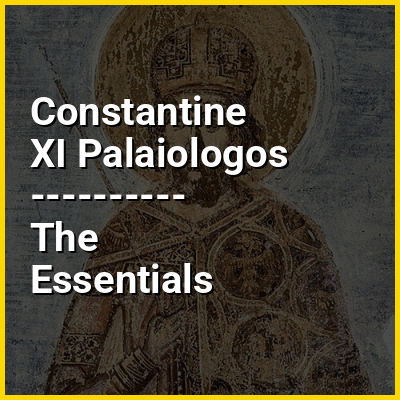
Constantine XI Dragases Palaiologos or Dragaš Palaeologus (Greek: Κωνσταντῖνος Δραγάσης Παλαιολόγος, romanizedKōnstantīnos Dragásēs Palaiológos; 8 February 1404 – 29 May 1453) was the last reigning Byzantine emperor from 23 January 1449 until his death in battle at the fall of Constantinople on 29 May 1453. Constantine's death marked the definitive end of the Eastern Roman Empire, which traced its origin to Constantine the Great's foundation of Constantinople as the Roman Empire's new capital in 330.

Constantine was the fourth son of Emperor Manuel II Palaiologos and Serbian noblewoman Helena Dragaš. Little is known of his early life, but from the 1420s onward, he repeatedly demonstrated great skill as a military general. Based on his career and surviving contemporary sources, Constantine appears to have been primarily a soldier. This does not mean that Constantine was not also a skilled administrator: he was trusted and favored to such an extent by his older brother, Emperor John VIII Palaiologos, that he was designated as regent twice during John VIII's journeys away from Constantinople in 1423–1424 and 1437–1440. In 1427–1428, Constantine and John fended off an attack on the Morea (the Peloponnese) by Carlo I Tocco, ruler of Epirus, and in 1428 Constantine was proclaimed Despot of the Morea and ruled the province together with his older brother Theodore and his younger brother Thomas. Together, they extended Roman rule to cover almost the entire Peloponnese for the first time since the Fourth Crusade more than two hundred years before and rebuilt the ancient Hexamilion wall, which defended the peninsula from outside attacks. Although ultimately unsuccessful, Constantine personally led a campaign into Central Greece and Thessaly in 1444–1446, attempting to extend Byzantine rule into Greece once more.
↓ Menu

>>>PUT SHARE BUTTONS HERE<<<

👉 Constantine XI Palaiologos in the context of Helena Dragaš

Helena Dragaš (Serbian: Јелена Драгаш, romanizedJelena Dragaš; Greek: Ἑλένη Δραγάση, romanizedHelénē Dragásē; c. 1372 – 23 March 1450) was the Empress consort of the Byzantine Emperor Manuel II Palaiologos and the mother of the last two emperors, John VIII Palaiologos and Constantine XI Palaiologos. She served as the regent of the Byzantine Empire after the death of her son John VIII in 1448 until the enthronement of her son Constantine XI in 1449.

Born into Serbian nobility, she later became a nun and is venerated as a saint by the Eastern Orthodox Church under her monastic name, Saint Hypomone (Ὑπομονὴ), which is translated into English as Saint Patience.

↓ Explore More Topics
In this Dossier

Constantine XI Palaiologos in the context of Fall of Constantinople

The Fall of Constantinople, also known as the Conquest of Constantinople, was the capture of the capital of the Byzantine Empire by the Ottoman Empire. The city was captured on 29 May 1453 as part of the culmination of a 53-day siege which had begun on 6 April.

The attacking Ottoman Army, which significantly outnumbered Constantinople's defenders, was commanded by the 21-year-old Sultan Mehmed II (later nicknamed "the Conqueror"), while the Byzantine army was led by Emperor Constantine XI Palaiologos. After conquering the city, Mehmed II made Constantinople the new Ottoman capital, replacing Adrianople.

↑ Return to Menu

Constantine XI Palaiologos in the context of Manuel II Palaiologos

Manuel II Palaiologos or Palaeologus (Greek: Μανουὴλ Παλαιολόγος, romanizedManouḗl Palaiológos, pronounced [ma.nuˈil pa.le.oˈlo.ɣos]; 27 June 1350 – 21 July 1425) was Byzantine emperor from 1391 to 1425. Shortly before his death he was tonsured a monk and received the name Matthaios (Ματθαίος). Manuel was a vassal of the Ottoman Empire, which sometimes threatened to capture his territory outright. Accordingly he continued his father's practice of soliciting Western European aid against the Ottomans, and personally visited several foreign courts to plead his cause. These efforts failed, although an Ottoman civil war and Byzantine victories against Latin neighbors helped Manuel's government survive and slightly expand its influence. His wife Helena Dragaš saw to it that their sons, John VIII and Constantine XI, became emperors. He is commemorated by the Greek Orthodox Church on 21 July.

↑ Return to Menu

Constantine XI Palaiologos in the context of John VIII Palaiologos

John VIII Palaiologos or Palaeologus (Greek: Ἰωάννης Παλαιολόγος, romanizedIōánnēs Palaiológos; 18 December 1392 – 31 October 1448) was the penultimate Byzantine emperor. Ruling from 1425 to 1448, he attempted to bring about the reunification of the Orthodox and Catholic churches and prioritized the protection of Constantinople against the Ottoman Empire. He was succeeded by his brother, Constantine XI, who would become the final emperor.

↑ Return to Menu

Constantine XI Palaiologos in the context of Thomas Palaiologos

Thomas Palaiologos (Greek: Θωμᾶς Παλαιολόγος; 1409 – 12 May 1465) was Despot of the Morea from 1428 until the fall of the despotate in 1460, although he continued to claim the title until his death five years later. He was the younger brother of Constantine XI Palaiologos, the final Byzantine emperor. Thomas was appointed as Despot of the Morea by his oldest brother, Emperor John VIII Palaiologos, in 1428, joining his two brothers and other despots Theodore and Constantine, already governing the Morea. Though Theodore proved reluctant to cooperate with his brothers, Thomas and Constantine successfully worked to strengthen the despotate and expand its borders. In 1432, Thomas brought the remaining territories of the Latin Principality of Achaea, established during the Fourth Crusade more than two hundred years earlier, into Byzantine hands by marrying Catherine Zaccaria, heiress to the principality.

In 1449, Thomas supported the ascension of his brother Constantine, who then became Emperor Constantine XI, to the throne despite the machinations of his other brother, Demetrios, who himself desired the throne. After Constantine's rise to the throne, Demetrios was then assigned by Constantine to govern the Morea with Thomas but the two brothers found it difficult to cooperate, often quarreling with each other. In the aftermath of the Fall of Constantinople and end of the Byzantine Empire in 1453, Ottoman Sultan Mehmed II allowed Thomas and Demetrios to continue to rule as Ottoman vassals in the Morea. Thomas hoped to turn the small despotate into a rallying point of a campaign to restore the empire, hoping to gain support from the Papacy and Western Europe. Constant quarreling with Demetrios, who supported the Ottomans instead, eventually led Mehmed to invade and conquer the Morea in 1460.

↑ Return to Menu

Constantine XI Palaiologos in the context of Basilic (cannon)

The Basilic or Basilica cannon, i.e. 'royal gun', as the Greeks called it, also known as Urban's cannon or the Ottoman Cannon was a very large-calibre cannon designed by Orban or Urban, a Hungarian cannon engineer, at a time when cannons were still new. It is one of the largest cannons ever built.

The cannon was first offered in 1452 to Byzantine emperor Constantine XI, who was not able to bring up the sum required for its construction. It was then offered to the Ottoman Sultan Mehmed II, who ordered the cannon built after learning that it could smash through walls using a large projectile. Huge amounts of scrap bronze were needed in order to cast the 27 ft (8.2 m) long cannon, with 8 in (200 mm) thick walls. When it was completed, the cannon was used by the Ottoman Army during the 1453 siege which led to the fall of Constantinople, and played a key role in damaging the city walls. It was one of a total of some 70 guns built by Orban for Mehmed.

↑ Return to Menu

Constantine XI Palaiologos in the context of Demetrios Palaiologos

Demetrios Palaiologos or Demetrius Palaeologus (Greek: Δημήτριος Παλαιολόγος, romanizedDēmētrios Palaiologos; 1407–1470) was Despot of the Morea together with his brother Thomas from 1449 until the fall of the despotate in 1460. Demetrios and Thomas were sons of Byzantine Emperor Manuel II Palaiologos, and brothers of the final two emperors John VIII and Constantine XI. Demetrios had a complicated relationship with his brothers, whom he frequently quarrelled with, usually over the matter of Demetrios's wish to establish himself as the most senior of them and claim the imperial throne for himself.

In 1437, Demetrios accompanied his elder brother John VIII to the Council of Florence, the main objective of which was to unify the Roman Catholic and Eastern Orthodox churches so that Western Europe might be more inclined to lend military aid to the desperate Byzantine Empire. Even though Demetrios was staunchly against a union of the churches, he was brought along as John did not dare to leave him in the east without he himself being present. Demetrios attempted to claim the throne twice, first attempting to take it with Ottoman support in 1442 and then by hoping to be proclaimed emperor after John VIII's death in 1448. Both attempts failed and in 1449, Demetrios was proclaimed as Despot of the Morea by the new emperor, his brother Constantine XI.

↑ Return to Menu

Constantine XI Palaiologos in the context of King asleep in mountain

The king asleep in the mountain (D 1960.2 in Stith Thompson's motif-index) is a prominent folklore trope found in many folktales and legends. Thompson termed it as the Kyffhäuser type. Some other designations are king in the mountain, king under the mountain, sleeping hero, or Bergentrückung ("mountain rapture").

Examples include the legends of King Arthur, Fionn mac Cumhaill, Charlemagne, Ogier the Dane, King David, Frederick Barbarossa at Kyffhäuser, Falanto of Taranto, Genghis Khan, Constantine XI Palaiologos, Kraljević Marko, Sebastian of Portugal and King Matjaž.

↑ Return to Menu