Complex plane in the context of Real number


Complex plane in the context of Real number

Complex plane Study page number 1 of 2

Play TriviaQuestions Online!

or

Skip to study material about Complex plane in the context of "Real number"


⭐ Core Definition: Complex plane

In mathematics, the complex plane is the plane formed by the complex numbers, with a Cartesian coordinate system such that the horizontal x-axis, called the real axis, is formed by the real numbers, and the vertical y-axis, called the imaginary axis, is formed by the imaginary numbers.

The complex plane allows for a geometric interpretation of complex numbers. Under addition, they add like vectors. The multiplication of two complex numbers can be expressed more easily in polar coordinates: the magnitude or modulus of the product is the product of the two absolute values, or moduli, and the angle or argument of the product is the sum of the two angles, or arguments. In particular, multiplication by a complex number of modulus 1 acts as a rotation.

↓ Menu
HINT:

In this Dossier

Complex plane in the context of Two-dimensional

A two-dimensional space is a mathematical space with two dimensions, meaning points have two degrees of freedom: their locations can be locally described with two coordinates or they can move in two independent directions. Common two-dimensional spaces are often called planes, or, more generally, surfaces. These include analogs to physical spaces, like flat planes, and curved surfaces like spheres, cylinders, and cones, which can be infinite or finite. Some two-dimensional mathematical spaces are not used to represent physical positions, like an affine plane or complex plane.

View the full Wikipedia page for Two-dimensional
↑ Return to Menu

Complex plane in the context of Complex analysis

Complex analysis, traditionally known as the theory of functions of a complex variable, is the branch of mathematical analysis that investigates functions of a complex variable of complex numbers. It is helpful in many branches of mathematics, including real analysis, algebraic geometry, number theory, analytic combinatorics, and applied mathematics, as well as in physics, including the branches of hydrodynamics, thermodynamics, quantum mechanics, and twistor theory. By extension, use of complex analysis also has applications in engineering fields such as nuclear, aerospace, mechanical and electrical engineering.

At first glance, complex analysis is the study of holomorphic functions that are the differentiable functions of a complex variable. By contrast with the real case, a holomorphic functions is always infinitely differentiable and equal to the sum of its Taylor series in some neighborhood of each point of its domain.This makes methods and results of complex analysis significantly different from that of real analysis. In particular, contrarily, with the real case, the domain of every holomorphic function can be uniquely extended to almost the whole complex plane. This implies that the study of real analytic functions needs often the power of complex analysis. This is, in particular, the case in analytic combinatorics.

View the full Wikipedia page for Complex analysis
↑ Return to Menu

Complex plane in the context of Analytic number theory

In mathematics, analytic number theory is a branch of number theory that uses methods from mathematical analysis to solve problems about the integers. It is often said to have begun with Peter Gustav Lejeune Dirichlet's 1837 introduction of Dirichlet L-functions to give the first proof of Dirichlet's theorem on arithmetic progressions. It is well known for its results on prime numbers (involving the Prime Number Theorem and Riemann zeta function) and additive number theory (such as the Goldbach conjecture and Waring's problem).

View the full Wikipedia page for Analytic number theory
↑ Return to Menu

Complex plane in the context of Imaginary unit

The imaginary unit, usually denoted by i, is a mathematical constant that is a solution to the quadratic equation x = −1, which is not solved by any real number. Any real-number multiple of the imaginary unit is called an imaginary number.

Combining the real numbers with the imaginary unit using addition and multiplication generates a new number system called the complex numbers, which consists of all numbers of the form a + bi with real numbers a and b.

View the full Wikipedia page for Imaginary unit
↑ Return to Menu

Complex plane in the context of Mandelbrot set

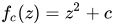
The Mandelbrot set (/ˈmændəlbrt, -brɒt/) is a two-dimensional set that is defined in the complex plane as the complex numbers for which the function does not diverge to infinity when iterated starting at , i.e., for which the sequence , , etc., remains bounded in absolute value.

This set was first defined and drawn by Robert W. Brooks and Peter Matelski in 1978, as part of a study of Kleinian groups. Afterwards, in 1980, Benoit Mandelbrot obtained high-quality visualizations of the set while working at IBM's Thomas J. Watson Research Center in Yorktown Heights, New York.

View the full Wikipedia page for Mandelbrot set
↑ Return to Menu

Complex plane in the context of Functions of a complex variable

Complex analysis, traditionally known as the theory of functions of a complex variable, is the branch of mathematical analysis that investigates functions of a complex variable of complex numbers. It is helpful in many branches of mathematics, including real analysis, algebraic geometry, number theory, analytic combinatorics, and applied mathematics, as well as in physics, including the branches of hydrodynamics, thermodynamics, quantum mechanics, and twistor theory. By extension, use of complex analysis also has applications in engineering fields such as nuclear, aerospace, mechanical and electrical engineering.

At first glance, complex analysis is the study of holomorphic functions that are the differentiable functions of a complex variable. By contrast with the real case, a holomorphic function is always infinitely differentiable and equal to the sum of its Taylor series in some neighborhood of each point of its domain.This makes methods and results of complex analysis significantly different from that of real analysis. In particular, contrarily, with the real case, the domain of every holomorphic function can be uniquely extended to almost the whole complex plane. This implies that the study of real analytic functions needs often the power of complex analysis. This is, in particular, the case in analytic combinatorics.

View the full Wikipedia page for Functions of a complex variable
↑ Return to Menu

Complex plane in the context of Taylor series

In mathematical analysis, the Taylor series or Taylor expansion of a function is an infinite sum of terms that are expressed in terms of the function's derivatives at a single point. For most common functions, the function and the sum of its Taylor series are equal near this point. Taylor series are named after Brook Taylor, who introduced them in 1715. A Taylor series is also called a Maclaurin series when 0 is the point where the derivatives are considered, after Colin Maclaurin, who made extensive use of this special case of Taylor series in the 18th century.

The partial sum formed by the first n + 1 terms of a Taylor series is a polynomial of degree n that is called the nth Taylor polynomial of the function. Taylor polynomials are approximations of a function, which become generally more accurate as n increases. Taylor's theorem gives quantitative estimates on the error introduced by the use of such approximations. If the Taylor series of a function is convergent, its sum is the limit of the infinite sequence of the Taylor polynomials. A function may differ from the sum of its Taylor series, even if its Taylor series is convergent. A function is analytic at a point x if it is equal to the sum of its Taylor series in some open interval (or open disk in the complex plane) containing x. This implies that the function is analytic at every point of the interval (or disk).

View the full Wikipedia page for Taylor series
↑ Return to Menu

Complex plane in the context of Domain coloring

In complex analysis, domain coloring or a color wheel graph is a technique for visualizing complex functions by assigning a color to each point of the complex plane. By assigning points on the complex plane to different colors and brightness, domain coloring allows for a function from the complex plane to itself, whose graph would normally require four spatial dimensions, to be easily represented and understood. This provides insight to the fluidity of complex functions and shows natural geometric extensions of real functions.

View the full Wikipedia page for Domain coloring
↑ Return to Menu

Complex plane in the context of Argument (complex analysis)

In mathematics (particularly in complex analysis), the argument of a complex number z, denoted arg(z), is the angle between the positive real axis and the line joining the origin and z, represented as a point in the complex plane, shown as in Figure 1. By convention the positive real axis is drawn pointing rightward, the positive imaginary axis is drawn pointing upward, and complex numbers with positive real part are considered to have an anticlockwise argument with positive sign.

When any real-valued angle is considered, the argument is a multivalued function operating on the nonzero complex numbers. The principal value of this function is single-valued, typically chosen to be the unique value of the argument that lies within the interval (−π, π]. In this article the multi-valued function will be denoted arg(z) and its principal value will be denoted Arg(z), but in some sources the capitalization of these symbols is exchanged.

View the full Wikipedia page for Argument (complex analysis)
↑ Return to Menu

Complex plane in the context of Dirichlet L-function

In mathematics, a Dirichlet L-series is a function of the form

where is a Dirichlet character and a complex variable with real part greater than . It is a special case of a Dirichlet series. By analytic continuation, it can be extended to a meromorphic function on the whole complex plane; it is then called a Dirichlet L-function.

View the full Wikipedia page for Dirichlet L-function
↑ Return to Menu

Complex plane in the context of Complex coordinate space

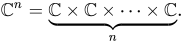
In mathematics, the n-dimensional complex coordinate space (or complex n-space) is the set of all ordered n-tuples of complex numbers, also known as complex vectors. The space is denoted , and is the n-fold Cartesian product of the complex line with itself. Symbolically,orThe variables are the (complex) coordinates on the complex n-space. The special case , called the complex coordinate plane, is not to be confused with the complex plane, a graphical representation of the complex line.

Complex coordinate space is a vector space over the complex numbers, with componentwise addition and scalar multiplication. The real and imaginary parts of the coordinates set up a bijection of with the 2n-dimensional real coordinate space, . With the standard Euclidean topology, is a topological vector space over the complex numbers.

View the full Wikipedia page for Complex coordinate space
↑ Return to Menu

Complex plane in the context of Circular symmetry

In geometry, circular symmetry is a type of continuous symmetry for a planar object that can be rotated by any arbitrary angle and map onto itself.

Rotational circular symmetry is isomorphic with the circle group in the complex plane, or the special orthogonal group SO(2), and unitary group U(1). Reflective circular symmetry is isomorphic with the orthogonal group O(2).

View the full Wikipedia page for Circular symmetry
↑ Return to Menu

Complex plane in the context of Complex projective line

In mathematics, the Riemann sphere, named after Bernhard Riemann, is a model of the extended complex plane (also called the closed complex plane): the complex plane plus one point at infinity. This extended plane represents the extended complex numbers, that is, the complex numbers plus a value for infinity. With the Riemann model, the point is near to very large numbers, just as the point is near to very small numbers.

The extended complex numbers are useful in complex analysis because they allow for division by zero in some circumstances, in a way that makes expressions such as well-behaved. For example, any rational function on the complex plane can be extended to a holomorphic function on the Riemann sphere, with the poles of the rational function mapping to infinity. More generally, any meromorphic function can be thought of as a holomorphic function whose codomain is the Riemann sphere.

View the full Wikipedia page for Complex projective line
↑ Return to Menu