Complex number in the context of S-domain


Complex number in the context of S-domain

Complex number Study page number 1 of 8

Play TriviaQuestions Online!

or

Skip to study material about Complex number in the context of "S-domain"


⭐ Core Definition: Complex number

In mathematics, a complex number is an element of a number system that extends the real numbers with a specific element denoted i, called the imaginary unit and satisfying the equation ; every complex number can be expressed in the form , where a and b are real numbers. Because no real number satisfies the above equation, i was called an imaginary number by René Descartes. For the complex number , a is called the real part, and b is called the imaginary part. The set of complex numbers is denoted by either of the symbols or C. Despite the historical nomenclature, "imaginary" complex numbers have a mathematical existence as firm as that of the real numbers, and they are fundamental tools in the scientific description of the natural world.

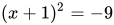
Complex numbers allow solutions to all polynomial equations, even those that have no solutions in real numbers. More precisely, the fundamental theorem of algebra asserts that every non-constant polynomial equation with real or complex coefficients has a solution which is a complex number. For example, the equationhas no real solution, because the square of a real number cannot be negative, but has the two nonreal complex solutions and .
↓ Menu
HINT:

In this Dossier

Complex number in the context of Mathematical analysis

Analysis is the branch of mathematics dealing with continuous functions, limits, and related theories, such as differentiation, integration, measure, infinite sequences, series, and analytic functions.

These theories are usually studied in the context of real and complex numbers and functions. Analysis evolved from calculus, which involves the elementary concepts and techniques of analysis.Analysis may be distinguished from geometry; however, it can be applied to any space of mathematical objects that has a definition of nearness (a topological space) or specific distances between objects (a metric space).

View the full Wikipedia page for Mathematical analysis
↑ Return to Menu

Complex number in the context of Number

A number is a mathematical object used to count, measure, and label. The most basic examples are the natural numbers: 1, 2, 3, 4, 5, and so forth. Individual numbers can be represented in language with number words or by dedicated symbols called numerals; for example, "five" is a number word and "5" is the corresponding numeral. As only a limited list of symbols can be memorized, a numeral system is used to represent any number in an organized way. The most common representation is the Hindu–Arabic numeral system, which can display any non-negative integer using a combination of ten symbols, called numerical digits. Numerals can be used for counting (as with cardinal number of a collection or set), labels (as with telephone numbers), for ordering (as with serial numbers), and for codes (as with ISBNs). In common usage, a numeral is not clearly distinguished from the number that it represents.

In mathematics, the notion of number has been extended over the centuries to include zero (0), negative numbers, rational numbers such as one half , real numbers such as the square root of 2 , and π, and complex numbers which extend the real numbers with a square root of −1, and its combinations with real numbers by adding or subtracting its multiples. Calculations with numbers are done with arithmetical operations, the most familiar being addition, subtraction, multiplication, division, and exponentiation. Their study or usage is called arithmetic, a term which may also refer to number theory, the study of the properties of numbers.

View the full Wikipedia page for Number
↑ Return to Menu

Complex number in the context of Arithmetic function

In number theory, an arithmetic, arithmetical, or number-theoretic function is generally any function whose domain is the set of positive integers and whose range is a subset of the complex numbers. Hardy & Wright include in their definition the requirement that an arithmetical function "expresses some arithmetical property of n". There is a larger class of number-theoretic functions that do not fit this definition, for example, the prime-counting functions. This article provides links to functions of both classes.

An example of an arithmetic function is the divisor function whose value at a positive integer n is equal to the number of divisors of n.

View the full Wikipedia page for Arithmetic function
↑ Return to Menu

Complex number in the context of Algebraic integer

In algebraic number theory, an algebraic integer is a complex number that is integral over the integers. That is, an algebraic integer is a complex root of some monic polynomial (a polynomial whose leading coefficient is 1) whose coefficients are integers. The set of all algebraic integers A is closed under addition, subtraction and multiplication and therefore is a commutative subring of the complex numbers.

The ring of integers of a number field K, denoted by OK, is the intersection of K and A: it can also be characterized as the maximal order of the field K. Each algebraic integer belongs to the ring of integers of some number field. A number α is an algebraic integer if and only if the ring is finitely generated as an abelian group, which is to say, as a -module.

View the full Wikipedia page for Algebraic integer
↑ Return to Menu

Complex number in the context of Coordinate

In geometry, a coordinate system is a system that uses one or more numbers, or coordinates, to uniquely determine and standardize the position of the points or other geometric elements on a manifold such as Euclidean space. The coordinates are not interchangeable; they are commonly distinguished by their position in an ordered tuple, or by a label, such as in "the x-coordinate". The coordinates are taken to be real numbers in elementary mathematics, but may be complex numbers or elements of a more abstract system such as a commutative ring. The use of a coordinate system allows problems in geometry to be translated into problems about numbers and vice versa; this is the basis of analytic geometry.

View the full Wikipedia page for Coordinate
↑ Return to Menu

Complex number in the context of Complex plane

In mathematics, the complex plane is the plane formed by the complex numbers, with a Cartesian coordinate system such that the horizontal x-axis, called the real axis, is formed by the real numbers, and the vertical y-axis, called the imaginary axis, is formed by the imaginary numbers.

The complex plane allows for a geometric interpretation of complex numbers. Under addition, they add like vectors. The multiplication of two complex numbers can be expressed more easily in polar coordinates: the magnitude or modulus of the product is the product of the two absolute values, or moduli, and the angle or argument of the product is the sum of the two angles, or arguments. In particular, multiplication by a complex number of modulus 1 acts as a rotation.

View the full Wikipedia page for Complex plane
↑ Return to Menu

Complex number in the context of Algebraic surface

In mathematics, an algebraic surface is an algebraic variety of dimension two. Thus, an algebraic surface is a solution of a set of polynomial equations, in which there are two independent directions at every point. An example of an algebraic surface is the sphere, which is determined by the single polynomial equation Studying the intrinsic geometry of algebraic surfaces is a central topic in algebraic geometry. The theory is much more complicated than for algebraic curves (one-dimensional cases), and was developed substantially by the Italian school of algebraic geometry in the late 19th and early 20th centuries.It remains an active field of research.

In the simplest cases, algebraic surfaces are studied as algebraic varieties over the complex numbers. For example, the familiar sphere (for real ), becomes a complex (affine) quadric surface, which simultaneously incorporates the sphere and hyperboloids of one and two sheets, and this allows some complications (such as the topology: whether the surface is connected, or simply connected) to be deferred somewhat. Higher degree surfaces include, for example, the Kummer surface. The classification of algebraic surfaces is much more intricate than the classification of algebraic curves, which have dimension one, and is already quite complicated.

View the full Wikipedia page for Algebraic surface
↑ Return to Menu

Complex number in the context of Addition

Addition, usually denoted with the plus sign +, is one of the four basic operations of arithmetic, the other three being subtraction, multiplication, and division. The addition of two whole numbers results in the total or sum of those values combined. For example, the adjacent image shows two columns of apples, one with three apples and the other with two apples, totaling to five apples. This observation is expressed as "3 + 2 = 5", which is read as "three plus two equals five".

Besides counting items, addition can also be defined and executed without referring to concrete objects, using abstractions called numbers instead, such as integers, real numbers, and complex numbers. Addition belongs to arithmetic, a branch of mathematics. In algebra, another area of mathematics, addition can also be performed on abstract objects such as vectors, matrices, and elements of additive groups.

View the full Wikipedia page for Addition
↑ Return to Menu

Complex number in the context of Elementary algebra

Elementary algebra, also known as high school algebra or college algebra, encompasses the basic concepts of algebra. It is often contrasted with arithmetic: arithmetic deals with specified numbers, whilst algebra introduces numerical variables (quantities without fixed values).

This use of variables entails use of algebraic notation and an understanding of the general rules of the operations introduced in arithmetic: addition, subtraction, multiplication, division, etc. Unlike abstract algebra, elementary algebra is not concerned with algebraic structures outside the realm of real and complex numbers.

View the full Wikipedia page for Elementary algebra
↑ Return to Menu

Complex number in the context of Continuous function

Continuity is one of the core concepts of calculus and mathematical analysis, where arguments and values of functions are real and complex numbers. The concept has been generalized to functions between metric spaces and between topological spaces. The latter are the most general continuous functions, and their definition is the basis of topology.

View the full Wikipedia page for Continuous function
↑ Return to Menu

Complex number in the context of Absolute value

In mathematics, the absolute value or modulus of a real number , denoted , is the non-negative value of without regard to its sign. Namely, if is a positive number, and if is negative (in which case negating makes positive), and . For example, the absolute value of 3 is 3, and the absolute value of −3 is also 3. The absolute value of a number may be thought of as its distance from zero.

Generalisations of the absolute value for real numbers occur in a wide variety of mathematical settings. For example, an absolute value is also defined for the complex numbers, the quaternions, ordered rings, fields and vector spaces. The absolute value is closely related to the notions of magnitude, distance, and norm in various mathematical and physical contexts.

View the full Wikipedia page for Absolute value
↑ Return to Menu

Complex number in the context of Imaginary unit

The imaginary unit, usually denoted by i, is a mathematical constant that is a solution to the quadratic equation x = −1, which is not solved by any real number. Any real-number multiple of the imaginary unit is called an imaginary number.

Combining the real numbers with the imaginary unit using addition and multiplication generates a new number system called the complex numbers, which consists of all numbers of the form a + bi with real numbers a and b.

View the full Wikipedia page for Imaginary unit
↑ Return to Menu

Complex number in the context of Zero set

In mathematics, a zero (also sometimes called a root) of a real-, complex-, or generally vector-valued function , is a member of the domain of such that vanishes at ; that is, the function attains the value of 0 at , or equivalently, is a solution to the equation . A "zero" of a function is thus an input value that produces an output of 0.

A root of a polynomial is a zero of the corresponding polynomial function. The fundamental theorem of algebra shows that any non-zero polynomial has a number of roots at most equal to its degree, and that the number of roots and the degree are equal when one considers the complex roots (or more generally, the roots in an algebraically closed extension) counted with their multiplicities. For example, the polynomial of degree two, defined by has the two roots (or zeros) that are 2 and 3.

View the full Wikipedia page for Zero set
↑ Return to Menu

Complex number in the context of Product (mathematics)

In mathematics, a product is the result of multiplication, or an expression that identifies objects (numbers or variables) to be multiplied, called factors. For example, 21 is the product of 3 and 7 (the result of multiplication), and is the product of and (indicating that the two factors should be multiplied together).When one factor is an integer, the product is called a multiple.

The order in which real or complex numbers are multiplied has no bearing on the product; this is known as the commutative law of multiplication. When matrices or members of various other associative algebras are multiplied, the product usually depends on the order of the factors. Matrix multiplication, for example, is non-commutative, and so is multiplication in other algebras in general as well.

View the full Wikipedia page for Product (mathematics)
↑ Return to Menu

Complex number in the context of Sine

In mathematics, sine and cosine are trigonometric functions of an angle. The sine and cosine of an acute angle are defined in the context of a right triangle: for the specified angle, its sine is the ratio of the length of the side opposite that angle to the length of the longest side of the triangle (the hypotenuse), and the cosine is the ratio of the length of the adjacent leg to that of the hypotenuse. For an angle , the sine and cosine functions are denoted as and .

The definitions of sine and cosine have been extended to any real value in terms of the lengths of certain line segments in a unit circle. More modern definitions express the sine and cosine as infinite series, or as the solutions of certain differential equations, allowing their extension to arbitrary positive and negative values and even to complex numbers.

View the full Wikipedia page for Sine
↑ Return to Menu

Complex number in the context of Riemann hypothesis

In mathematics, the Riemann hypothesis is the conjecture that the Riemann zeta function has its zeros only at the negative even integers and complex numbers with real part 1/2. Many consider it to be the most important unsolved problem in pure mathematics. It is of great interest in number theory because it implies results about the distribution of prime numbers. It was proposed by Bernhard Riemann (1859), after whom it is named.

The Riemann hypothesis and some of its generalizations, along with Goldbach's conjecture and the twin prime conjecture, make up Hilbert's eighth problem in David Hilbert's list of twenty-three unsolved problems; it is also one of the Millennium Prize Problems of the Clay Mathematics Institute, which offers US$1 million for a solution to any of them. The name is also used for some closely related analogues, such as the Riemann hypothesis for curves over finite fields.

View the full Wikipedia page for Riemann hypothesis
↑ Return to Menu


