Color charge in the context of "Higgs boson"

Play Trivia Questions online!

or

Skip to study material about Color charge in the context of "Higgs boson"

Ad spacer

⭐ Core Definition: Color charge

Color charge is a property of quarks and gluons that is related to the particles' strong interactions in the theory of quantum chromodynamics (QCD). Like electric charge, it determines how quarks and gluons interact through the strong force; however, rather than there being only positive and negative charges, there are three "charges", commonly called red, green, and blue. Additionally, there are three "anti-colors", commonly called anti-red, anti-green, and anti-blue. Unlike electric charge, color charge is never observed in nature: in all cases, red, green, and blue (or anti-red, anti-green, and anti-blue) or any color and its anti-color combine to form a "color-neutral" system. For example, the three quarks making up any baryon universally have three different color charges, and the two quarks making up any meson universally have opposite color charge.

The "color charge" of quarks and gluons is completely unrelated to the everyday meaning of color, which refers to the frequency of photons, the particles that mediate a different fundamental force, electromagnetism. The term color and the labels red, green, and blue became popular simply because of the loose but convenient analogy to the primary colors.
↓ Menu

>>>PUT SHARE BUTTONS HERE<<<

👉 Color charge in the context of Higgs boson

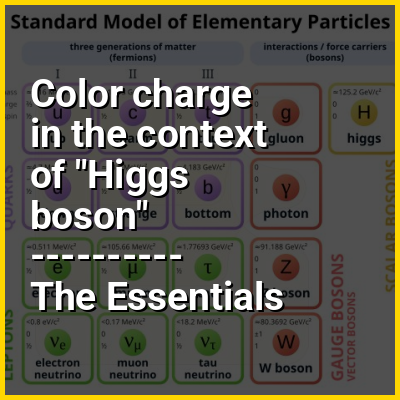
The Higgs boson, sometimes called the Higgs particle, is an elementary particle in the Standard Model of particle physics produced by the quantum excitation of the Higgs field, one of the fields in particle physics theory. In the Standard Model, the Higgs particle is a massive scalar boson that couples to (interacts with) particles whose mass arises from their interactions with the Higgs Field, has zero spin, even (positive) parity, no electric charge, and no colour charge. It is also very unstable, decaying into other particles almost immediately upon generation.

The Higgs field is a scalar field with two neutral and two electrically charged components that form a complex doublet of the weak isospin SU(2) symmetry. Its "sombrero potential" leads it to take a nonzero value everywhere (including otherwise empty space), which breaks the weak isospin symmetry of the electroweak interaction and, via the Higgs mechanism, gives a rest mass to all massive elementary particles of the Standard Model, including the Higgs boson itself. The existence of the Higgs field became the last unverified part of the Standard Model of particle physics, and for several decades was considered "the central problem in particle physics".

↓ Explore More Topics
In this Dossier

Color charge in the context of Quark–gluon plasma

Quark–gluon plasma (QGP or quark soup) is an interacting localized assembly of quarks and gluons at thermal (local kinetic) and (close to) chemical (abundance) equilibrium. The word plasma signals that free color charges are allowed. In a 1987 summary, Léon Van Hove pointed out the equivalence of the three terms: quark gluon plasma, quark matter and a new state of matter. Since the temperature is above the Hagedorn temperature—and thus above the scale of light u,d-quark mass—the pressure exhibits the relativistic Stefan–Boltzmann format governed by temperature to the fourth power () and many practically massless quark and gluon constituents. It can be said that QGP emerges to be the new phase of strongly interacting matter which manifests its physical properties in terms of nearly free dynamics of practically massless gluons and quarks. Both quarks and gluons must be present in conditions near chemical (yield) equilibrium with their color charge open for a new state of matter to be referred to as QGP.

↑ Return to Menu

Color charge in the context of Quark

A quark (/ˈkwɔːrk, ˈkwɑːrk/ ) is a type of elementary particle and a fundamental constituent of matter. Quarks combine to form composite particles called hadrons, the most stable of which are protons and neutrons, the components of atomic nuclei. All commonly observable matter is composed of up quarks, down quarks and electrons. Owing to a phenomenon known as color confinement, quarks are never found in isolation; they can be found only within hadrons, which include baryons (such as protons and neutrons) and mesons, or in quark–gluon plasmas. For this reason, much of what is known about quarks has been drawn from observations of hadrons.

Quarks have various intrinsic properties, including electric charge, mass, color charge, and spin. They are the only elementary particles in the Standard Model of particle physics to experience all four fundamental interactions, also known as fundamental forces (electromagnetism, gravitation, strong interaction, and weak interaction), as well as the only known particles whose electric charges are not integer multiples of the elementary charge.

↑ Return to Menu

Color charge in the context of Gluons

A gluon (/ˈɡlɒn/ GLOO-on) is a type of massless elementary particle that mediates the strong interaction between quarks, acting as the exchange particle for the interaction. Gluons are massless vector bosons, thereby having a spin of 1. Through the strong interaction, gluons bind quarks into groups according to quantum chromodynamics (QCD), forming hadrons such as protons and neutrons.

Gluons carry the color charge of the strong interaction, thereby participating in the strong interaction as well as mediating it. Because gluons carry the color charge, QCD is more difficult to analyze compared to quantum electrodynamics (QED) where the photon carries no electric charge.

↑ Return to Menu

Color charge in the context of Proton decay

Proton decay is the hypothetical decay of a proton into lighter subatomic particles, such as a neutral pion and a positron. The proton decay hypothesis was first formulated by Andrei Sakharov in 1967. Despite significant experimental effort, proton decay has never been observed. If it does decay via a positron, the proton's half-life is constrained to be at least 1.67×10 years.

According to the Standard Model, the proton, a type of baryon, is stable because baryon number (quark number) is conserved (under normal circumstances; see Chiral anomaly for an exception). Therefore, protons will not decay into other particles on their own, because they are the lightest (and therefore least energetic) baryon. Positron emission and electron capture—forms of radioactive decay in which a proton becomes a neutron—are not proton decay, since the proton interacts with other particles within the atom.

↑ Return to Menu

Color charge in the context of Color confinement

In quantum chromodynamics (QCD), color confinement or infrared slavery, often simply called confinement, is the phenomenon that color-charged particles (such as quarks and gluons) cannot be isolated, and therefore cannot be directly observed in normal conditions below the Hagedorn temperature of approximately 2 terakelvin (corresponding to energies of approximately 130–140 MeV per particle). Quarks and gluons must clump together to form hadrons. The two main types of hadron are the mesons (one quark, one antiquark) and the baryons (often three quarks or antiquarks, though other exotic variants exist). In addition, colorless glueballs formed only of gluons are also consistent with confinement, though difficult to identify experimentally. Quarks and gluons cannot be separated from their parent hadron without producing new hadrons.

↑ Return to Menu