Coaxial cable in the context of "Electrical conductor"

Play Trivia Questions online!

or

Skip to study material about Coaxial cable in the context of "Electrical conductor"

Ad spacer

⭐ Core Definition: Coaxial cable

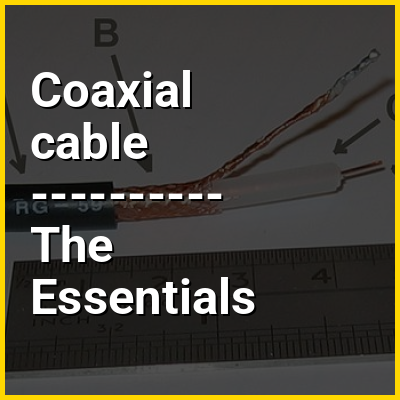
Coaxial cable, or coax (pronounced /ˈk.æks/), is a type of electrical cable consisting of an inner conductor surrounded by a concentric conducting shield, with the two separated by a dielectric (insulating material); many coaxial cables also have a protective outer sheath or jacket. The term coaxial refers to the inner conductor and the outer shield sharing a geometric axis.

Coaxial cable is a type of unbalanced transmission line, used to carry high-frequency unbalanced electrical signals with low losses. It is used in such applications as telephone trunk lines, broadband internet networking cables, high-speed computer data buses, cable television signals, and connecting radio transmitters and receivers to their antennas. It differs from other shielded cables because the dimensions of the cable and connectors are controlled to give a precise, constant conductor spacing, which is needed for it to function efficiently as a transmission line.
↓ Menu

>>>PUT SHARE BUTTONS HERE<<<
In this Dossier

Coaxial cable in the context of Communication channel

A communication channel refers either to a physical transmission medium such as a wire, or to a logical connection over a multiplexed medium such as a radio channel in telecommunications and computer networking. A channel is used for information transfer of, for example, a digital bit stream, from one or several senders to one or several receivers. A channel has a certain capacity for transmitting information, often measured by its bandwidth in Hz or its data rate in bits per second.

Communicating an information signal across distance requires some form of pathway or medium. These pathways, called communication channels, use two types of media: Transmission line-based telecommunications cable (e.g. twisted-pair, coaxial, and fiber-optic cable) and broadcast (e.g. microwave, satellite, radio, and infrared).

↑ Return to Menu

Coaxial cable in the context of Broadband

In telecommunications, broadband or high speed is the wide-bandwidth data transmission that uses signals at a wide spread of frequencies or several different simultaneous frequencies. It is used in fast Internet access where the transmission medium can be coaxial cable, optical fiber, wireless Internet (radio), twisted pair cable, or satellite.

Originally used to mean "using a wide-spread frequency" and for services that were analog at the lowest level, in the context of Internet access, "broadband" is now often used to mean any high-speed Internet access that is seemingly always "on" and is faster than dial-up access over traditional analog or ISDN PSTN services.

↑ Return to Menu

Coaxial cable in the context of Dispersion (optics)

Dispersion is the phenomenon in which the phase velocity of a wave depends on its frequency. Sometimes the term chromatic dispersion is used to refer to optics specifically, as opposed to wave propagation in general. A medium having this common property may be termed a dispersive medium.

Although the term is used in the field of optics to describe light and other electromagnetic waves, dispersion in the same sense can apply to any sort of wave motion such as acoustic dispersion in the case of sound and seismic waves, and in gravity waves (ocean waves). Within optics, dispersion is a property of telecommunication signals along transmission lines (such as microwaves in coaxial cable) or the pulses of light in optical fiber.

↑ Return to Menu

Coaxial cable in the context of Terrestrial television

Terrestrial television, or over-the-air television (OTA) is a type of television broadcasting in which the content is transmitted via radio waves from the terrestrial (Earth-based) transmitter of a TV station to a TV receiver having an antenna. The term terrestrial is more common in Europe and Latin America, while in Canada and the United States it is called over-the-air or simply broadcast. This type of TV broadcast is distinguished from newer technologies, such as satellite television (direct broadcast satellite or DBS television), in which the signal is transmitted to the receiver from an overhead satellite; cable television, in which the signal is carried to the receiver through a cable; and Internet Protocol television, in which the signal is received over an Internet stream or on a network utilizing the Internet Protocol. Terrestrial television stations broadcast on television channels with frequencies between about 52 and 600 MHz in the VHF and UHF bands. Since radio waves in these bands travel by line of sight, reception is generally limited by the visual horizon to distances of 64–97 kilometres (40–60 miles), although under better conditions and with tropospheric ducting, signals can sometimes be received hundreds of kilometers distant.

Terrestrial television was the first technology used for television broadcasting. The BBC began broadcasting in 1929 and by 1930 many radio stations had a regular schedule of experimental television programmes. However, these early experimental systems had insufficient picture quality to attract the public, due to their mechanical scan technology, and television did not become widespread until after World War II with the advent of electronic scan television technology. The television broadcasting business followed the model of radio networks, with local television stations in cities and towns affiliated with television networks, either commercial (in the US) or government-controlled (in Europe), which provided content. Television broadcasts were in greyscale (called black and white) until the transition to color television in the 1960s.

↑ Return to Menu

Coaxial cable in the context of Cable television

Cable television is a system of delivering television programming to consumers via radio frequency (RF) signals transmitted through coaxial cables, or in more recent systems, light pulses through fibre-optic cables. This contrasts with broadcast television, in which the television signal is transmitted over-the-air by radio waves and received by a television antenna, or satellite television, in which the television signal is transmitted over-the-air by radio waves from a communications satellite and received by a satellite dish on the roof. FM radio programming, high-speed Internet, telephone services, and similar non-television services may also be provided through these cables. Analog television was standard in the 20th century, but since the 2000s, cable systems have been upgraded to digital cable operation.

A cable channel (sometimes known as a cable network) is a television network available via cable television. Many of the same channels are distributed through satellite television. Alternative terms include non-broadcast channel or programming service, the latter being mainly used in legal contexts. The abbreviation CATV is used in the US for cable television and originally stood for community antenna television, from cable television's origins in 1948; in areas where over-the-air TV reception was limited by distance from transmitters or mountainous terrain, large community antennas were constructed, and cable was run from them to individual homes.

↑ Return to Menu

Coaxial cable in the context of Transmission medium

A transmission medium is a system or substance that can mediate the propagation of signals for the purposes of telecommunication. Signals are typically imposed on a wave of some kind suitable for the chosen medium. For example, data can modulate sound, and a transmission medium for sounds may be air, but solids and liquids may also act as the transmission medium. Vacuum or air constitutes a good transmission medium for electromagnetic waves such as light and radio waves. While a material substance is not required for electromagnetic waves to propagate, such waves are usually affected by the transmission medium they pass through, for instance, by absorption or reflection or refraction at the interfaces between media. Technical devices can therefore be employed to transmit or guide waves. Thus, an optical fiber or a copper cable is used as transmission media.

Electromagnetic radiation can be transmitted through an optical medium, such as optical fiber, or through twisted pair wires, coaxial cable, or dielectric-slab waveguides. It may also pass through any physical material that is transparent to the specific wavelength, such as water, air, glass, or concrete. Sound is, by definition, the vibration of matter, so it requires a physical medium for transmission, as do other kinds of mechanical waves and heat energy. Historically, science incorporated various aether theories to explain the transmission medium. However, it is now known that electromagnetic waves do not require a physical transmission medium, and so can travel through the vacuum of free space. Regions of the insulative vacuum can become conductive for electrical conduction through the presence of free electrons, holes, or ions.

↑ Return to Menu

Coaxial cable in the context of Transmission line

In electrical engineering, a transmission line is a specialized cable or other structure designed to conduct electromagnetic waves in a contained manner. The term applies when the conductors are long enough that the wave nature of the transmission must be taken into account. This applies especially to radio-frequency engineering because the short wavelengths mean that wave phenomena arise over very short distances (this can be as short as millimetres depending on frequency). However, the theory of transmission lines was historically developed to explain phenomena on very long telegraph lines, especially submarine telegraph cables.

Transmission lines are used for purposes such as connecting radio transmitters and receivers with their antennas (they are then called feed lines or feeders), distributing cable television signals, trunklines routing calls between telephone switching centres, computer network connections and high speed computer data buses. RF engineers commonly use short pieces of transmission line, usually in the form of printed planar transmission lines, arranged in certain patterns to build circuits such as filters. These circuits, known as distributed-element circuits, are an alternative to traditional circuits using discrete capacitors and inductors.

↑ Return to Menu