Chuck Berry in the context of "Maybellene"

Play Trivia Questions online!

or

Skip to study material about Chuck Berry in the context of "Maybellene"


⭐ Core Definition: Chuck Berry

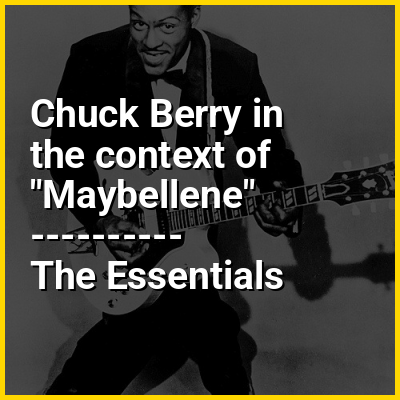
Charles Edward Anderson "Chuck" Berry (October 18, 1926 – March 18, 2017) was an American guitarist, singer, and songwriter; and one of the pioneers of rock and roll. Nicknamed the "Father of Rock and Roll", he refined and developed rhythm and blues into the major elements that made rock and roll distinctive with songs such as "Maybellene" (1955), "Roll Over Beethoven" (1956), "Rock and Roll Music" (1957), and "Johnny B. Goode" (1958). Writing lyrics that focused on teen life and consumerism, and developing a music style that included guitar solos and showmanship, Berry was a major influence on subsequent rock music.

Born into a middle-class black family in St. Louis, Berry had an interest in music from an early age and gave his first public performance at Sumner High School. While still a high school student, he was convicted of armed robbery and was sent to a reformatory, where he was held from 1944 to 1947. After his release, Berry settled into married life and worked at an automobile assembly plant. By early 1953, influenced by the guitar riffs and showmanship techniques of the blues musician T-Bone Walker, Berry began performing with the Johnnie Johnson Trio. His break came when he traveled to Chicago in May 1955 and met Muddy Waters, who suggested he contact Leonard Chess, of Chess Records. With Chess, he recorded "Maybellene"—Berry's adaptation of the country song "Ida Red"—which sold over a million copies, reaching number one on Billboard magazine's rhythm and blues chart.
↓ Menu

In this Dossier

Chuck Berry in the context of Chicago blues

Chicago blues is a form of blues music that developed in Chicago, Illinois. It is based on earlier blues idioms, such as Delta blues, but is performed in an urban style. It developed alongside the Great Migration of African Americans of the first half of the twentieth century. Key features that distinguish Chicago blues from the earlier traditions, such as Delta blues, are the prominent use of electrified instruments (especially the electric guitar), and the use of electronic effects, such as distortion and overdrive.

Muddy Waters, often acknowledged as the “father” of Chicago blues, was a colleague of Delta blues musicians Son House and Robert Johnson. He migrated to Chicago in 1943, joining the established Big Bill Broonzy, where they developed a distinct style of the Chicago blues, which hit its peak around the late 1940s and early 1950s. Joined by artists such as Willie Dixon, Howlin' Wolf, and John Lee Hooker, Chicago blues reached an international audience by the late 1950s and early 1960s, directly influencing not only the development of early rock and roll musicians such as Chuck Berry and Bo Diddley, but also reaching across the Atlantic to influence both British blues and early hard rock acts such as Eric Clapton, the Rolling Stones, and Led Zeppelin. Prominent record labels such as Vee-Jay Records and Chess Records helped promote and spread the style. The Chicago Blues Festival has been held annually since 1984, on the anniversary of Muddy Waters' death, as a means of preserving and promoting Chicago blues.

↑ Return to Menu

Chuck Berry in the context of Decca Records

Decca Records is a British record label established in 1929 by Edward Lewis after his acquisition of a gramophone manufacturer, The Decca Gramophone Company. It set up an American subsidiary under the Decca name, which became an independent company just before the Second World War. The American spin-off became a subsidiary of MCA Inc. in 1962. Known for its technical innovations, the British parent company grew to become the second most successful recording company in Britain and celebrated fifty years of existence in 1979, shortly before being sold to PolyGram. Both Decca and its former subsidiary were subsequently acquired by Universal Music.

Decca and its American spin-off both built up strong catalogues of popular music. In their first two decades, their artists included Gertrude Lawrence, George Formby, Jack Hylton and Vera Lynn in Britain and Bing Crosby, Al Jolson, the Andrews Sisters and the Mills Brothers in the US. Later performers in their popular catalogues included in the US Bill Haley & His Comets and Buddy Holly plus in the UK Elvis Presley (licensed from RCA Records), Tommy Steele, Lonnie Donegan, Chuck Berry (licensed from Chess Records), Johnny Cash (licensed from Sun Records), Eddie Cochran (licensed from Liberty Records), and the Rolling Stones.

↑ Return to Menu

Chuck Berry in the context of British R&B

British rhythm and blues (or R&B) was a musical movement that developed in the United Kingdom between the late 1950s and the early 1960s, and reached a peak in the mid-1960s. It overlapped with, but was distinct from, the broader British beat and more purist British blues scenes, attempting to emulate the music of American blues and rock and roll pioneers, such as Muddy Waters and Howlin' Wolf, Chuck Berry and Bo Diddley. It often placed greater emphasis on guitars and was often played with greater energy.

The origins of the movement were in the British jazz, skiffle and folk movements of the 1950s. The 1958 visit of Muddy Waters influenced key figures Cyril Davies and Alexis Korner to turn to electric blues and form the band Blues Incorporated, which became something of a clearing house for British rhythm and blues musicians. A flourishing scene of clubs and groups emerged in the later 1950s and 1960s and bands began to break through into mainstream success. Major acts included the Rolling Stones, Manfred Mann, the Animals, the Yardbirds, Them, and the Spencer Davis Group, who dominated the UK and US charts from 1964, in the wake of the Merseybeat craze, becoming central to the beatnik and mod subculture in the UK and a second wave of British Invasion acts in the US.

↑ Return to Menu

Chuck Berry in the context of Sister Rosetta Tharpe

Sister Rosetta Tharpe (born Rosetta Nubin, March 20, 1915 – October 9, 1973) was an American singer, songwriter, and guitarist. She gained popularity in the 1930s and 1940s with her Gospel recordings, characterized by a unique mixture of spiritual lyrics and electric guitar. She was rooted in a pentecostal church and became the first great recording star of gospel music, and was among the first gospel musicians to appeal to Rhythm and blues and Rock and roll audiences, later being referred to as "the original soul sister" and "the Godmother of rock and roll". She influenced early rock-and-roll musicians, including Tina Turner, Little Richard, Chuck Berry, Johnny Cash, Carl Perkins, Elvis Presley, and Jerry Lee Lewis.

Tharpe was a pioneer in her guitar technique; she was among the first popular recording artists to use heavy distortion on her electric guitar, opening the way to the rise of electric blues. Her guitar-playing technique had a profound influence on the development of British blues in the 1960s. Her European tour with Muddy Waters in 1964, with a stop in Manchester on May 7, is cited by British guitarists such as Eric Clapton, Jeff Beck, and Keith Richards.

↑ Return to Menu

Chuck Berry in the context of Cultural impact of Elvis Presley

The cultural impact of Elvis Presley was a seismic and defining phenomenon of the 20th century. As a musician and entertainer, Presley's influence extended far beyond music, shaping popular culture in the realms of fashion, youth identity, sexuality, and media. The Rolling Stone Encyclopedia of Rock & Roll describes Presley as "an American music giant of the 20th century who single-handedly changed the course of music and culture in the mid-1950s".  His synthesis of diverse musical genres (particularly African-American blues, Christian gospel, and Southern country) combined with an uninhibited performance style, challenged the social and racial barriers of his time and galvanized a new youth-oriented consumer culture. In a list of the greatest English language singers, as compiled by Q magazine, Presley was ranked first, and second in the list of greatest singers of the 20th century by BBC Radio.

Presley sang hard-driving rock and roll, rockabilly dance songs, and ballads, laying a commercial foundation upon which other rock musicians would build their careers. African-American performers such as Big Joe Turner, Wynonie Harris and Fats Domino came to national prominence after Presley's acceptance among mass audiences of white American adults. Singers like Jerry Lee Lewis, the Everly Brothers, Chuck Berry, Bo Diddley, Little Richard, Buddy Holly, Johnny Cash, Roy Orbison, and others immediately followed in his wake. John Lennon commented the day after the Beatles visited the singer at his home: "The only person that we wanted to meet in the United States of America was Elvis Presley. You can't imagine what a thrill that was last night. Nothing really affected me until I heard Elvis. If there hadn't been an Elvis, there wouldn't have been the Beatles."

↑ Return to Menu

Chuck Berry in the context of George Harrison

George Harrison (25 February 1943 – 29 November 2001) was an English musician who achieved international fame as the lead guitarist of the Beatles. Known as "the quiet Beatle", Harrison played a significant role in shaping the band's musical direction and later established a successful solo career, particularly through his interest in non-Western musical influences.

Although most of the band's songs were written by John Lennon and Paul McCartney, most Beatles albums from 1965 onwards contained at least two Harrison compositions, including "Taxman", "Within You Without You", "While My Guitar Gently Weeps", "Something" and "Here Comes the Sun". Harrison's earliest musical influences included George Formby and Django Reinhardt; subsequent influences were Carl Perkins, Chet Atkins and Chuck Berry. By 1965, he had begun to lead the Beatles into folk rock through his interest in Bob Dylan and the Byrds, and towards Indian classical music through his use of Indian instruments, such as the sitar, which he had become acquainted with on the set of the film Help!. He played sitar on numerous Beatles songs, starting with "Norwegian Wood (This Bird Has Flown)". Having initiated the band's embrace of Transcendental Meditation in 1967, he subsequently developed an association with the Hare Krishna movement. Harrison's first marriage to model Pattie Boyd in 1966 ended in divorce in 1977. In the following year he married Olivia Arias, with whom he had a son, Dhani.

↑ Return to Menu