Chemical potential in the context of Fermi level


Chemical potential in the context of Fermi level

Chemical potential Study page number 1 of 1

Play TriviaQuestions Online!

or

Skip to study material about Chemical potential in the context of "Fermi level"


⭐ Core Definition: Chemical potential

In thermodynamics, the chemical potential of a species is the energy that can be absorbed or released due to a change of the particle number of the given species, e.g. in a chemical reaction or phase transition. The chemical potential of a species in a mixture is defined as the rate of change of free energy of a thermodynamic system with respect to the change in the number of atoms or molecules of the species that are added to the system. Thus, it is the partial derivative of the free energy with respect to the amount of the species, all other species' concentrations in the mixture remaining constant. When both temperature and pressure are held constant, and the number of particles is expressed in moles, the chemical potential is the partial molar Gibbs free energy. At chemical equilibrium or in phase equilibrium, the total sum of the product of chemical potentials and stoichiometric coefficients is zero, as the free energy is at a minimum. In a system in diffusion equilibrium, the chemical potential of any chemical species is uniformly the same everywhere throughout the system.

In semiconductor physics, the chemical potential of a system of electrons is known as the Fermi level.

↓ Menu
HINT:

In this Dossier

Chemical potential in the context of Diffusion

Diffusion is the net movement of anything (for example, atoms, ions, molecules, energy) generally from a region of higher concentration to a region of lower concentration. Diffusion is driven by a gradient in Gibbs free energy or chemical potential. It is possible to diffuse "uphill" from a region of lower concentration to a region of higher concentration, as in spinodal decomposition. Diffusion is a stochastic process due to the inherent randomness of the diffusing entity and can be used to model many real-life stochastic scenarios. Therefore, diffusion and the corresponding mathematical models are used in several fields beyond physics, such as statistics, probability theory, information theory, neural networks, finance, and marketing.

The concept of diffusion is widely used in many fields, including physics (particle diffusion), chemistry, biology, sociology, economics, statistics, data science, and finance (diffusion of people, ideas, data and price values). The central idea of diffusion, however, is common to all of these: a substance or collection undergoing diffusion spreads out from a point or location at which there is a higher concentration of that substance or collection.

View the full Wikipedia page for Diffusion
↑ Return to Menu

Chemical potential in the context of Thermodynamic activity

In thermodynamics, activity (symbol a) is a measure of the "effective concentration" of a species in a mixture, in the sense that the species' chemical potential depends on the activity of a real solution in the same way that it would depend on concentration for an ideal solution. The term "activity" in this sense was coined by the American chemist Gilbert N. Lewis in 1907.

By convention, activity is treated as a dimensionless quantity, although its value depends on customary choices of standard state for the species. The activity of pure substances in condensed phases (solids and liquids) is taken as a = 1. Activity depends on temperature, pressure and composition of the mixture, among other things. For gases, the activity is the effective partial pressure, and is usually referred to as fugacity.

View the full Wikipedia page for Thermodynamic activity
↑ Return to Menu

Chemical potential in the context of Electrochemical potential

In electrochemistry, the electrochemical potential (ECP), μ, is a thermodynamic measure of chemical potential that does not omit the energy contribution of electrostatics. Electrochemical potential is expressed in the unit of J/mol.

View the full Wikipedia page for Electrochemical potential
↑ Return to Menu

Chemical potential in the context of Particle number

In thermodynamics, the particle number (symbol N) of a thermodynamic system is the number of constituent particles in that system. The particle number is a fundamental thermodynamic property which is conjugate to the chemical potential. Unlike most physical quantities, the particle number is a dimensionless quantity, specifically a countable quantity. It is an extensive property, as it is directly proportional to the size of the system under consideration and thus meaningful only for closed systems.

A constituent particle is one that cannot be broken into smaller pieces at the scale of energy k·T involved in the process (where k is the Boltzmann constant and T is the temperature). For example, in a thermodynamic system consisting of a piston containing water vapour, the particle number is the number of water molecules in the system. The meaning of constituent particles, and thereby of particle numbers, is thus temperature-dependent.

View the full Wikipedia page for Particle number
↑ Return to Menu

Chemical potential in the context of Photon gas

In physics, a photon gas is a gas-like collection of photons, which has many of the same properties of a conventional gas like hydrogen or neon – including pressure, temperature, and entropy. The most common example of a photon gas in equilibrium is the black-body radiation.

Photons are part of a family of particles known as bosons, particles that follow Bose–Einstein statistics and with integer spin. A gas of bosons with only one type of particle is uniquely described by three state functions such as the temperature, volume, and the number of particles. However, for a black body, the energy distribution is established by the interaction of the photons with matter, usually the walls of the container, and the number of photons is not conserved. As a result, the chemical potential of the black-body photon gas is zero at thermodynamic equilibrium. The number of state variables needed to describe a black-body state is thus reduced from three to two (e.g. temperature and volume).

View the full Wikipedia page for Photon gas
↑ Return to Menu

Chemical potential in the context of Cahn–Hilliard equation

The Cahn–Hilliard equation (after John W. Cahn and John E. Hilliard) is an equation of mathematical physics which describes the process of phase separation, spinodal decomposition, by which the two components of a binary fluid spontaneously separate and form domains pure in each component. If is the concentration of the fluid, with indicating domains, then the equation is written as

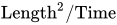
where is a diffusion coefficient with units of and gives the length of the transition regions between the domains. Here is the partial time derivative and is the Laplacian in dimensions. Additionally, the quantity is identified as a chemical potential.

View the full Wikipedia page for Cahn–Hilliard equation
↑ Return to Menu

Chemical potential in the context of Binodal

In thermodynamics, the binodal, also known as the coexistence curve or binodal curve, denotes the state of a multi-component system at which the system's distinct phases straddle between coexistence or miscibility. Equivalently, it is the boundary on which thermodynamics favors the system components to dissolve or separate into two phases. In general, the binodal is defined by the condition at which the chemical potential of all solution components is equal in each phase. The extremum of a binodal curve in temperature coincides with the extremum of the spinodal curve, and is known as a critical point.

View the full Wikipedia page for Binodal
↑ Return to Menu

Chemical potential in the context of Superacid

In chemistry, a superacid (according to the original definition) is an acid with an acidity greater than that of 100% pure sulfuric acid (H2SO4), which has a Hammett acidity function (H0) of −12. According to the modern definition, a superacid is a medium in which the chemical potential of the proton is higher than in pure sulfuric acid. Commercially available superacids include trifluoromethanesulfonic acid (CF3SO3H), also known as triflic acid, and fluorosulfuric acid (HSO3F), both of which are about a thousand times stronger (i.e. have more negative H0 values) than sulfuric acid. Most strong superacids are prepared by the combination of a strong Lewis acid and a strong Brønsted acid. A strong superacid of this kind is fluoroantimonic acid. Another group of superacids, the carborane acid group, contains some of the strongest known acids. Finally, when treated with anhydrous acid, zeolites (microporous aluminosilicate minerals) will contain superacidic sites within their pores. These materials are used on massive scale by the petrochemical industry in the upgrading of hydrocarbons to make fuels.

View the full Wikipedia page for Superacid
↑ Return to Menu