Charles Wheatstone in the context of "Cooke and Wheatstone telegraph"

Play Trivia Questions online!

or

Skip to study material about Charles Wheatstone in the context of "Cooke and Wheatstone telegraph"


⭐ Core Definition: Charles Wheatstone

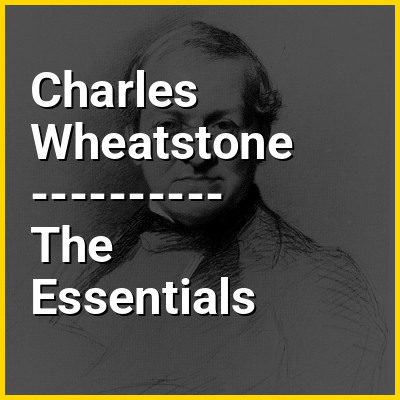
Sir Charles Wheatstone (/ˈwtstən/; 6 February 1802 – 19 October 1875) was an English physicist and inventor best known for his contributions to the development of the Wheatstone bridge, originally invented by Samuel Hunter Christie, which is used to measure an unknown electrical resistance, and as a major figure in the development of telegraphy. His other contributions include the English concertina, the stereoscope (a device for displaying three-dimensional images) and the Playfair cipher (an encryption technique).

↓ Menu

👉 Charles Wheatstone in the context of Cooke and Wheatstone telegraph

The Cooke and Wheatstone telegraph was an early electrical telegraph system dating from the 1830s invented by English inventor William Fothergill Cooke and English scientist Charles Wheatstone. It was a form of needle telegraph, and the first telegraph system to be put into commercial service. The receiver consisted of a number of needles that could be moved by electromagnetic coils to point to letters on a board. This feature was liked by early users who were unwilling to learn codes, and employers who did not want to invest in staff training.

In later systems, the letter board was dispensed with, and the code was read directly from the movement of the needles. This occurred because the number of needles was reduced, leading to more complex codes. The change was motivated by the economic need to reduce the number of telegraph wires used, which was related to the number of needles. The change became more urgent as the insulation of some of the early installations deteriorated, causing some of the original wires to be unusable. Cooke and Wheatstone's most successful system was eventually a one-needle system that continued in service into the 1930s.

↓ Explore More Topics
In this Dossier

Charles Wheatstone in the context of Telecommunications

Telecommunication, often used in its plural form or abbreviated as telecom, is the transmission of information over a distance using electrical or electronic means, typically through cables, radio waves, or other communication technologies. These means of transmission may be divided into communication channels for multiplexing, allowing for a single medium to transmit several concurrent communication sessions. Long-distance technologies invented during the 20th and 21st centuries generally use electric power, and include the electrical telegraph, telephone, television, and radio.

Early telecommunication networks used metal wires as the medium for transmitting signals. These networks were used for telegraphy and telephony for many decades. In the first decade of the 20th century, a revolution in wireless communication began with breakthroughs including those made in radio communications by Guglielmo Marconi, who won the 1909 Nobel Prize in Physics. Other early pioneers in electrical and electronic telecommunications include co-inventors of the telegraph Charles Wheatstone and Samuel Morse, numerous inventors and developers of the telephone including Antonio Meucci, Philipp Reis, Elisha Gray and Alexander Graham Bell, inventors of radio Edwin Armstrong and Lee de Forest, as well as inventors of television like Vladimir K. Zworykin, John Logie Baird and Philo Farnsworth.

↑ Return to Menu

Charles Wheatstone in the context of Wheatstone bridge

A Wheatstone bridge is an electrical circuit used to measure an unknown electrical resistance by balancing two legs of a bridge circuit, one leg of which includes the unknown component. The primary benefit of the circuit is its ability to provide extremely accurate measurements (in contrast with something like a simple voltage divider). Its operation is similar to the original potentiometer.

The Wheatstone bridge was invented by Samuel Hunter Christie (sometimes spelled "Christy") in 1833 and improved and popularized by Sir Charles Wheatstone in 1843. One of the Wheatstone bridge's initial uses was for soil analysis and comparison.

↑ Return to Menu

Charles Wheatstone in the context of Playfair cipher

The Playfair cipher or Playfair square or Wheatstone–Playfair cipher is a manual symmetric encryption technique and was the first literal digram substitution cipher. The scheme was invented in 1854 by Charles Wheatstone, but bears the name of Lord Playfair for promoting its use.

The technique encrypts pairs of letters (bigrams or digrams), instead of single letters as in the simple substitution cipher and rather more complex Vigenère cipher systems then in use. The Playfair cipher is thus significantly harder to break since the frequency analysis used for simple substitution ciphers does not work with it. The frequency analysis of bigrams is possible, but considerably more difficult. With 600 possible bigrams rather than the 26 possible monograms (single symbols, usually letters in this context), a considerably larger cipher text is required in order to be useful.

↑ Return to Menu

Charles Wheatstone in the context of Siemens & Halske

Siemens & Halske AG (or Siemens-Halske) was a German electrical engineering company that later became part of Siemens.

It was founded on 12 October 1847 as Telegraphen-Bauanstalt von Siemens & Halske by Werner von Siemens and Johann Georg Halske. The company, located in Berlin-Kreuzberg, specialised in manufacturing electrical telegraphs according to Charles Wheatstone's patent of 1837. In 1848, the company constructed one of the first European telegraph lines from Berlin to Frankfurt am Main. Siemens & Halske was not alone in the realm of electrical engineering. In 1887, Emil Rathenau had established Allgemeine Elektrizitäts-Gesellschaft (AEG), which became a long-time rival.

↑ Return to Menu

Charles Wheatstone in the context of Concertina

A concertina is a free-reed musical instrument, like the various accordions and the harmonica. It consists of expanding and contracting bellows, with buttons (or keys) usually on both ends, unlike accordion buttons, which are on the front.

The concertina was developed independently in both England and Germany. The English version was invented in 1829 by Sir Charles Wheatstone, while Carl Friedrich Uhlig introduced the German version five years later, in 1834. Various forms of concertina are used for classical music, for the traditional music of Ireland, England, and South Africa, and for tango and polka music.

↑ Return to Menu