Chariot in the context of "Propulsion"

Play Trivia Questions online!

or

Skip to study material about Chariot in the context of "Propulsion"

Ad spacer

⭐ Core Definition: Chariot

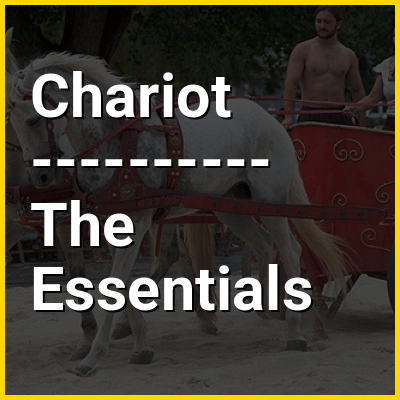
A chariot is a type of vehicle similar to a cart, driven by a charioteer, usually using horses to provide rapid motive power. The oldest known chariots have been found in burials of the Sintashta culture in modern-day Chelyabinsk Oblast, Russia, dated to c. 1950–1880 BC and are depicted on cylinder seals from Central Anatolia in Kültepe dated to c. 1900 BC. The critical invention that allowed the construction of light, horse-drawn chariots was the spoked wheel.

The chariot was a fast, light, open, two-wheeled conveyance drawn by two or more equids (usually horses) that were hitched side by side, and was little more than a floor with a waist-high guard at the front and sides. It was initially used for ancient warfare during the Bronze and Iron Ages, but after its military capabilities had been superseded by light and heavy cavalries, chariots continued to be used for travel and transport, in processions, for games, and in races.
↓ Menu

>>>PUT SHARE BUTTONS HERE<<<
In this Dossier

Chariot in the context of Hector

In Greek mythology, Hector (/ˈhɛktər/; Ἕκτωρ, Hektōr, pronounced [héktɔːr]) was a Trojan prince, a hero, and the greatest warrior for Troy during the Trojan War. He is a major character in Homer's Iliad, where he leads the Trojans and their allies in the defense of Troy, killing countless Greek warriors. He is ultimately killed in single combat by the Greek hero Achilles, who proceeds to drag his dead body around the city of Troy behind his chariot.

↑ Return to Menu

Chariot in the context of Horses in warfare

The first evidence of horses in warfare dates from Eurasia between 4000 and 3000 BC. A Sumerian illustration of warfare from 2500 BC depicts some type of equine pulling wagons. By 1600 BC, improved harness and chariot designs made chariot warfare common throughout the Ancient Near East, and the earliest written training manual for war horses was a guide for training chariot horses written about 1350 BC. As formal cavalry tactics replaced the chariot, so did new training methods, and by 360 BC, the Greek cavalry officer Xenophon had written an extensive treatise on horsemanship. The effectiveness of horses in battle was also revolutionized by improvements in technology, such as the invention of the saddle, the stirrup, and the horse collar.

Many different types and sizes of horses were used in war, depending on the form of warfare. The type used varied with whether the horse was being ridden or driven, and whether they were being used for reconnaissance, cavalry charges, raiding, communication, or supply. Throughout history, mules and donkeys, as well as horses played a crucial role in providing support to armies in the field.

↑ Return to Menu

Chariot in the context of 2nd millennium BC

The 2nd millennium BC spanned the years 2000 BC to 1001 BC. In the Ancient Near East, it marks the transition from the Middle to the Late Bronze Age.The Ancient Near Eastern cultures are well within the historical era:The first half of the millennium is dominated by the Middle Kingdom of Egypt and Babylonia. The alphabet develops. At the center of the millennium, a new order emerges with Mycenaean Greek dominance of the Aegean and the rise of the Hittite Empire. The end of the millennium sees the Bronze Age collapse and the transition to the Iron Age.

Other regions of the world are still in the prehistoric period. In Europe, the Beaker culture introduces the Bronze Age, presumably associated with Indo-European expansion. The Indo-Iranian expansion reaches the Iranian plateau and onto the Indian subcontinent (Vedic India), propagating the use of the chariot. Mesoamerica enters the Pre-Classic (Olmec) period. North America is in the late Archaic stage. In Maritime Southeast Asia, the Austronesian expansion reaches Micronesia. In Sub-Saharan Africa, the Bantu expansion begins.

↑ Return to Menu

Chariot in the context of Cavalry

Historically, cavalry (from the French word cavalerie, itself derived from cheval meaning "horse") are groups of soldiers or warriors who fight mounted on horseback. Until the 20th century, cavalry were the most mobile of the combat arms, operating as light cavalry in the roles of reconnaissance, screening, and skirmishing, or as heavy cavalry for decisive economy of force and shock attacks. An individual soldier in the cavalry is known by a number of designations depending on era and tactics, such as a cavalryman, horseman, trooper, cataphract, knight, drabant, hussar, uhlan, mamluk, cuirassier, lancer, dragoon, samurai or horse archer. The designation of cavalry was not usually given to any military forces that used other animals or platforms for mounts, such as chariots, camels or elephants. Infantry who moved on horseback, but dismounted to fight on foot, were known in the early 17th to the early 18th century as dragoons, a class of mounted infantry which in most armies later evolved into standard cavalry while retaining their historic designation.

Cavalry had the advantage of improved mobility, and a soldier fighting from horseback also had the advantages of greater height, speed, and inertial mass over an opponent on foot. Another element of horse mounted warfare is the psychological impact a mounted soldier can inflict on an opponent.

↑ Return to Menu

Chariot in the context of Agon

Agon (Ancient Greek: Ἀγών) is the Greek deity who personified conflict, struggle or contest. This could be a contest in athletics, in chariot or horse racing, or in music or literature at a public festival in ancient Greece. Agon is the word-forming element in 'agony', explaining the concept of agon(y) in tragedy by its fundamental characters, the protagonist and antagonist.

↑ Return to Menu

Chariot in the context of History of technology

The history of technology is the history of the invention of tools and techniques by humans. Technology includes methods ranging from simple stone tools to the complex genetic engineering and information technology that has emerged since the 1980s. The term technology comes from the Greek word techne, meaning art and craft, and the word logos, meaning word and speech. It was first used to describe applied arts, but it is now used to describe advancements and changes that affect the environment around us.

New knowledge has enabled people to create new tools, and conversely, many scientific endeavors are made possible by new technologies, for example scientific instruments which allow us to study nature in more detail than our natural senses.

↑ Return to Menu

Chariot in the context of Indo-Iranians

The Indo-Iranian peoples, or Indo-Iranic peoples, also known as Ā́rya or Aryans from their self-designation, were a group of speakers of Indo-European languages who brought the offshoot Indo-Iranian languages to parts of Eurasia in waves from the first part of the 2nd millennium BC onwards. They eventually branched out into the Iranian peoples and Indo-Aryan peoples.

↑ Return to Menu

Chariot in the context of Chariot racing

Chariot racing (Ancient Greek: ἁρματοδρομία, harmatodromía; Latin: ludi circenses) was one of the most popular ancient Greek, Roman, and Byzantine sports. In Greece, chariot racing played an essential role in aristocratic funeral games from a very early time. With the institution of formal races and permanent racetracks, chariot racing was adopted by many Greek states and their religious festivals. Horses and chariots were very costly. Their ownership was a preserve of the wealthiest aristocrats, whose reputations and status benefitted from offering such extravagant, exciting displays. Their successes could be further broadcast and celebrated through commissioned odes and other poetry.

In standard Greek racing practise, each chariot held a single driver and was pulled by four horses, or sometimes two. Drivers and horses risked serious injury or death through collisions and crashes; this added to the excitement and interest for spectators. Most charioteers were slaves or contracted professionals. While records almost invariably credit victorious owners and their horses for winning, their drivers are often not mentioned at all. In the ancient Olympic Games, and other Panhellenic Games, chariot racing was one of the most important equestrian events, and could be watched by unmarried women. Married women were banned from watching any Olympic events but a Spartan noblewoman is known to have trained horse-teams for the Olympics and won two races, one of them as driver.

↑ Return to Menu

Chariot in the context of Lucius Tarquinius Priscus

Lucius Tarquinius Priscus (Classical Latin: [tarˈkʷɪniʊs ˈpriːskʊs]), or Tarquin the Elder, was the legendary fifth king of Rome and first of its Etruscan dynasty. He reigned for thirty-eight years. Tarquinius expanded Roman power through military conquest and grand architectural constructions. His wife was the prophetess Tanaquil.

Not much is known about the early life of Lucius Tarquinius Priscus. According to Livy, Tarquin came from Etruria. Livy claims that his original Etruscan name was Lucumo, but since lucumo is the latinized form of the Etruscan word lauchume "king", there is reason to believe that his name and title have been confused in the official tradition. After inheriting his father's entire fortune, Lucius attempted to gain a political office. However, he was prohibited from obtaining political office in Tarquinii because of the ethnicity of his father, Demaratus, who came from the Greek city of Corinth. As a result, his wife Tanaquil advised him to relocate to Rome. Legend has it that on his arrival in Rome in a chariot, an eagle took his cap, flew away and then returned it back upon his head. Tanaquil, who was skilled in prophecy, interpreted this as an omen of his future greatness. In Rome, he attained respect through his courtesy. King Ancus Marcius noticed Tarquinius and, by his will, appointed Tarquinius guardian of his own sons.

↑ Return to Menu