Central-West Region, Brazil in the context of "Mato Grosso do Sul"

Play Trivia Questions online!

or

Skip to study material about Central-West Region, Brazil in the context of "Mato Grosso do Sul"

Ad spacer

⭐ Core Definition: Central-West Region, Brazil

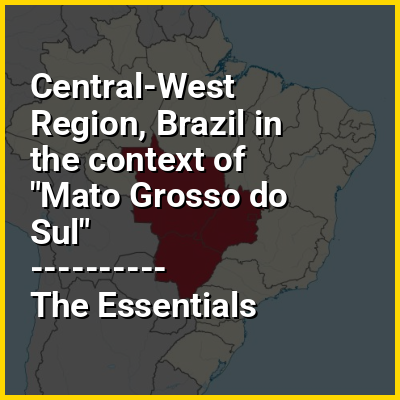
The Central-West or Center-West Region of Brazil (Portuguese: Região Centro-Oeste do Brasil [ʁeʒiˈɐ̃w ˌsẽtɾoˈɛstʃi du bɾaˈziw]) is composed of the states of Goiás, Mato Grosso and Mato Grosso do Sul; along with the Distrito Federal (Federal District), where Brazil's national capital, Brasília, is situated. The region comprises 18.86% of the national territory, and is the least populated in Brazil.

With the move of the country's federal capital from Rio de Janeiro to Brasília in the 1960s, the construction of roads and railways to the interior of the country made access to the region easier, speeding up population growth and contributing significantly to the region's development.

↓ Menu

>>>PUT SHARE BUTTONS HERE<<<

👉 Central-West Region, Brazil in the context of Mato Grosso do Sul

Mato Grosso do Sul (Portuguese pronunciation: [ˈmatu ˈɡɾosu du ˈsuw] lit.'South Thick Bush') is one of Brazil's 27 federal units, located in the southern part of the Central-West Region, bordering five Brazilian states: Mato Grosso (to the north), Goiás and Minas Gerais (northeast), São Paulo (east) and Paraná (southeast); and two South American countries: Paraguay (south and southwestern) and Bolivia (west). It is divided into 79 municipalities and covers an area of 357,145.532 square kilometers, which is about the same size as Germany. With a population of 2,839,188 inhabitants in 2021, Mato Grosso do Sul is the 21st most populous state in Brazil.

Campo Grande is the capital and largest city of Mato Grosso do Sul. The economy of the state is largely based on agriculture and cattle-raising. Crossed in the south by the Tropic of Capricorn, Mato Grosso do Sul generally has a warm, sometimes hot, and humid climate, and is crossed by numerous tributaries of the Paraná River. The state has 1.3% of the Brazilian population and is responsible for 1.5% of the Brazilian GDP. Mato Grosso do Sul is also known for its natural environment, and is a destination for domestic and international tourism. The Pantanal lowlands cover 12 municipalities and presents a variety of flora and fauna, with forests, natural sand banks, savannahs, open pasture, fields and bushes. The city Bonito, in the mountain of Bodoquena, has prehistoric caves, natural rivers, waterfalls, swimming pools and the Gruta do Lago Azul cave.
↓ Explore More Topics
In this Dossier

Central-West Region, Brazil in the context of Federal District (Brazil)

The Federal District (Portuguese: Distrito Federal [dʒisˈtɾitu fedeˈɾaw] ) is one of 27 federative units of Brazil. Located in the Center-West Region, it is the smallest Brazilian federal unit and the only one that has no municipalities, being divided into 35 administrative regions. The federal capital of Brazil, Brasília, which is also the seat of government of the Federal District, is located in its territory. The Federal District is almost completely surrounded by the state of Goiás, but it shares a small border with Minas Gerais.

↑ Return to Menu

Central-West Region, Brazil in the context of Brasília

Brasília (/brəˈzɪliə/ brə-ZIL-ee-ə, Brazilian Portuguese: [bɾaˈziliɐ, bɾaˈziljɐ] ) is the capital city of Brazil and the Federal District. Located in the Brazilian highlands in the country's Central-West region, it was founded by President Juscelino Kubitschek on 21 April 1960, to replace Rio de Janeiro as the national capital. Brasília is Brazil's third-most populous city after São Paulo and Rio de Janeiro, with a population of 2.8 million. Among major Latin American cities, it has the highest GDP per capita.

Brasília is a planned city developed by Lúcio Costa, Oscar Niemeyer and Joaquim Cardozo in 1956 in a scheme to move the capital from Rio de Janeiro to a more central location, which was chosen through a committee. The landscape architect was Roberto Burle Marx. The city's design divides it into numbered blocks as well as sectors for specified activities, such as the Hotel Sector, the Banking Sector, and the Embassy Sector. Brasília was inscribed as a UNESCO World Heritage Site in 1987 due to its modernist architecture and uniquely artistic urban planning. It was named "City of Design" by UNESCO in October 2017 and has been part of the Creative Cities Network since then.

↑ Return to Menu

Central-West Region, Brazil in the context of Goiás

Goiás (Brazilian Portuguese: [ɡo(j)ˈjas] ; English: /ɡɔɪˈɑːs/, UK also /ɡɔɪˈæs/) is a Brazilian state located in the Central-West region. Goiás borders the Federal District and the states of (from north clockwise) Tocantins, Bahia, Minas Gerais, Mato Grosso do Sul and Mato Grosso. The state capital is Goiânia. With 7.2 million inhabitants, Goiás is the most populous state in the Central-West region and the 11th most populous in the country. It has the ninth largest economy among Brazilian federative units. In Brazil's geoeconomic division, Goiás belongs to the Centro-Sul (Center-South), being the northernmost state of the southern portion of Brazil. The state has 3.3% of the Brazilian population and is responsible for 2.7% of the Brazilian GDP.

The history of Goiás dates back to the beginning of the 18th century, with the arrival of pioneers from São Paulo. The Rio Vermelho region was the first to be occupied, where Vila Boa (later renamed Goiás) was founded. The development and settlement of the state took place, in a more intensified way, starting in the 1930s with the founding of the new capital, Goiânia, and especially with the construction of Brasília in the 1950s.

↑ Return to Menu

Central-West Region, Brazil in the context of South Region, Brazil

The South Region of Brazil (Região Sul do Brasil [ʁeʒiˈɐ̃w ˈsuw du bɾaˈziw]) is one of the five regions of Brazil. It includes the states of Paraná, Rio Grande do Sul, and Santa Catarina, and covers 576,409.6 square kilometres (222,553.0 sq mi), being the smallest region of the country, occupying only about 6.76% of the territory of Brazil. Its whole area is smaller than that of the state of Minas Gerais, in Southeast Brazil, for example or the whole metropolitan France.

It is a tourist, economic and cultural pole. It borders Uruguay, Argentina, and Paraguay, as well as the Centre-West and Southeast regions, and the Atlantic Ocean. The region is considered the safest in Brazil to visit, having a lower crime rate than other regions in the country.

↑ Return to Menu

Central-West Region, Brazil in the context of Tacuru

Tacuru is a city in the Brazilian state of Mato Grosso do Sul, located in the Midwest region of the country. The city is located on the border with Paraguay. Tacuru, which uses Guarani as an official language alongside Portuguese, is noted as one of the few cities in Brazil that have adopted an indigenous language as an official language.

↑ Return to Menu

Central-West Region, Brazil in the context of Mato Grosso

Mato Grosso (Portuguese pronunciation: [ˈmatu ˈɡɾosu] lit.'Thick Bush') is one of the states of Brazil, the third largest by area, located in the Central-West region. The state has 1.66% of the Brazilian population and is responsible for 1.9% of the Brazilian GDP. Neighboring states (from west clockwise) are: Rondônia, Amazonas, Pará, Tocantins, Goiás and Mato Grosso do Sul. It is divided into 142 municipalities and covers an area of 903,357 square kilometers, consequently the state is roughly 82.2% of the size of its southwest neighbor, the nation of Bolivia.

A state with a flat landscape that alternates between vast chapadas and plain areas, Mato Grosso contains three main ecosystems: the Cerrado, the Pantanal and the Amazon rainforest. The Chapada dos Guimarães National Park, with its caves, grottoes, tracks, and waterfalls, is one of its tourist attractions. The extreme northwest of the state has a small part of the Amazonian forest. The Xingu Indigenous Park and the Araguaia River are in Mato Grosso. Farther south, the Pantanal, the world's largest wetland, is the habitat for nearly one thousand species of animals and many aquatic birds.

↑ Return to Menu

Central-West Region, Brazil in the context of Campo Grande

Campo Grande (Brazilian Portuguese: [ˈkɐ̃pu ˈɡɾɐ̃dʒi], lit.'Great Field') is a city in the central and western region of Brazil, capital and the largest city of the state of Mato Grosso do Sul. Historically a stronghold of separatists from the North and South, founded by José Antônio Pereira, the city is planned in the middle of a vast green space, with wide streets and tree-lined avenues with several gardens along the way. It is one of the most wooded cities in Brazil, with 96.3% of houses in shade.

The region where the city is located was in the past a waypoint for travellers who wanted to go from São Paulo or Minas Gerais to northern Mato Grosso by land. In the early 1900s, a railway was completed, connecting Campo Grande to Corumbá on the Bolivian border and to Bauru, São Paulo. Also in the beginning of the 20th century, the Western Brazilian Army Headquarters was established in Campo Grande, making it an important military center.

↑ Return to Menu