Cathedral close in the context of "Hamburg Concathedral"

Play Trivia Questions online!

or

Skip to study material about Cathedral close in the context of "Hamburg Concathedral"

Ad spacer

⭐ Core Definition: Cathedral close

A cathedral close is the area immediately around a cathedral, sometimes extending for a hundred metres or more from the main cathedral building. In Europe in the Middle Ages, and often later, it was usually all the property of the cathedral, and under the bishop or cathedral's legal jurisdiction rather than that of the surrounding city. It normally had gates which were locked at night or when there were disturbances in the wider city, hence the name – "close" in the sense of "something enclosed". It usually included buildings housing diocesan offices, schools, free-standing chapels associated with the cathedral, and the palace of the bishop and other clergy houses associated with the cathedral. Cathedral closes are sometimes – but not necessarily – arranged in a sort of square around a courtyard, as at the close at Salisbury Cathedral, which is the largest in Britain.

In the 21st century such areas often include residences of non-clerics, possibly including the houses of official or prominent persons (such as judges' houses). Until recent local-government reforms many cathedral closes still functioned as separate administrative units: St. David's cathedral close, in Pembrokeshire, counted as a separate civil parish distinct from that of the adjacent village-city for some 50 years after the 1914 disestablishment of the Church in Wales. Other closes still have the secularised former residences of canons but no resident senior clergy. In some cities, such as Trier, property close to the cathedral is occupied by clergy. The equivalent German term is Domfreiheit.
↓ Menu

>>>PUT SHARE BUTTONS HERE<<<

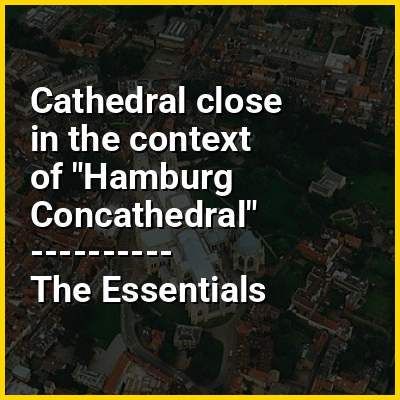
👉 Cathedral close in the context of Hamburg Concathedral

Saint Mary's Cathedral in Hamburg (German: Sankt Mariendom, also Mariendom, or simply Dom or Domkirche, or Hamburger Dom) was the cathedral of the ancient Roman Catholic Archdiocese of Hamburg (not to be confused with Hamburg's modern Archdiocese, est. 1994), which was merged in personal union with the Diocese of Bremen in 847, and later in real union to form the Archdiocese of Hamburg-Bremen, as of 1027.

In 1180 the cathedral compound turned into the cathedral close (German: Domfreiheit; i.e. cathedral immunity district), forming an exclave of the Prince-Archbishopric of Bremen within the city of Hamburg. By the Reformation the concathedral was converted into a Lutheran church. The cathedral immunity district, since 1648 an exclave of the Duchy of Bremen, was seized by Hamburg in 1803. The city then prompted the demolition of the proto-cathedral between 1804 and 1807.

↓ Explore More Topics
In this Dossier

Cathedral close in the context of Georgian architecture

Georgian architecture is the name given in most English-speaking countries to the set of architectural styles current between 1714 and 1830. It is named after the first four British monarchs of the House of Hanover, George I, George II, George III, and George IV, who reigned in continuous succession from August 1714 to June 1830.

The Georgian cities of the British Isles were Edinburgh, Bath, pre-independence Dublin, and London, and to a lesser extent York and Bristol. The style was revived in the late 19th century in the United States as Colonial Revival architecture and in the early 20th century in Great Britain as Neo-Georgian architecture; in both it is also called Georgian Revival architecture.

↑ Return to Menu