Cartesian product in the context of Set-like relation


Cartesian product in the context of Set-like relation

Cartesian product Study page number 1 of 1

Play TriviaQuestions Online!

or

Skip to study material about Cartesian product in the context of "Set-like relation"


⭐ Core Definition: Cartesian product

In mathematics, specifically set theory, the Cartesian product of two sets A and B, denoted A × B, is the set of all ordered pairs (a, b) where a is an element of A and b is an element of B. In terms of set-builder notation, that is

A table can be created by taking the Cartesian product of a set of rows and a set of columns. If the Cartesian product rows × columns is taken, the cells of the table contain ordered pairs of the form (row value, column value).

↓ Menu
HINT:

In this Dossier

Cartesian product in the context of Binary relation

In mathematics, a binary relation associates some elements of one set called the domain with some elements of another set (possibly the same) called the codomain. Precisely, a binary relation over sets and is a set of ordered pairs , where is an element of and is an element of . It encodes the common concept of relation: an element is related to an element , if and only if the pair belongs to the set of ordered pairs that defines the binary relation.

An example of a binary relation is the "divides" relation over the set of prime numbers and the set of integers , in which each prime is related to each integer that is a multiple of , but not to an integer that is not a multiple of . In this relation, for instance, the prime number is related to numbers such as , , , , but not to or , just as the prime number is related to , , and , but not to or .

View the full Wikipedia page for Binary relation

↑ Return to Menu

Cartesian product in the context of Finitary relation

In mathematics, a finitary relation over a sequence of sets X1, ..., Xn is a subset of the Cartesian product X1 × ... × Xn; that is, it is a set of n-tuples (x1, ..., xn), each being a sequence of elements xi in the corresponding Xi. Typically, the relation describes a possible connection between the elements of an n-tuple. For example, the relation "x is divisible by y and z" consists of the set of 3-tuples such that when substituted to x, y and z, respectively, make the sentence true.

The non-negative integer n that gives the number of "places" in the relation is called the arity, adicity or degree of the relation. A relation with n "places" is variously called an n-ary relation, an n-adic relation or a relation of degree n. Relations with a finite number of places are called finitary relations (or simply relations if the context is clear). It is also possible to generalize the concept to infinitary relations with infinite sequences.

View the full Wikipedia page for Finitary relation
↑ Return to Menu

Cartesian product in the context of Three-torus

The three-dimensional torus, or 3-torus, is defined as any topological space that is homeomorphic to the Cartesian product of three circles, In contrast, the usual torus is the Cartesian product of only two circles.

View the full Wikipedia page for Three-torus
↑ Return to Menu

Cartesian product in the context of Complex coordinate space

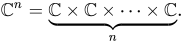
In mathematics, the n-dimensional complex coordinate space (or complex n-space) is the set of all ordered n-tuples of complex numbers, also known as complex vectors. The space is denoted , and is the n-fold Cartesian product of the complex line with itself. Symbolically,orThe variables are the (complex) coordinates on the complex n-space. The special case , called the complex coordinate plane, is not to be confused with the complex plane, a graphical representation of the complex line.

Complex coordinate space is a vector space over the complex numbers, with componentwise addition and scalar multiplication. The real and imaginary parts of the coordinates set up a bijection of with the 2n-dimensional real coordinate space, . With the standard Euclidean topology, is a topological vector space over the complex numbers.

View the full Wikipedia page for Complex coordinate space
↑ Return to Menu

Cartesian product in the context of Elliptic curve

In mathematics, an elliptic curve is a smooth, projective, algebraic curve of genus one, on which there is a specified point O. An elliptic curve is defined over a field K and describes points in K, the Cartesian product of K with itself. If the field's characteristic is different from 2 and 3, then the curve can be described as a plane algebraic curve which consists of solutions (x, y) for:

for some coefficients a and b in K. The curve is required to be non-singular, which means that the curve has no cusps or self-intersections. (This is equivalent to the condition 4a + 27b ≠ 0, that is, being square-free in x.) It is always understood that the curve is really sitting in the projective plane, with the point O being the unique point at infinity. Many sources define an elliptic curve to be simply a curve given by an equation of this form. (When the coefficient field has characteristic 2 or 3, the above equation is not quite general enough to include all non-singular cubic curves; see § Elliptic curves over a general field below.)

View the full Wikipedia page for Elliptic curve
↑ Return to Menu

Cartesian product in the context of Direct product

In mathematics, a direct product of objects already known can often be defined by giving a new one. That induces a structure on the Cartesian product of the underlying sets from that of the contributing objects. The categorical product is an abstraction of these notions in the setting of category theory.

Examples are the product of sets, groups (described below), rings, and other algebraic structures. The product of topological spaces is another instance.

View the full Wikipedia page for Direct product
↑ Return to Menu

Cartesian product in the context of Homogeneous relation

In mathematics, a homogeneous relation (also called endorelation) on a set X is a binary relation between X and itself, i.e. it is a subset of the Cartesian product X × X. This is commonly phrased as "a relation on X" or "a (binary) relation over X". An example of a homogeneous relation is the relation of kinship, where the relation is between people.

Common types of endorelations include orders, graphs, and equivalences. Specialized studies of order theory and graph theory have developed understanding of endorelations. Terminology particular for graph theory is used for description, with an ordinary (undirected) graph presumed to correspond to a symmetric relation, and a general endorelation corresponding to a directed graph. An endorelation R corresponds to a logical matrix of 0s and 1s, where the expression xRy (x is R-related to y) corresponds to an edge between x and y in the graph, and to a 1 in the square matrix of R. It is called an adjacency matrix in graph terminology.

View the full Wikipedia page for Homogeneous relation
↑ Return to Menu

Cartesian product in the context of Triadic relation

In mathematics, a ternary relation or triadic relation is a finitary relation in which the number of places in the relation is three. Ternary relations may also be referred to as 3-adic, 3-ary, 3-dimensional, or 3-place.

Just as a binary relation is formally defined as a set of pairs, i.e. a subset of the Cartesian product A × B of some sets A and B, so a ternary relation is a set of triples, forming a subset of the Cartesian product A × B × C of three sets A, B and C.

View the full Wikipedia page for Triadic relation
↑ Return to Menu

Cartesian product in the context of Cartesian product of graphs

In graph theory, the Cartesian product GH of graphs G and H is a graph such that:

  • the vertex set of GH is the Cartesian product V(G) × V(H); and
  • two vertices (u,v) and (u' ,v' ) are adjacent in GH if and only if either
    • u = u' and v is adjacent to v' in H, or
    • v = v' and u is adjacent to u' in G.

The Cartesian product of graphs is sometimes called the box product of graphs [Harary 1969].

View the full Wikipedia page for Cartesian product of graphs
↑ Return to Menu

Cartesian product in the context of Solid torus

In mathematics, a solid torus is the topological space formed by sweeping a disk around a circle. It is homeomorphic to the Cartesian product of the disk and the circle, endowed with the product topology.

A standard way to visualize a solid torus is as a toroid, embedded in 3-space. However, it should be distinguished from a torus, which has the same visual appearance: the torus is the two-dimensional space on the boundary of a toroid, while the solid torus includes also the compact interior space enclosed by the torus.

View the full Wikipedia page for Solid torus
↑ Return to Menu

Cartesian product in the context of Product (category theory)

In category theory, the product of two (or more) objects in a category is a notion designed to capture the essence behind constructions in other areas of mathematics such as the Cartesian product of sets, the direct product of groups or rings, and the product of topological spaces. Essentially, the product of a family of objects is the "most general" object which admits a morphism to each of the given objects.

View the full Wikipedia page for Product (category theory)
↑ Return to Menu

Cartesian product in the context of Product ring

In mathematics, a product of rings or direct product of rings is a ring that is formed by the Cartesian product of the underlying sets of several rings (possibly an infinity), equipped with componentwise operations. It is a direct product in the category of rings.

Since direct products are defined up to an isomorphism, one says colloquially that a ring is the product of some rings if it is isomorphic to the direct product of these rings. For example, the Chinese remainder theorem may be stated as: if m and n are coprime integers, the quotient ring is the product of and

View the full Wikipedia page for Product ring
↑ Return to Menu

Cartesian product in the context of Product topology

In topology and related areas of mathematics, a product space is the Cartesian product of a family of topological spaces equipped with a natural topology called the product topology. This topology differs from another, perhaps more natural-seeming, topology called the box topology, which can also be given to a product space and which agrees with the product topology when the product is over only finitely many spaces. However, the product topology is "correct" in that it makes the product space a categorical product of its factors, whereas the box topology is too fine; in that sense the product topology is the natural topology on the Cartesian product.

View the full Wikipedia page for Product topology
↑ Return to Menu

Cartesian product in the context of Simply typed lambda calculus

The simply typed lambda calculus (), a formof type theory, is a typed interpretation of the lambda calculus with only one type constructor () that builds function types. It is the canonical and simplest example of a typed lambda calculus. The simply typed lambda calculus was originally introduced by Alonzo Church in 1940 as an attempt to avoid paradoxical use of the untyped lambda calculus.

The term simple type is also used to refer to extensions of the simply typed lambda calculus with constructs such as products, coproducts or natural numbers (System T) or even full recursion (like PCF). In contrast, systems that introduce polymorphic types (like System F) or dependent types (like the Logical Framework) are not considered simply typed. The simple types, except for full recursion, are still considered simple because the Church encodings of such structures can be done using only and suitable type variables, while polymorphism and dependency cannot.

View the full Wikipedia page for Simply typed lambda calculus
↑ Return to Menu

Cartesian product in the context of Projection function

In set theory, a projection is one of two closely related types of functions or operations, namely:

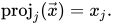
  • A set-theoretic operation typified by the projection map, written that takes an element of the Cartesian product to the value
  • A function that sends an element to its equivalence class under a specified equivalence relation or, equivalently, a surjection from a set to another set. The function from elements to equivalence classes is a surjection, and every surjection corresponds to an equivalence relation under which two elements are equivalent when they have the same image. The result of the mapping is written as when is understood, or written as when it is necessary to make explicit.
View the full Wikipedia page for Projection function
↑ Return to Menu