Carmathians in the context of "Battle of Kasahrada"

Play Trivia Questions online!

or

Skip to study material about Carmathians in the context of "Battle of Kasahrada"

Ad spacer

⭐ Core Definition: Carmathians

The Qarmatians were an Isma'ili Shia militant movement led by a dynasty of Persian descent, centred in Al-Ahsa in Eastern Arabia, where they established a religious state in 899 CE. Its members were part of a movement that adhered to a syncretic branch of Sevener Ismaili Shia Islam, and were ruled by a dynasty founded by Abu Sa'id al-Jannabi. They rejected the claim of Fatimid Caliph Abdallah al-Mahdi Billah to imamate and clung to their belief in the coming of the Mahdi, and they revolted against the Fatimid and Abbasid Caliphates.

Mecca was sacked by a Qarmatian leader, Abu Tahir al-Jannabi, outraging the Muslim world, particularly with their theft of the Black Stone and desecration of the Zamzam Well with corpses during the Hajj season of 930 CE.

↓ Menu

>>>PUT SHARE BUTTONS HERE<<<

👉 Carmathians in the context of Battle of Kasahrada

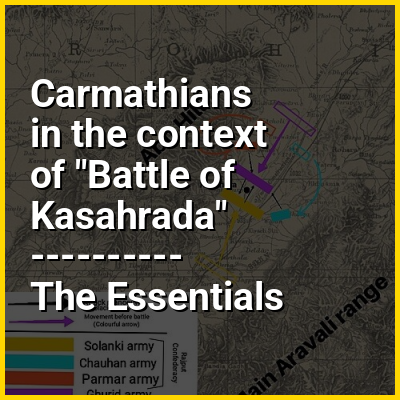
The Battle of Kasahrada, also known as Battle of Kayadara or Battle of Gadararaghatta was fought in 1178 at modern Kasahrada in Sirohi district near Mount Abu in present-day Rajasthan. It was fought between the Rajput Confederacy led by Mularaja II and the invading Ghurid forces led by Muhammad of Ghor, during which the Ghurid forces were signally defeated.

Endeavoring for Ghurid expansion east of Indus during the last quarter of twelfth century, Muhammad of Ghor, marched down the Gumal Pass and seized Multan and Uch ejecting the Carmathians from there before he attempted to penetrate into mainland India, approaching it through the territory of Chaulukyas situated in the present-day Gujarat. The Ghurid army marching by the way of Multan and Uch reached Kasahrada, at foot of Mount Abu in state of exhaustion after a long march through the Thar Desert, where they confronted the forces of Chaulukya king Mularaja aided by his Rajput allies. In the decisive battle, the famished Ghurid army was routed and wounded Muhammad of Ghor, retreated back to his capital Ghazna, through the desert with considerable difficulty.

↓ Explore More Topics
In this Dossier

Carmathians in the context of Muhammad of Ghor

Mu'izz al-Din Muhammad ibn Sam (Persian: معز الدین محمد بن سام, romanizedMuʿizz al-Dīn Muḥammad ibn Sām; c. 1144 – 15 March 1206), also known as Muhammad of Ghor or Muhammad Ghori, was a ruler from the Ghurid dynasty based in the Ghor region of what is today central Afghanistan who ruled from 1173 to 1206. Muhammad and his elder brother Ghiyath al-Din Muhammad ruled in a dyarchy until the latter's death in 1203. Ghiyath al-Din, the senior partner, governed the western Ghurid regions from his capital at Firozkoh whereas Muhammad extended Ghurid rule eastwards into South Asia, laying the foundation of Islamic rule in South Asia, which lasted after him for nearly half a millennium under evolving Muslim dynasties.

During his early career as governor of the southern tract of Ghurid Empire, Muhammad subjugated the Oghuz Turks after a series of forays and annexed Ghazni where he was installed by Ghiyath al-Din Muhammad as an independent sovereign. Expanding the Ghurid dominion east of the Indus Delta from his base in Ghazni, Muhammad crossed the river Indus in 1175, approaching it through the Gomal Pass and captured Multan and Uch from the Carmathians within a year. Afterwards, Muhammad took his army by the way of lower Sindh, endeavouring to penetrate into present-day Gujarat through the Thar Desert. However, he was wounded and his forces were routed near Mount Abu at Kasahrada by a coalition of Rajput chiefs led by the Chaulukya king Mularaja. This setback forced him to change his route for future inroads into the Indian Plains. Hence, Muhammad pressed his forces against the Ghaznavids and uprooted them by 1186, conquering the upper Indus Plain along with most of the Punjab. After expelling the Ghaznavids from their last bastion, Muhammad secured the Khyber Pass, the traditional route of entry for invading armies into northern India.
↑ Return to Menu