The prehistory of Italy began in the Paleolithic period, when members of the genus Homo first inhabited what is now modern Italian territory, and ended in the Iron Age, when the first written records appeared in Italy.

The prehistory of Italy began in the Paleolithic period, when members of the genus Homo first inhabited what is now modern Italian territory, and ended in the Iron Age, when the first written records appeared in Italy.
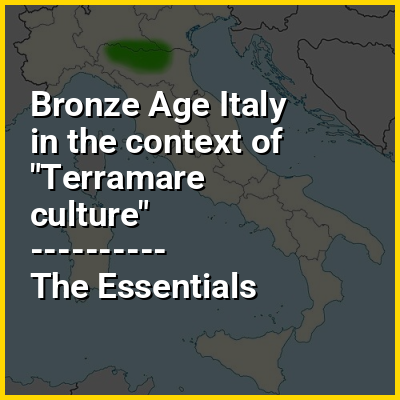
Terramare, terramara, or terremare is a technology complex mainly of the central Po valley, in Emilia, Northern Italy, dating to the Middle and Late Bronze Age c. 1700–1150 BC. It takes its name from the "black earth" residue of settlement mounds. Terramare is from terra marna, "marl-earth", where marl is a lacustrine deposit. It may be any color but in agricultural lands it is most typically black, giving rise to the "black earth" identification of it. The population of the terramare sites is called the terramaricoli. The sites were excavated exhaustively in 1860–1910.
These sites prior to the second half of the 19th century were commonly believed to have been used for Gallic and Roman sepulchral rites. They were called terramare and marnier by the farmers of the region, who mined the soil for fertilizer. Scientific study began with Bartolomeo Gastaldi in 1860. He was investigating peat bogs and old lake sites in north Italy but did some investigations of the marnier, recognizing them finally as habitation, not funerary, sites similar to the pile dwellings further north.