A Brodmann area is a region of the cerebral cortex, in the human or other primate brain, defined by its cytoarchitecture, or histological structure and organization of cells. The concept was first introduced by the German anatomist Korbinian Brodmann in the early 20th century. Brodmann mapped the human brain based on the varied cellular structure across the cortex and identified 52 distinct regions, which he numbered 1 to 52. These regions, or Brodmann areas, correspond with diverse functions including sensation, motor control, and cognition.
>>>PUT SHARE BUTTONS HERE<<<
👉 Brodmann areas in the context of Brodmann area 6
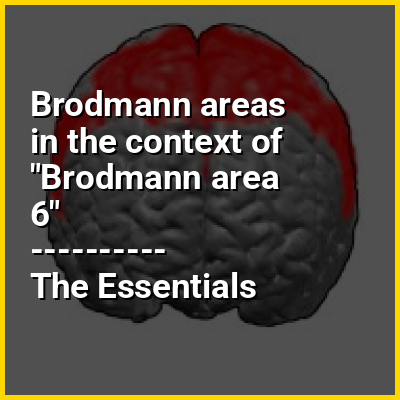
Brodmann area 6 (BA6) is part of the frontal cortex in the human brain. It is one of the Brodmann areas. Situated just anterior to the primary motor cortex (BA4), it is composed of the premotor cortex and, medially, the supplementary motor area (SMA). This large area of the frontal cortex is believed to play a role in planning complex, coordinated movements.
Brodmann area 6 is also called agranular frontal area 6 in humans because it lacks an internal granular cortical layer (layer IV). It is a subdivision of the cytoarchitecturally defined precentral region of cerebral cortex. In the human brain, it is located on the portions of the precentral gyrus that are not occupied by Brodmann area 4; furthermore, BA6 extends onto the caudal portions of the superior frontal and middle frontal gyri. It extends from the cingulate sulcus on the medial aspect of the hemisphere to the lateral sulcus on the lateral aspect. It is bounded rostrally by the granular frontal region and caudally by the gigantopyramidal area 4 (Brodmann, 1909).
In this Dossier
Brodmann areas in the context of Neurolinguistics
Neurolinguistics is the study of neural mechanisms in the human brain that control the comprehension, production, and acquisition of language. As an interdisciplinary field, neurolinguistics draws methods and theories from fields such as neuroscience, linguistics, cognitive science, communication disorders and neuropsychology. Researchers are drawn to the field from a variety of backgrounds, bringing along a variety of experimental techniques as well as widely varying theoretical perspectives. Much work in neurolinguistics is informed by models in psycholinguistics and theoretical linguistics, and is focused on investigating how the brain can implement the processes that theoretical and psycholinguistics propose are necessary in producing and comprehending language. Neurolinguists study the physiological mechanisms by which the brain processes information related to language, and evaluate linguistic and psycholinguistic theories, using aphasiology, brain imaging, electrophysiology, and computer modeling.
Brodmann areas in the context of Brain regions
The human brain anatomical regions are ordered following standard neuroanatomy hierarchies. Functional, connective, and developmental regions are listed in parentheses where appropriate.
Brodmann areas in the context of Brodmann area 4
Brodmann area 4 refers to the primary motor cortex of the human brain, one of the Brodmann areas. It is located in the posterior portion of the frontal lobe.
Brodmann area 4 is part of the precentral gyrus. The borders of this area are: the precentral sulcus in front (anteriorly), the medial longitudinal fissure at the top (medially), the central sulcus in back (posteriorly), and the lateral sulcus along the bottom (laterally).