Black Madonna of Częstochowa in the context of "Częstochowa"

Play Trivia Questions online!

or

Skip to study material about Black Madonna of Częstochowa in the context of "Częstochowa"


⭐ Core Definition: Black Madonna of Częstochowa

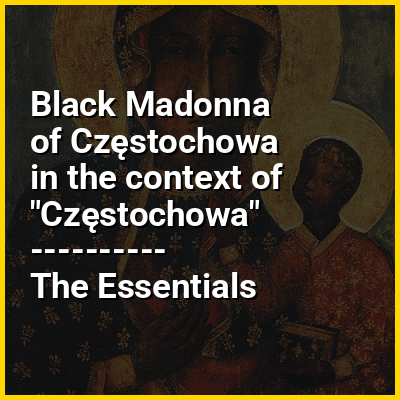
The Black Madonna of Częstochowa (Polish: Czarna Madonna z Częstochowy; Latin: Imago thaumaturga Beatae Virginis Mariae Immaculatae Conceptae, in Claro Monte, lit.'Miraculous Image of the Immaculate Conception, the Blessed Virgin Mary in the Crystal Mountain'), also known as Our Lady of Częstochowa (Polish: Matka Boska Częstochowska) is a venerated icon of the Blessed Virgin Mary enshrined at the Jasna Góra Monastery in Częstochowa, Poland.

Pope Clement XI issued a Pontifical decree of canonical coronation to the image on 8 September 1717 via the Vatican Chapter. It has also merited three Pontifical golden roses.
↓ Menu

👉 Black Madonna of Częstochowa in the context of Częstochowa

Częstochowa (/ˌɛnstəˈkvə/ CHEN-stə-KOH-və, Polish: [t͡ʂɛ̃stɔˈxɔva] ) is a city in southern Poland on the Warta with 214,342 inhabitants, making it the thirteenth-largest city in Poland. It is situated in the Silesian Voivodeship. However, Częstochowa is historically part of Lesser Poland, not Silesia, and before the 1795 Partition of Poland, it belonged to the Kraków Voivodeship. Częstochowa is located in the Kraków-Częstochowa Upland. It is the largest economic, cultural and administrative hub in the northern part of the Silesian Voivodeship.

The city is known for the famous Jasna Góra Monastery of the Order of Saint Paul the First Hermit of the Catholic Church, which is the home of the Black Madonna of Częstochowa, a shrine to Mary, mother of Jesus. Every year, millions of pilgrims from all over the world come to Częstochowa to see it.

↓ Explore More Topics
In this Dossier

Black Madonna of Częstochowa in the context of Black Madonna

The terms Black Madonna and Black Virgin refer to statues or paintings in Western Christendom of the Blessed Virgin Mary and the Infant Jesus, where both figures are depicted with dark skin. Examples of the Black Madonna can be found both in Catholic and Orthodox countries.

The paintings are usually icons, which are Byzantine in origin or style, some of which were produced in 13th or 14th-century Italy. Other examples from the Middle East, Caucasus or Africa, mainly Egypt and Ethiopia, are even older. Statues are often made of wood but are occasionally made of stone, painted, and up to 75 cm (30 in) tall. They fall into two main groups: free-standing upright figures or seated figures on a throne. About 400–500 Black Madonnas have been recorded in Europe, with the number related to how they are classified. There are at least 180 Vierges Noires in Southern France alone. There are hundreds of copies made since the medieval era. Some are displayed in museums, but most are in churches or shrines and are venerated by believers. Some are associated with miracles and attract substantial numbers of pilgrims.

↑ Return to Menu

Black Madonna of Częstochowa in the context of Jasna Góra

The Jasna Góra Monastery (Polish: Jasna Góra [ˈjas.na ˈɡu.ra] , Luminous or Light Mountain, Latin: Clarus Mons) in Częstochowa, Poland, is a shrine dedicated to the Virgin Mary and one of the country's places of pilgrimage. The image of the Black Madonna of Częstochowa, also known as Our Lady of Częstochowa, to which miraculous powers are attributed, is one of Jasna Góra's most precious treasures.

The site is one of Poland's official national Historic Monuments (Pomnik historii) and is tracked by the National Heritage Board of Poland.

↑ Return to Menu