Bighorn sheep in the context of "White Goat Wilderness Area"

Play Trivia Questions online!

or

Skip to study material about Bighorn sheep in the context of "White Goat Wilderness Area"

Ad spacer

⭐ Core Definition: Bighorn sheep

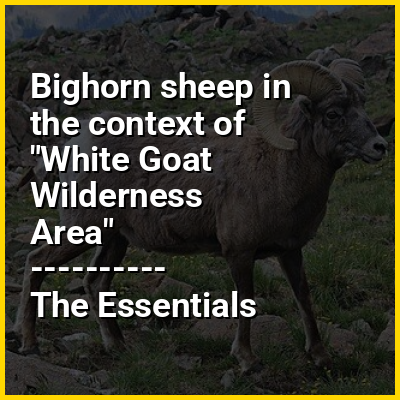
The bighorn sheep (Ovis canadensis) or bighorn, is a species of sheep native to North America. It is named for its large horns. A pair of horns may weigh up to 14 kg (30 lb); the sheep typically weigh up to 143 kg (315 lb). Recent genetic testing indicates three distinct subspecies of Ovis canadensis, one of which is endangered: O. c. sierrae.

Sheep originally crossed to North America over the Bering Land Bridge from Siberia; the population in North America peaked in the millions, and the bighorn sheep entered into the mythology of Native Americans. By 1900, the population had crashed to several thousand due to diseases introduced through European livestock and overhunting.

↓ Menu

>>>PUT SHARE BUTTONS HERE<<<

👉 Bighorn sheep in the context of White Goat Wilderness Area

The White Goat Wilderness Area is a provincially designated wilderness area in the Canadian Rockies of Alberta. It was established in 1961 and it, as one of the three wilderness areas of Alberta, has the strictest form of government protection available in Canada. All development is forbidden and only travel by foot is permitted. Hunting and fishing are not allowed. The other two wilderness areas are Ghost River Wilderness Area and Siffleur Wilderness Area and together the three areas total 249,548.80 acres (100,988.82 ha).

White Goat is located near the west end and north side of Canadian Highway 11 and slightly north of the Siffleur Wilderness area. It is near the north end of Banff National Park, the south end of Jasper National Park, and east of the Columbia Icefield. Mountains rise to over 3,300 metres (10,800 ft). The area has rugged mountains, glacier-carved valleys, mountain lakes, waterfalls, and alpine meadows. There are two distinct vegetation zones. Above 2,100 metres (6,900 ft), the tree line, are grasses, sedges and wildflowers. Below that are spruce, fir, and lodgepole pine. Animals in the lower regions include woodland caribou, moose, elk, white-tailed deer, mule deer, grizzly bear, black bear, cougar, coyote, timber wolf, and wolverine. Animals in the upper regions include golden-mantled ground squirrels, bighorn sheep, mountain goat, hoary marmot, pika, white-tailed ptarmigan, grey-crowned rosy finch, water pipit and horned lark. Eagles are seen in both the lower and upper regions.
↓ Explore More Topics
In this Dossier

Bighorn sheep in the context of Elk

The elk (pl.: elk or elks; Cervus canadensis) or wapiti is the second largest species within the deer family, Cervidae, and one of the largest terrestrial mammals in its native range of North America and Central and East Asia. The word "elk" originally referred to the European variety of the moose, Alces alces, but was transferred to Cervus canadensis by North American colonists.

The name "wapiti" is derived from a Shawnee and Cree word meaning "white rump", after the distinctive light fur around the tail region which the animals may fluff-up or raise to signal their agitation or distress to one another, when fleeing perceived threats, or among males courting females and sparring for dominance. A similar trait is seen in other artiodactyl species, like the bighorn sheep, pronghorn and the white-tailed deer, to varying degrees.

↑ Return to Menu

Bighorn sheep in the context of Altitudinal migration

Altitudinal migration is a short-distance animal migration from lower altitudes to higher altitudes and back. Altitudinal migrants change their elevation with the seasons, making this form of animal migration seasonal. Altitudinal migration can be most commonly observed in species inhabiting temperate or tropical ecosystems. This behavior is commonly seen among avian species but can also be observed within other vertebrates and some invertebrates. It is commonly thought to happen in response to climate and food availability changes as well as increasingly due to anthropogenic influence. These migrations can occur both during reproductive and non-reproductive seasons.

The patterns of altitudinal migration may be affected by climate change resulting in potentially life-threatening situations for some species. Deforestation can affect the migration corridors of altitudinal migrant and could lead to smaller areas for these species to migrate. Changes in the environment of altitudinally migrating species can also affect seed dispersal.

↑ Return to Menu

Bighorn sheep in the context of Henrys Lake Mountains

The Henrys Lake Mountains, highest point Sheep Point, el. 10,609 feet (3,234 m), (See also ) are a small mountain range northwest of West Yellowstone, Montana, in Madison County, Montana. These mountains are also referred to as the Lionhead Mountains, and straddle the Continental Divide along the Idaho-Montana border. On the northwest corner of these mountains is Quake Lake, created when the 1959 Hebgen Lake earthquake caused a massive landslide and dammed the Madison River. Nine subalpine lakes sit in high cirques in the higher reaches, with several peaks topping 10,000'. Coffin Lake is the largest and most popular, on the Montana side. About 32,000 acres are roadless in the Montana portion, with an unknown amount in Idaho. Dense forests, pristine streams, rolling tundra, and grassy parks provide year-round habitat for grizzly bears, elk, and bighorn sheep. Rocks and soils are inherently unstable, a factor in the landslide that caused much loss of life in 1959. The instability exists because the range is basically limestone blocks sitting on top of shale and Yellowstone volcanic rocks.

↑ Return to Menu

Bighorn sheep in the context of Siffleur Wilderness Area

The Siffleur Wilderness Area is a provincially designated wilderness area in the Canadian Rockies of Alberta. It was established in 1961 and it, as one of the three wilderness areas of Alberta, has the strictest form of government protection available in Canada. All development is forbidden and only travel by foot is permitted. Hunting and fishing are not allowed. The other two wilderness areas are White Goat Wilderness Area and Ghost River Wilderness Area and together the three areas total 249,548.80 acres (100,988.82 ha).

Siffleur is located near the west end and south side of Canadian Highway 11 and slightly south of the White Goat Wilderness area. It is near the north end of Banff National Park and the south end of Jasper National Park. Mountains rise to 3,300 metres (10,800 ft). The area has rugged mountains, glacier-carved valleys, mountain lakes, and alpine meadows. There are two distinct vegetation zones. Above 2,100 metres (6,900 ft), the tree line, are grasses, sedges and wildflowers. Below that are subalpine forests of spruce, fir, and lodgepole pine. At even lower elevations there are aspen and balsam poplar. Animals in the lower regions include woodland caribou, moose, elk, white-tailed deer, mule deer, grizzly bear, black bear, cougar, coyote, timber wolf, and wolverine. Animals in the upper regions include golden-mantled ground squirrels, bighorn sheep, mountain goat, hoary marmot, pika, white-tailed ptarmigan, grey-crowned rosy finch, water pipit and horned lark. Eagles are seen in both the lower and upper regions.

↑ Return to Menu