
The Old Straight Road, the Straight Road, the Lost Road, or the Lost Straight Road, is J. R. R. Tolkien's conception, in his fantasy world of Arda, that his Elves are able to sail to the earthly paradise of Valinor, realm of the godlike Valar. The tale is mentioned in The Silmarillion and in The Lord of the Rings, and documented in The Lost Road and Other Writings. The Elves are immortal, but may grow weary of the world, and then sail across the Great Sea to reach Valinor. The men of Númenor are persuaded by Sauron, servant of the first Dark Lord Melkor, to attack Valinor to get the immortality they feel should be theirs. The Valar ask for help from the creator, Eru Ilúvatar. He destroys Númenor and its army, in the process reshaping Arda into a sphere, and separating it and its continent of Middle-earth from Valinor so that men can no longer reach it. Elves can still set sail from the shores of Middle-earth in ships, bound for Valinor: they sail into the Uttermost West, following the Old Straight Road.
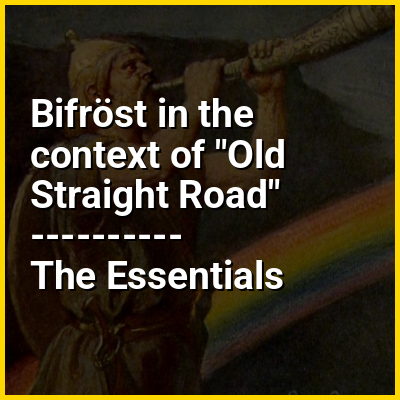
Scholars have noted the importance of the theme to Tolkien, as he revisited it repeatedly. His early mention of the Straight Road as being a level bridge recalls Bifröst, the bridge between the earthly Midgard and the gods' home of Asgard in Norse mythology. Other possible inspirations for the theme include a literary crux in Beowulf in the shape of the character Scyld Scefing. He arrives in the world as a baby in a boat filled with gifts, and he departs from it in a ship-burial, with the odd feature that the ship is not set on fire, as in the typical Viking ritual. The scholar Tom Shippey suggests that Tolkien may have felt that Scyld is being sent back to the gods across the Western sea via a kind of Straight Road, and that Tolkien perhaps created his Valar and their home Valinor to explain that gap in Beowulf. His poem "A Walking Song", which occurs in different versions at the start and end of The Lord of the Rings, also alludes to the theme.