Bhimsen Thapa in the context of "Bahadur Shah of Nepal"

Play Trivia Questions online!

or

Skip to study material about Bhimsen Thapa in the context of "Bahadur Shah of Nepal"

Ad spacer

⭐ Core Definition: Bhimsen Thapa

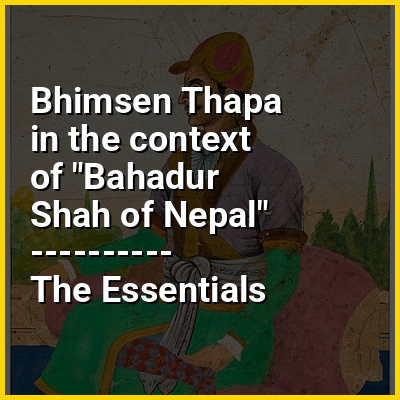
Bhimsen Thapa (Nepali: भीमसेन थापाlisten (August 1775 – 29 July 1839)) was a Nepalese statesman who served as the Mukhtiyar (equivalent to prime minister) and de facto ruler of Nepal from 1806 to 1837. He is widely known as the longest-serving prime minister of Nepal and was inducted into the "National heroes of Nepal" by King Mahendra Bir Bikram Shah.

Born into an ordinary military family in the Gorkha Kingdom, Bhimsen first came close to the Crown Prince Rana Bahadur Shah at an early age in 1785. In 1798, he was recruited as a bodyguard for the King by his father. Thereafter, he rose to influence after helping the exiled ex-King Rana Bahadur Shah engineer his return to power in 1804. In gratitude, Rana Bahadur made Bhimsen a Kaji (equivalent to a minister) of the newly formed government. Rana Bahadur's assassination by his stepbrother Sher Bahadur Shah in 1806 led Bhimsen to initiate investigations into the context in which he ordered the death penalty for ninety-three people popularly known as the 1806 Bhandarkhal massacre, after which he claimed the title of Mukhtiyar (equivalent to prime minister) himself. The death of King Girvan Yuddha Bikram Shah in 1816 at the immature age of 17, with his heir, King Rajendra Bikram Shah being only 3 years old, along with the support from Queen Tripurasundari (the junior queen of Rana Bahadur Shah) allowed him to remain in power even after Nepal's defeat in the Anglo-Nepalese War. After the death of Queen Tripurasundari in 1832, the intrigues of the newly adult King Rajendra, the conspiracies and infightings with the British envoy Brian Houghton Hodgson, Senior Queen Samrajya Laxmi Devi and the rival courtiers (especially the Kala Pandes, who held Bhimsen Thapa responsible for the death of Damodar Pande in 1804) finally led to his imprisonment on false charges of the murder of an infant prince and ultimately his death by suicide in 1839.
↓ Menu

>>>PUT SHARE BUTTONS HERE<<<

👉 Bhimsen Thapa in the context of Bahadur Shah of Nepal

Prince Bahadur Shah (Nepali: बहादुर शाह) was the youngest son of King Prithvi Narayan Shah of modern Nepal. He became the regent of Nepal for a brief period after the death of his predecessor Queen Rajendra Laxmi and accelerated his father's campaign for the conquest of the small and scattered Hindu nations of the Himalayas into modern-day Nepal. Despite his many conquests, he also started the tradition of beheading fellow courtiers against his father's advice which would eventually lead to him meeting the same fate. This, along with the political turmoil created in Nepal after his death eventually led to the rise of Bhimsen Thapa and the Anglo-Nepal War.

↓ Explore More Topics
In this Dossier

Bhimsen Thapa in the context of Kingdom of Nepal

The Kingdom of Nepal (Nepali: नेपाल अधिराज्य) was a Hindu kingdom in South Asia, formed in 1768 by the expansion of the Gorkha Kingdom, and disestablished and replaced by the Federal Democratic Republic of Nepal in 2008. The king of Nepal served as its head of state, and it was also known as the Gorkha Empire (Nepali: गोरखा अधिराज्य), or sometimes Asal Hindustan (Nepali: असल हिन्दुस्तान, lit.'Real Land of the Hindus'). The kingdom was founded by King Prithvi Narayan Shah, a Gorkha monarch of the Shah dynasty who claimed to be of Thakuri origin from chaubisi.

After the invasion of Tibet and plundering of Digarcha by Nepali forces under Prince Regent Bahadur Shah in 1792, the Dalai Lama and Chinese Ambans reported to the Chinese administration for military support. The Chinese and Tibetan forces under Fuk'anggan attacked Nepal but went for negotiations after failure at Nuwakot. Mulkaji Damodar Pande, who was the most influential among the four Kajis, was appointed after the removal of Bahadur Shah. Chief Kaji (Mulkaji) Kirtiman Singh Basnyat, tried to protect king Girvan Yuddha Shah and keep former king, Rana Bahadur Shah away from Nepal. However, on 4 March 1804, the former king came back and took over as Mukhtiyar and Damodar Pande was then beheaded in Thankot. The 1806 Bhandarkhal massacre instigated upon the death of Rana Bahadur Shah, set forth the rise of the authoritative Mukhtiyar Bhimsen Thapa, who became the de facto ruler of Nepal from 1806 to 1837. During the early nineteenth century, however, the expansion of the East India Company's rule in India led to the Anglo-Nepalese War (1814–1816), which resulted in Nepal's defeat.

↑ Return to Menu

Bhimsen Thapa in the context of Rana dynasty

The Rana dynasty (Nepali: राणा वंश, romanized: Rāṇā vaṃśa, Sanskrit: [raːɳaː ʋɐ̃ɕɐ], Nepali: [raɳa bʌŋsʌ]) was a Chhetri dynasty that imposed authoritarianism in the Kingdom of Nepal from 1846 until 1951, reducing the Shah monarch to a figurehead, and making the Prime Minister and other government positions held by the Ranas hereditary. The Rana dynasty is historically known for their iron-fisted rule in Nepal. This changed after the Revolution of 1951 with the promulgation of a new constitution, when power shifted back to the monarchy of King Tribhuvan.

The Rana dynasty were descended from the Kunwar family, a nobility of the Gorkha Kingdom. Due to their marital lineages with the politically reigning Thapa dynasty (of Mukhtiyar Bhimsen Thapa) from the early 19th century, the Ranas gained entry to central Darbar politics. The Ranas were also linked to a minor faction of the Pande dynasty of Gorkha through the Thapa dynasty.

↑ Return to Menu

Bhimsen Thapa in the context of Damodar Pande

Damodar Pande (Nepali: दामोदर पाँडे) (1752 – March 13, 1804) was the Mulkaji of Nepal (equivalent to Prime Minister of Nepal) from 1803 until March 1804 and the most influential Kaji from 1794 to his execution on March 13, 1804. He is also arguably referred to as the first Prime Minister of Nepal. He was the youngest son of famous Kaji of Prithivi Narayan Shah Kalu Pande. He was born in 1752 in Gorkha. Damodar Pande was one of the commanders during the Sino-Nepalese War and in Nepal-Tibet War. He was among the successful Gorkhali warriors sent towards the east by Prithivinarayan Shah.

After his execution, Ranajit Pande (who was his paternal cousin) was established as Mulkaji (Chief Kaji), along with Bhimsen Thapa as second Kaji, Sher Bahadur Shah as Mul Chautariya and Ranganath Paudel as Raj Guru (Royal Preceptor).

↑ Return to Menu

Bhimsen Thapa in the context of Girvan Yuddha Bikram Shah Deva

Girvan Yuddha Bikram Shah (Nepali: श्री ५ महाराजाधिराज गीर्वाणयुद्ध विक्रम शाह देव; 19 October 1797 – 20 November 1816) also called Girvanyuddha Bikrama Shah, was King of Nepal. Although he was not the legitimate heir to the throne his father, King Rana Bahadur Shah, made him the heir for being the son of his favourite wife Kantavati Jha.

Girvan Yuddha ascended the throne at the age of 1 and 1/2 years when his father abdicated to become an ascetic. He ruled under the regency of Queen Tripurasundari of Nepal and Prime Minister Bhimsen Thapa. He died at age 19 and was succeeded by his young son Rajendra Bikram Shah.

↑ Return to Menu

Bhimsen Thapa in the context of 1806 Bhandarkhal massacre

The Bhandarkhal massacre (Nepali: भण्डारखाल पर्व) was a political massacre that occurred in Bhandarkhal garden of Hanuman Dhoka, Kathmandu, Nepal in 1806. The chief perpetrator of the massacre was then Kaji Bhimsen Thapa. Bhimsen instigated the massacre as investigation and trial upon the death of then reigning Mukhtiyar and former King Rana Bahadur Shah. It began when Tribhuvan Khawas (Pradhan), a member of Sher Bahadur's faction, was imprisoned on the re-opened charges of conspiracy with the British that led to Knox's mission and finally convicted with a death penalty on the charge of treason. After the implication, Tribhuvan decided to reveal everyone that was involved in the dialogue with the British on his house meeting on the night of 25 April 1806. The confession implicated Sher Bahadur Shah, Rana Bahadur's step-brother and he began to harass his stepbrother. Unable to bear desperation, Sher Bahadur killed Rana Bahadur and triggered the massacre which lasted for two weeks. The number of deaths occurred was ninety-three people (16 women and 77 men).

↑ Return to Menu

Bhimsen Thapa in the context of Kunwar family

The Kunwar family (Nepali: कुँवर परिवार) was a noble Khas-Chhetri family in the Gorkha Kingdom and the Kingdom of Nepal. The Kunwars were linked to the Thapa dynasty and family of Amar Singh Thapa by marital lineages and, thus, to Pande dynasty through the Thapa dynasty. Three branches of the Kunwars; Ramakrishna, Jayakrishna and Amar Singh Kunwar were formed with opposite political aspirations. Bal Narsingh Kunwar (of Ramkrishna section) supported Mukhtiyar Bhimsen Thapa while Chandrabir Kunwar (of Jayakrishna section) supported Bada Kaji Amar Singh Thapa due to their marital relations with those families. Later, the Ramakrishna section of the family including Amarsingh established the Rana dynasty of Nepal and styled themselves as Rana Rajputs while Jayakrishna most section remained as Kunwars.

↑ Return to Menu

Bhimsen Thapa in the context of Pande dynasty

The Pande family or Pande dynasty (also spelled as Pandey or Panday) (Nepali: पाँडे वंश/पाँडे काजी खलक; pronounced [paɳɖe] or [pãɽẽ]) was a Chhetri political family with ancestral roots from Gorkha Kingdom that directly ruled Nepali administration affairs from the 16th century to 19th century as Mulkaji and Mukhtiyar (Prime Minister). This dynasty/family was one of the four noble families to be involved in active politics of Nepal together with the Shah dynasty, Basnyat family and Thapa dynasty before the rise of the Rana dynasty. The Pande dynasty is the oldest noble family to hold the title of Kaji. This family was decimated from political power in 1843 CE in the political massacre by Prime Minister Mathabar Singh Thapa as a revenge for his uncle Bhimsen's death in 1839.

The family is descended from nobleman Ganesh Pande of the Gorkha Kingdom. Kalu Pande and Tularam Pande were descendants of Ganesh Pande. Pande dynasty and Thapa dynasty were the two chief political families who alternatively contested for central power in the Nepalese court politics. The Pande family was divided into two sections, Kala Pandes and Gora Pandes, who were always aligned to opposite political factions. The Pande aristocratic family of Gora (White) Pande section was connected to Thapa dynasty through daughter of Chief Kazi Ranajit Pande, Rana Kumari who was married to Kaji General Nain Singh Thapa and to Rana dynasty through Nain Singh's son-in-law Bal Narsingh Kunwar. The Pande family of Kala (Black) Pande section was maritally linked to Basnyat Family through Chitravati Pande who married Kaji Kehar Singh Basnyat.

↑ Return to Menu