Bernicia in the context of "Northumbria"

Play Trivia Questions online!

or

Skip to study material about Bernicia in the context of "Northumbria"

Ad spacer

⭐ Core Definition: Bernicia

Bernicia (Old English: Bernice, Beornice) was an Anglo-Saxon kingdom established by Anglian settlers of the 6th century in what is now southeastern Scotland and North East England.

The Anglian territory of Bernicia was approximately equivalent to the modern English counties of Northumberland, Tyne and Wear, and Durham, as well as the Scottish counties of Berwickshire and East Lothian, stretching from the Forth to the Tees. In the early 7th century, it merged with its southern neighbour, Deira, to form the kingdom of Northumbria, and its borders subsequently expanded considerably.

↓ Menu

>>>PUT SHARE BUTTONS HERE<<<

👉 Bernicia in the context of Northumbria

Northumbria (/nɔːrˈθʌmbriə/) was an early medieval kingdom in what is now Northern England and South Scotland.

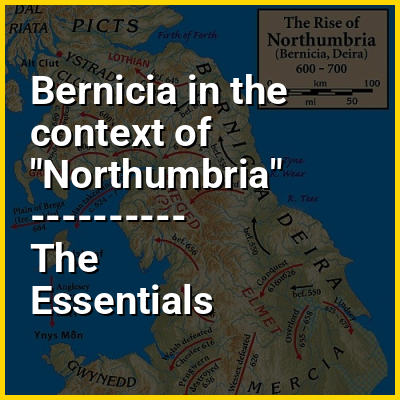
The name derives from the Old English Norþanhymbre meaning "the people or province north of the Humber", as opposed to the people south of the Humber Estuary. What was to become Northumbria started as two kingdoms, Deira in the south and Bernicia in the north. Conflict in the first half of the seventh century ended with the murder of the last king of Deira in 651, and Northumbria was thereafter unified under Bernician kings.

↓ Explore More Topics
In this Dossier

Bernicia in the context of Y Gododdin

Y Gododdin (Welsh: [əː ɡɔˈdɔðɪn]) is a medieval Welsh poem consisting of a series of elegies to the men of the Brittonic kingdom of Gododdin and its allies who, according to the conventional interpretation, died fighting the Angles of Deira and Bernicia at a place named Catraeth in about AD 600. It is traditionally ascribed to the bard Aneirin and survives only in one manuscript, the "Book of Aneirin".

The Book of Aneirin manuscript is from the later 13th century, but Y Gododdin has been dated to between the 7th and the early 11th centuries. The text is partly written in Middle Welsh orthography and partly in Old Welsh. The early date would place its oral composition soon after the battle, presumably in the Hen Ogledd ("Old North"); as such it would have originated in the Cumbric dialect of Common Brittonic. Others consider it the work of a poet from Wales in the 9th, 10th, or 11th century. Even a 9th-century date would make it one of the oldest surviving Welsh works of poetry.

↑ Return to Menu

Bernicia in the context of Scotland in the early Middle Ages

Scotland was divided into a series of kingdoms in the Early Middle Ages, i.e. between the end of Roman authority in southern and central Britain from around 400 AD and the rise of the kingdom of Alba in 900 AD. Of these, the four most important to emerge were the Picts, the Gaels of Dál Riata, the Britons of Alt Clut, and the Anglian kingdom of Bernicia. After the arrival of the Vikings in the late 8th century, Scandinavian rulers and colonies were established on the islands and along parts of the coasts. In the 9th century, the House of Alpin combined the lands of the Scots and Picts to form a single kingdom which constituted the basis of the Kingdom of Scotland.

Scotland has an extensive coastline, vast areas of difficult terrain and poor agricultural land. In this period, more land became marginal due to climate change, resulting in relatively light human settlement, particularly in the interior and Highlands. Northern Britain lacked urban centres and settlements were based on farmsteads and around fortified positions such as brochs, with mixed farming primarily based on self-sufficiency. In this period, changes in settlement and colonisation meant that the Pictish and Brythonic languages began to be subsumed by Gaelic, Scots, and, at the end of the period, by Old Norse. Life expectancy was relatively low, leading to a young population, with a ruling aristocracy, freemen, and relatively large numbers of slaves. Kingship was multi-layered, with different kings surrounded by their warbands that made up the most important elements of armed forces, and who engaged in both low-level raiding and occasional longer-range, major campaigns.
↑ Return to Menu

Bernicia in the context of Scotland in the Middle Ages

Scotland in the Middle Ages concerns the history of Scotland from the departure of the Romans to the adoption of major aspects of the Renaissance in the early sixteenth century.

From the fifth century northern Britain was divided into a series of kingdoms. Of these the four most important to emerge were the Picts, the Gaels of Dál Riata, the Britons of Strathclyde and the Anglo-Saxon kingdom of Bernicia, later taken over by Northumbria. After the arrival of the Vikings in the late eighth century, Scandinavian rulers and colonies were established along parts of the coasts and in the islands.

↑ Return to Menu

Bernicia in the context of Hen Ogledd

The Old North (Welsh: Hen Ogledd, Welsh pronunciation: [ˌheːn ˈɔɡlɛð]) is the term used in modern scholarship for the historical and literary space which was inhabited by Brittonic-speaking peoples of modern Northern England and southern Scotland in the Early Middle Ages. The people of Wales and those of the Old North considered themselves to be one people, and both were referred to as Cymry ('fellow-countrymen') from the Brittonic word combrogi. The Old North was distinct from the parts of Great Britain inhabited by the Picts, Anglo-Saxons, and Scoti.

The major kingdoms of the Old North were Elmet, Gododdin, Rheged, and the Kingdom of Strathclyde (Welsh: Ystrad Clud). Smaller kingdoms included Aeron and Calchfynydd. Eidyn, Lleuddiniawn, and Manaw Gododdin were evidently parts of Gododdin. The later Anglian kingdoms of Deira and Bernicia both had Brittonic-derived names, suggesting they may have been Brittonic kingdoms originally. All the kingdoms of the Old North except Strathclyde were gradually either integrated or subsumed by the emerging Anglo-Saxon kingdoms, Gaelic Scots and fellow Brittonic Picts by about 800; Strathclyde was eventually incorporated into the rising Middle Irish-speaking Kingdom of Scotland in the 11th century.

↑ Return to Menu

Bernicia in the context of Haddington, East Lothian

The Royal Burgh of Haddington (Scots: Haidintoun, Scottish Gaelic: Baile Adainn) is a town in East Lothian, Scotland. It is the main administrative, cultural and geographical centre for East Lothian. It lies about 17 miles (27 kilometres) east of Edinburgh. The name Haddington is Anglo-Saxon, dating from the sixth or seventh century AD when the area was incorporated into the Kingdom of Bernicia. The town, like the rest of the Lothian region, was ceded by King Edgar of England and became part of Scotland in the tenth century. Haddington received Burgh status, one of the earliest to do so, during the reign of David I (1124–1153), giving it trading rights which encouraged its growth into a market town.

Today, Haddington is a small town with a population of about 10,000 people, but during the High Middle Ages it was the fourth-biggest town in Scotland (after Aberdeen, Roxburgh and Edinburgh). In the middle of the town is the Haddington Town House, completed in 1745 based on a plan by William Adam. When first built, it contained markets on the ground floor, and an assembly hall on the first floor to which improvements were made in 1788, and a spire was added in 1831. Nearby is the corn exchange (1854) and the county courthouse (1833). Other notable nearby sites include: the Jane Welsh Carlyle House; Mitchell's Close; and a building on the High Street that was the birthplace of the author and government reformer Samuel Smiles and is marked by a commemorative plaque. John Knox was probably born in Haddington and Knox Academy, the local high school, is named after him.

↑ Return to Menu

Bernicia in the context of Edwin of Northumbria

Edwin (Old English: Ēadwine; c. 586 – 12 October 632/633), also known as Eadwine or Æduinus, was the King of Deira and Bernicia – which later became known as Northumbria – from around 616 until his death. He was the second monarch to rule both of these northern English kingdoms and the first to convert to Christianity. After he died in battle, he was venerated as a saint.

Edwin was the son of Ælle, the first known king of Deira, and likely had at least two siblings. His sister Acha was married to Æthelfrith, king of neighbouring Bernicia. Edwin was forced into exile when Æthelfrith conquered Deira. His travels took him to the court of Rædwald of East Anglia, who defeated Æthelfrith in 616, allowing Edwin to ascend the thrones of Bernicia and Deira. After the death of his patron Rædwald around 624, Edwin became the most powerful ruler in Britain. Bede the Venerable includes him in his list of kings who exercised imperium over other Anglo-Saxon monarchs, and the Anglo-Saxon Chronicle gives him the title bretwalda, or "ruler of Britain".

↑ Return to Menu