Beatus vir in the context of "Psalter"

Play Trivia Questions online!

or

Skip to study material about Beatus vir in the context of "Psalter"

Ad spacer

⭐ Core Definition: Beatus vir

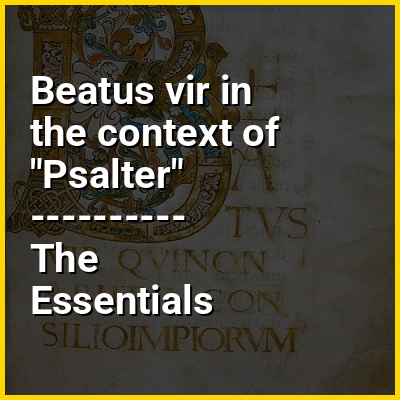
Beatus vir (Ecclesiastical Latin: [beˈatus ˈvir]; "Blessed is the man ...") are the first words in the Latin Vulgate Bible of both Psalm 1 and Psalm 112 (in the general modern numbering; it is Psalm 111 in the Greek Septuagint and the Vulgate). In each case, the words are used to refer to frequent and significant uses of these psalms in art, although the two psalms are prominent in different fields, art in the case of Psalm 1 and music in the case of Psalm 112. In psalter manuscripts, the initial letter B of Beatus is often rendered prominently as a Beatus initial.

Altogether the phrase occurs 14 times in the Vulgate text, eight times in the Book of Psalms, and four times in the rest of the Old Testament, but no uses in the New Testament.
↓ Menu

>>>PUT SHARE BUTTONS HERE<<<
In this Dossier

Beatus vir in the context of Initial

In a written or published work, an initial is a letter at the beginning of a word, a chapter, or a paragraph that is larger than the rest of the text. The word is derived from Latin: initiālis, which means of the beginning. An initial is often several lines in height, and, in older books or manuscripts, may take the form of an inhabited or historiated initial. There are certain important initials, such as the Beatus initial, or B, of Beatus vir... at the opening of Psalm 1 at the start of a Vulgate (Bible). These specific initials in an illuminated manuscript were also called initia (sg.: initium).
Cite error: There are <ref group=lower-alpha> tags or {{efn}} templates on this page, but the references will not show without a {{reflist|group=lower-alpha}} template or {{notelist}} template (see the help page).

↑ Return to Menu

Beatus vir in the context of Stuttgart Psalter

The Stuttgart Psalter (Württembergische Landesbibliothek Stuttgart, Bibl. fol. 23) is a richly illuminated 9th-century psalter, considered one of the most significant of the Carolingian period. Written in Carolingian minuscule, it contains 316 images illustrating the Book of Psalms according to the Gallican Rite. It has been archived since the late 18th century at the Württembergische Landesbibliothek in Stuttgart.

↑ Return to Menu