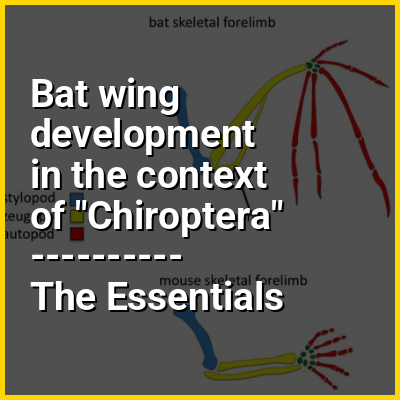
The order Chiroptera, comprising all bats, has evolved the unique mammalian adaptation of flight. Bat wings are modified tetrapod forelimbs. Because bats are mammals, the skeletal structures in their wings are morphologically homologous to the skeletal components found in other tetrapod forelimbs. Through adaptive evolution these structures in bats have undergone many morphological changes, such as webbed digits, elongation of the forelimb, and reduction in bone thickness. Recently, there have been comparative studies of mouse and bat forelimb development to understand the genetic basis of morphological evolution. Consequently, the bat wing is a valuable evo-devo model for studying the evolution of vertebrate limb diversity.
>>>PUT SHARE BUTTONS HERE<<<
👉 Bat wing development in the context of Chiroptera
Bats (order Chiroptera /kaɪˈrɒptərə/) are winged mammals; the only mammals capable of true and sustained flight. Bats are more agile in flight than most birds, flying with their long spread-out digits covered with a thin membrane or patagium. The smallest bat, and one of the smallest extant mammals, is Kitti's hog-nosed bat, which is 29–33 mm (1.1–1.3 in) in length, 150 mm (5.9 in) across the forearm and 2 g (0.071 oz) in mass. The largest bats are the flying foxes, with the giant golden-crowned flying fox (Acerodon jubatus) reaching a weight of 1.5 kg (3.3 lb) and having a wingspan of 1.6 m (5 ft 3 in).
The second largest order of mammals after rodents, bats comprise about 20% of all classified mammal species worldwide, with at least 1,500 known species. These were traditionally divided into two suborders: the largely fruit-eating megabats and the echolocating microbats. But more recent evidence has supported dividing the order into Yinpterochiroptera and Yangochiroptera, with megabats as members of the former along with several species of microbats. Many bats are insectivores, and most of the rest are frugivores (fruit-eaters) or nectarivores (nectar-eaters). A few species feed on animals other than insects; for example, the vampire bats are haematophagous (feeding on blood). Most bats are nocturnal, and many roost in caves or other refuges; it is uncertain whether bats have these behaviours to escape predators. Bats are distributed globally in all except the coldest regions. They are important in their ecosystems for pollinating flowers and dispersing seeds as well as controlling insect populations.
In this Dossier
Bat wing development in the context of Bat
Bats (order Chiroptera /kaɪˈrɒptərə/) are winged mammals; the only mammals capable of true and sustained flight. Bats are more agile in flight than most birds, flying with their long spread-out digits covered with a thin membrane or patagium. The smallest bat, and one of the smallest extant mammals, is Kitti's hog-nosed bat, which is 29–33 mm (1.1–1.3 in) in length, 150 mm (5.9 in) across the forearm and 2 g (0.071 oz) in mass. The largest bats are the flying foxes, with the giant golden-crowned flying fox (Acerodon jubatus) reaching a weight of 1.5 kg (3.3 lb) and having a wingspan of 1.6 m (5 ft 3 in).
The second largest order of mammals after rodents, bats comprise about 20% of all classified mammal species worldwide, with at least 1,500 known species. These were traditionally divided into two suborders: the largely fruit-eating megabats, and the echolocating microbats. But more recent evidence has supported dividing the order into Yinpterochiroptera and Yangochiroptera, with megabats as members of the former along with several species of microbats. Many bats are insectivores, and most of the rest are frugivores (fruit-eaters) or nectarivores (nectar-eaters). A few species feed on animals other than insects; for example, the vampire bats are haematophagous (feeding on blood). Most bats are nocturnal, and many roost in caves or other refuges; it is uncertain whether bats have these behaviours to escape predators. Bats are distributed globally in all except the coldest regions. They are important in their ecosystems for pollinating flowers and dispersing seeds as well as controlling insect populations.
Bat wing development in the context of Homology (biology)
In biology, homology is similarity in anatomical structures or genes between organisms of different taxa due to shared ancestry, regardless of current functional differences. Evolutionary biology explains homologous structures as retained heredity from a common ancestor after having been subjected to adaptive modifications for different purposes as the result of natural selection.
The term was first applied to biology in a non-evolutionary context by the anatomist Richard Owen in 1843. Homology was later explained by Charles Darwin's theory of evolution in 1859, but had been observed before this from Aristotle's biology onwards, and it was explicitly analysed by Pierre Belon in 1555. A common example of homologous structures is the forelimbs of vertebrates, where the wings of bats and birds, the arms of primates, the front flippers of whales, and the forelegs of four-legged vertebrates like horses and crocodilians are all derived from the same ancestral tetrapod structure.