Henri-Joseph Harpignies (French pronunciation: [ɑ̃ʁi ʒozɛf aʁpiɲi]; June 28, 1819 – August 28, 1916) was a French landscape painter of the Barbizon school.

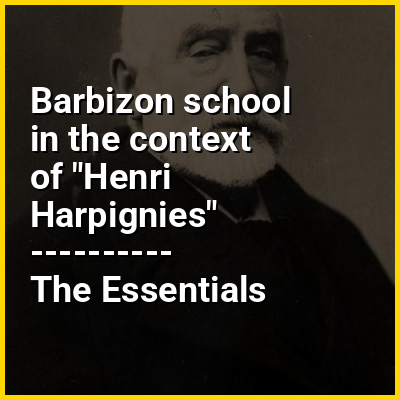
Henri-Joseph Harpignies (French pronunciation: [ɑ̃ʁi ʒozɛf aʁpiɲi]; June 28, 1819 – August 28, 1916) was a French landscape painter of the Barbizon school.
William Morris Hunt (March 31, 1824 – September 8, 1879) was an American painter. Born into the political Hunt family of Vermont, he trained in Paris with the realist Jean-François Millet and studied under him at the Barbizon artists’ colony, before founding a similar group on his return to America. He became Boston's leading portrait and landscape painter, also working as a lithographer and sculptor. In 1871 he was elected to the National Academy of Design as an Associate Academician. Many of his works were destroyed in the Great Boston Fire of 1872. Another disaster was the deterioration of the stone panels in the State Capitol at Albany, New York, on which a number of his murals had been painted. This is believed to have led to his depression and presumed suicide.
John Constable RA (/ˈkʌnstəbəl, ˈkɒn-/; 11 June 1776 – 31 March 1837) was an English landscape painter in the Romantic tradition. Born in Suffolk, he is known principally for revolutionising the genre of landscape painting with his pictures of Dedham Vale, the area surrounding his home – now known as "Constable Country" – which he invested with an intensity of affection. "I should paint my own places best", he wrote to his friend John Fisher in 1821, "painting is but another word for feeling".
Constable's most famous paintings include Wivenhoe Park (1816), Dedham Vale (1828) and The Hay Wain (1821). Although his paintings are now among the most popular and valuable in British art, he was never financially successful. He was elected to the Royal Academy of Arts at the age of 52. His work was embraced in France, where he sold more than in his native England and inspired the Barbizon school.
Charles-François Daubigny (/ˈdoʊbɪnji/ DOH-bin-yee, US: /ˌdoʊbiːnˈjiː, doʊˈbiːnji/ DOH-been-YEE, doh-BEEN-yee, French: [ʃaʁl fʁɑ̃swa dobiɲi]; 15 February 1817 – 19 February 1878) was a French painter, one of the members of the Barbizon school, and is considered an important precursor of impressionism.
He was also a prolific printmaker, mostly in etching, and one of the main artists who used the cliché verre technique.
Étienne Pierre Théodore Rousseau (French pronunciation: [etjɛn pjɛʁ teɔdɔʁ ʁuso]; 15 April 1812 – 22 December 1867) was a French painter of the Barbizon school.
Jules Louis Dupré (French pronunciation: [ʒyl lwi dypʁe]; April 5, 1811 – October 6, 1889) was a French painter, one of the chief members of the Barbizon school of landscape painters.
Constant Troyon (French pronunciation: [kɔ̃stɑ̃ tʁwajɔ̃]; August 28, 1810 – February 21, 1865) was a French painter of the Barbizon school. In the early part of his career, he painted mostly landscapes. It was only comparatively late in life that Troyon found his métier as a painter of animals, and achieved international recognition.
Jean-François Millet (French pronunciation: [ʒɑ̃ fʁɑ̃swa milɛ]; 4 October 1814 – 20 January 1875) was a French artist and one of the founders of the Barbizon school in rural France. Millet is noted for his paintings of peasant farmers and can be categorized as part of the Realism art movement. Toward the end of his career, he became increasingly interested in painting pure landscapes. He is known best for his oil paintings but is also noted for his pastels, Conté crayon drawings, and etchings.
Tonalism was an artistic style that emerged in the 1880s when American artists began to paint landscape forms with an overall tone of colored atmosphere or mist. Between 1880 and 1915, dark, neutral hues such as gray, brown or blue, often dominated compositions by artists associated with the style. During the late 1890s, American art critics began to use the term "tonal" to describe these works, as well as the lesser-known synonyms Quietism and Intimism. Two of the leading associated painters were George Inness and James McNeill Whistler.
Tonalism is sometimes used to describe American landscapes derived from the French Barbizon style, which emphasized mood and shadow. Tonalism was eventually eclipsed by Impressionism and European modernism.
Paul Durand-Ruel (French pronunciation: [pɔl dyʁɑ̃ ʁɥɛl]; 31 October 1831 – 5 February 1922) was a French art dealer associated with the Impressionists and the Barbizon School. Being the first to support artists such as Claude Monet, Camille Pissarro, and Pierre-Auguste Renoir, he is known for his innovations in modernizing art markets, and is generally considered to be the most important art dealer of the 19th century. An ambitious entrepreneur, Durand-Ruel cultivated international interest in French artists by establishing art galleries and exhibitions in London, New York, Berlin, Brussels, among other places. Additionally, he played a role in the decentralization of art markets in France, which prior to the mid-19th century was monopolized by the Salon system.