Bar Kokhba hiding complexes in the context of "Bar Kokhba Revolt"

Play Trivia Questions online!

or

Skip to study material about Bar Kokhba hiding complexes in the context of "Bar Kokhba Revolt"

Ad spacer

⭐ Core Definition: Bar Kokhba hiding complexes

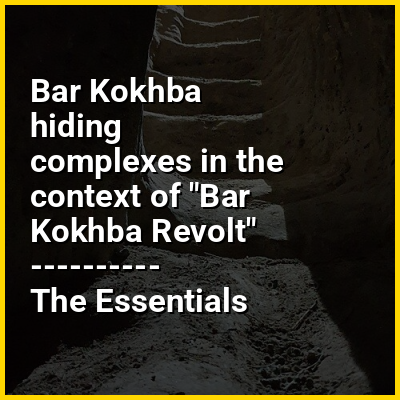
The Bar Kokhba hiding complexes are underground hideout systems built by Jewish rebels and their communities in Judaea and used during the Bar Kokhba revolt (132–136 CE) against the Roman Empire. The hiding complexes are believed to have played a significant role during the revolt, particularly in Judea proper. Functioning as hiding places during times of emergency, these systems facilitated defense strategies and guerrilla warfare tactics. Researchers distinguish among the concealment complexes between those constructed in conjunction with the revolts, which include hiding complexes and cliff shelters, and a different category, the natural refuge caves used as ad hoc hiding places toward the end of the wars.

By 2005 hiding complexes had been identified in over 100 settlements across Judea, mainly concentrated in the Shephelah, Hebron Hills, and Beit El Mountains, with fewer in Galilee. Most of these complexes were strategically located beneath or near homes in settlements. Some were established in preparation for the revolt, while others were built during its course. A few of these structures, though smaller and less intricate, date back even earlier to the First Jewish–Roman War (66–73).
↓ Menu

>>>PUT SHARE BUTTONS HERE<<<
In this Dossier

Bar Kokhba hiding complexes in the context of Bar Kokhba revolt

The Bar Kokhba revolt (132–136 AD), also known as the Bar Kokhba war, the War of Betar, and the Third (or Second) Jewish–Roman War, was the last and most devastating of three major Jewish rebellions against the Roman Empire. The rebels, led by Simon bar Kokhba, succeeded in establishing an independent Jewish state in Judaea that lasted several years. The revolt was ultimately crushed by the Romans, resulting in the near-depopulation of Judea through mass killings, widespread enslavement, and the displacement of much of the Jewish population.

Resentment toward Roman rule in Judaea and nationalistic aspirations remained high following the destruction of Jerusalem and the Second Temple during the First Jewish Revolt in 70 AD. The immediate triggers of the Bar Kokhba revolt included Emperor Hadrian's decision to rebuild Jerusalem as Aelia Capitolina, a Roman colony dedicated to Jupiter, extinguishing hopes for the Temple's reconstruction, as well as a possible ban on circumcision. The rebels used guerrilla tactics and underground hideouts embedded in their villages. Simon bar Kokhba was declared "nasi" (prince) of Israel, and the rebels established a full administration, issuing their own weights and coinage. Contemporary documents celebrated a new era of "the redemption of Israel".

↑ Return to Menu

Bar Kokhba hiding complexes in the context of Bar Kokhba refuge caves

The Bar Kokhba refuge caves are natural caves that were used for shelter by Jewish refugees during the later phases of the Bar Kokhba revolt. Most of the refuge caves were located in the Judaean Desert, nestled within steep cliffs far away from settlements, many overlooking the Dead Sea and the Jordan Valley. Some were also found in ravines flowing into the Dead Sea, while others were nestled within the Judaean Mountains. Unlike the other two hideout systems used by the rebels, the man-made rock-cut hiding complexes, and the hard-to-reach cliff shelters which often contain hewn installations, the refuge caves remained largely untouched by human intervention.

Jews taking shelter in refuge caves aimed to escape the Roman army during its suppression of the revolt. These caves are thought to have offered sanctuary to those in the eastern Judaean Mountains and the Jordan Valley. Some caves show signs of successful refuge, while others contain skeletal remains of adults and children, indicating deaths due to starvation, thirst, or encounters with Roman forces, as evidenced by the construction of siege camps and the discovery of arrowheads embedded in cave ceilings.

↑ Return to Menu