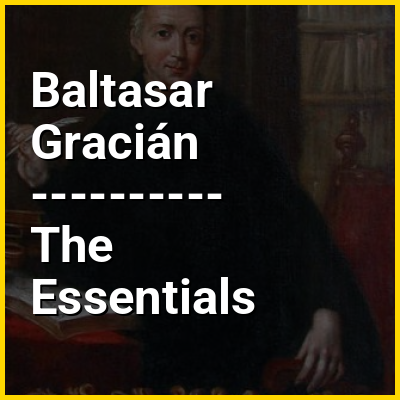
Baltasar Gracián y Morales S.J. (Spanish: [baltaˈsaɾ ɣɾaˈθjan]; 8 January 1601 – 6 December 1658), better known as Baltasar Gracián, was a Spanish Jesuit priest and Baroque prose writer and philosopher. He was born in Belmonte, near Calatayud (Aragón). His writings were lauded by Schopenhauer and Nietzsche.He is best known for his book The Art of Worldly Wisdom (1647), but his novel El Criticón (1651-57) is considered his greatest work.
HINT:
👉 Baltasar Gracián in the context of Conceptismo
Conceptismo (literally, conceptism) is a literary movement of the Baroque period in the Spanish literature. It began in the late 16th century and lasted through the 17th century, also the period of the Spanish Golden Age.
Conceptismo is characterized by a rapid rhythm, directness, simple vocabulary, witty metaphors, and wordplay. In this style, multiple meanings are conveyed in a very concise manner, and conceptual intricacies are emphasised over elaborate vocabulary.
In this Dossier
- ⭐ Core Definition: Baltasar Gracián
- 👉 Baltasar Gracián in the context of Conceptismo
- Baltasar Gracián in the context of Spanish Baroque literature
- Baltasar Gracián in the context of El Criticón
Baltasar Gracián in the context of Spanish Baroque literature
Spanish Baroque literature is the literature written in Spain during the Baroque, which occurred during the 17th century in which prose writers such as Baltasar Gracián and Francisco de Quevedo, playwrights such as Lope de Vega, Tirso de Molina, Calderón de la Barca and Juan Ruiz de Alarcón, or the poetic production of the aforementioned Francisco de Quevedo, Lope de Vega and Luis de Góngora reached their zenith. Spanish Baroque literature is a period of writing which begins approximately with the first works of Luis de Góngora and Lope de Vega, in the 1580s, and continues into the late 17th century.
The fundamental characteristics of Spanish Baroque literature are the progressive complexity in formal resources and a theme centered on the concern for the passage of time and the loss of confidence in the Neoplatonic ideals of the Renaissance. Likewise, the variety and diversity in the subjects dealt with, the attention to detail and the desire to attract a wide audience, of which the rise of the Lope de Vega comedies are an example. From the dominant sensual concern in the 16th century, there was an emphasis on moral values and didactics, where two currents converge: Neostoicism and Neoepicureism. El Criticón from Baltasar Gracián is a point of arrival in the baroque reflection on man and the world, the awareness of disappointment, a vital pessimism and a general crisis of values.
View the full Wikipedia page for Spanish Baroque literatureBaltasar Gracián in the context of El Criticón
El Criticón is a Spanish novel by Baltasar Gracián. It was published in three parts in the years 1651, 1653 and 1657. It is considered his greatest work and one of the most influential works in Spanish literature, along with Don Quixote and La Celestina. El Criticón collects and expands his previous works.
The work takes the form of an allegory covering the life of Andrenio, representing two facets of his life: his impulsiveness and lack of experience. It outlines the philosophical vision of Gracián's world in the form of an epic tale.
View the full Wikipedia page for El Criticón