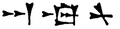
Babylonian cuneiform in the context of "Ennigaldi-Nanna"

Play Trivia Questions online!

or

Skip to study material about Babylonian cuneiform in the context of "Ennigaldi-Nanna"

Ad spacer

⭐ Core Definition: Babylonian cuneiform

Cuneiform is a logo-syllabic writing system that was used to write several languages of the ancient Near East. The script was in active use from the early Bronze Age until the beginning of the Common Era. Cuneiform scripts are marked by and named for the characteristic wedge-shaped impressions (Latin: cuneus) which form their signs. Cuneiform is the earliest known writing system and was originally developed to write the Sumerian language of southern Mesopotamia (modern Iraq).

Over the course of its history, cuneiform was adapted to write a number of languages in addition to Sumerian. Akkadian texts are attested from the 24th century BC onward and make up the bulk of the cuneiform record. Akkadian cuneiform was itself adapted to write the Hittite language in the early 2nd millennium BC. The other languages with significant cuneiform corpora are Eblaite, Elamite, Hurrian, Luwian, and Urartian. The Old Persian and Ugaritic alphabets feature cuneiform-style signs; however, they are unrelated to the cuneiform logo-syllabary proper. The latest known cuneiform tablet, an astronomical almanac from Uruk, dates to AD 79/80.

↓ Menu

>>>PUT SHARE BUTTONS HERE<<<

👉 Babylonian cuneiform in the context of Ennigaldi-Nanna

Ennigaldi-Nanna (Babylonian cuneiform: En-nígaldi-Nanna), also known as Bel-Shalti-Nanna and commonly called just Ennigaldi, was a princess of the Neo-Babylonian Empire and high priestess (entu) of Ur. As the first entu in six centuries, serving as the "human wife" of the moon-god Sin, Ennigaldi held large religious and political power. She is most famous today for founding a museum in Ur c. 530 BC. Ennigaldi's museum showcased, cataloged, and labelled artifacts from the preceding 1,500 years of Mesopotamian history and is often considered to have been the first museum in world history.

↓ Explore More Topics
In this Dossier

Babylonian cuneiform in the context of Nebuchadnezzar (governor of Uruk)

Nebuchadnezzar (Babylonian cuneiform: Nabû-kudurri-uṣur, meaning "Nabu, watch over my heir"), also spelled Nebuchadrezzar, and most commonly known under the nickname Kudurru, was a governor of the city Uruk in Babylonia under the rule of Ashurbanipal (r.669–631 BC) of the Neo-Assyrian Empire, appointed after the defeat of Shamash-shum-ukin of Babylon, Ashurbanipal's brother who had rebelled against Assyria, c. 648 BC. He was likely the son of the high priest Nabonassar.

In the reign of Ashurbanipal's son Sinsharishkun (r.627–612 BC), the grave of Nebuchadnezzar was desecrated, with the perpetrators going so far as dragging his body through the streets of Uruk. This was done as a response to the anti-Assyrian activities of his two sons. In 2007, Assyriologist Michael Jursa identified Nebuchadnezzar as the father of Nabopolassar, the founder of the Neo-Babylonian Empire, who rebelled against Sinsharishkun in 626 BC (this being the anti-Assyrian activities). If Nabopolassar was his son, Nabopolassar would go on to name his own son, Nebuchadnezzar II, after his father.

↑ Return to Menu

Babylonian cuneiform in the context of Neriglissar

Neriglissar (Babylonian cuneiform:   Nergal-šar-uṣur or Nergal-šarra-uṣur, meaning "Nergal, protect the king") was the fourth king of the Neo-Babylonian Empire, ruling from his usurpation of the throne in 560 BC to his death in 556 BC. Though unrelated to previous Babylonian kings, possibly being of Aramean ancestry, Neriglissar was a prominent official and general in the reign of Nebuchadnezzar II (r.605–562 BC) and became even more influential through marrying one of Nebuchadnezzar's daughters, possibly Kashshaya.

Nebuchadnezzar was initially succeeded by his son, Amel-Marduk, but Amel-Marduk's reign only lasted for two years before Neriglissar usurped the Babylonian throne and put him to death. Through his marriage to Nebuchadnezzar's daughter, possibly significantly older than any of the old king's sons, Neriglissar might have represented a less legitimate but more wealthy and well-established faction of the royal family, even if he himself was not part of this family.

↑ Return to Menu

Babylonian cuneiform in the context of Belshazzar

Belshazzar (Babylonian cuneiform:   Bēl-šar-uṣur, meaning "Bel, protect the king"; Hebrew: בֵּלְשַׁאצַּר Bēlšaʾṣṣar) was the son and crown prince of Nabonidus (r. 556 – 539 BC), the last king of the Neo-Babylonian Empire. Through his mother, he might have been a grandson of Nebuchadnezzar II (r. 605 – 562 BC), though this is not certain and the claims to kinship with Nebuchadnezzar may have originated from royal propaganda.

Belshazzar played a pivotal role in the coup d'état that overthrew the king Labashi-Marduk (r. 556 BC– ) and brought Nabonidus to power in 556 BC. Since Belshazzar was the main beneficiary of the coup, through confiscating and inheriting Labashi-Marduk's estates and wealth, it is likely that he was the chief orchestrator. Through proclaiming his father as the new king, Belshazzar also made himself the first-in-line to the throne. As Nabonidus was relatively old at the time, Belshazzar could expect to become king within a few years.

↑ Return to Menu

Babylonian cuneiform in the context of Nabonassar (7th century BC)

Nabonassar (Babylonian cuneiform: Nabû-nāṣir, meaning "Nabu (is) protector") was a high priest (šatammu) of the Eanna temple in Uruk in the reign of the Neo-Assyrian king Esarhaddon (r.681–669 BC), attested as such from 678 to 675 BC. He is very likely to have been the father of Nebuchadnezzar, governor of Uruk under Esarhaddon's successor Ashurbanipal (r.669–631 BC), and the grandfather of Nabopolassar (r.626–605 BC), the first king of the Neo-Babylonian Empire, making Nabonassar the progenitor of the Chaldean dynasty of Babylonian kings.

In addition to Nebuchadnezzar, it is probable that Nabonassar was also the father of Bēl-uballiṭ, who is recorded as high priest of the same temple in 642 BC, and of Bel-uballit's colleague and brother, Nabu-ušabši.

↑ Return to Menu