Austrian Littoral in the context of "Julian March"

Play Trivia Questions online!

or

Skip to study material about Austrian Littoral in the context of "Julian March"


⭐ Core Definition: Austrian Littoral

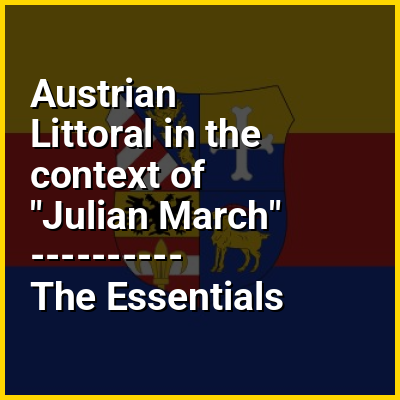
The Austrian Littoral (German: Österreichisches Küstenland, Italian: Litorale Austriaco, Croatian: Austrijsko primorje, Slovene: Avstrijsko primorje, Hungarian: Osztrák Tengermellék) was a crown land (Kronland) of the Austrian Empire, established in 1849. It consisted of three regions: the Margraviate of Istria in the south, Gorizia and Gradisca in the north, and the Imperial Free City of Trieste in the middle. The region has been contested frequently, with parts of it controlled at various times by the Republic of Venice, Austria-Hungary, Italy, and Yugoslavia among others.

The Kingdom of Italy annexed most of the area after World War I according to the Treaty of London and later the Treaty of Rapallo. After World War II it was split, with Italy in the west and Yugoslavia in the east.
↓ Menu

👉 Austrian Littoral in the context of Julian March

The Julian March (Croatian and Slovene: Julijska krajina), also called Julian Venetia (Italian: Venezia Giulia; Venetian: Venesia Julia; Friulian: Vignesie Julie; Austrian German: Julisch Venetien), is an area of southern Central Europe which is currently divided among Croatia, Italy, and Slovenia. The term was coined in 1863 by the Italian linguist Graziadio Isaia Ascoli, a native of the area, to demonstrate that the Austrian Littoral, Veneto, Friuli, and Trentino (then all part of the Austrian Empire) shared a common Italian linguistic identity. Ascoli emphasized the Augustan partition of Roman Italy at the beginning of the Empire, when Venetia et Histria was Regio X (the Tenth Region).

The term was later endorsed by Italian irredentists, who sought to annex regions in which ethnic Italians made up most (or a substantial portion) of the population: the Austrian Littoral, Trentino, Fiume and Dalmatia. The Triple Entente promised the regions to Italy in the dissolution of the Austro-Hungarian Empire in exchange for Italy's joining the Allied Powers in World War I. The secret 1915 Treaty of London promised Italy territories largely inhabited by Italians (such as Trentino) in addition to those largely inhabited by Croats or Slovenes; the territories housed 421,444 Italians, and about 327,000 ethnic Slovenes.

↓ Explore More Topics
In this Dossier

Austrian Littoral in the context of Slovene Littoral

The Slovene Littoral, or simply Littoral (Slovene: Primorska, pronounced [pɾiˈmóːɾska] ; Italian: Litorale; German: Küstenland), is one of the traditional regions of Slovenia. The littoral in its name – for a coastal-adjacent area – recalls the former Austrian Littoral (Avstrijsko Primorje), the Habsburg possessions on the upper Adriatic coast, of which the Slovene Littoral was part. Today, the Littoral is often associated with the Slovenian ethnic territory that, in the first half of the 20th century, found itself in Italy to the west of the Rapallo Border, which separated a quarter of Slovenes from the rest of the nation, and was strongly influenced by Italian fascism.

↑ Return to Menu

Austrian Littoral in the context of Mutilated victory

Mutilated victory (Italian: vittoria mutilata) is a term coined by Gabriele D'Annunzio at the end of World War I, used by a part of Italian nationalists to denounce the partial infringement (and request the full application) of the 1915 Treaty of London concerning territorial rewards for Kingdom of Italy.

In the 1915 treaty, Italy had agreed to join the powers of the Triple Entente in their war against Austria-Hungary and the German Empire in exchange for the Entente powers’ recognition of Italy’s control over Southern Tyrol, the Austrian Littoral and territories in Dalmatia. These lands were inhabited by Italians—alongside Austrian Germans (Tyroleans) and Slavs (Slovenes and Croats)—but had not become part of the Kingdom upon Italian unification in the late 19th century. Additionally, Italy was assured ownership of the Dodecanese, possessions in Albania, and a sphere of influence around the Turkish city of Antalya, alongside a possible enlargement of its colonial presence in Africa.

↑ Return to Menu

Austrian Littoral in the context of Portorož

Portorož (pronounced [pɔɾtɔˈɾóːʃ] ; Italian: Portorose) is a Slovenian Adriatic seaside resort and spa settlement located in the Municipality of Piran in southwestern Slovenia. Its modern development began in the late 19th century with the vogue for the first health resorts. In the early 20th century Portorož became one of the grandest seaside resorts in the Adriatic, along with Opatija, Lido and Grado, then as part of the Austrian Littoral. It is now one of Slovenia's major tourist areas. Located in the centre is the Palace Hotel, once one of the most important resorts for the Austro-Hungarian monarchy, and currently one of the finest hotels between Venice and Dubrovnik.

The settlement and its surrounding areas are served by Portorož International Airport which is located in the nearby village of Sečovlje.

↑ Return to Menu

Austrian Littoral in the context of Inner Austria

Inner Austria (German: Innerösterreich; Slovene: Notranja Avstrija; Italian: Austria Interiore) was a term used from the late 14th to the early 17th century for the Habsburg hereditary lands south of the Semmering Pass, referring to the Imperial duchies of Styria, Carinthia and Carniola and the lands of the Austrian Littoral. The residence of the Inner Austrian archdukes and stadtholders was at the Burg castle complex in Graz.

↑ Return to Menu

Austrian Littoral in the context of Kingdom of Illyria

The Kingdom of Illyria was a titular crown land of the Austrian Empire from 1816 to 1849, the successor state of the Napoleonic Illyrian Provinces, which were reconquered by Austria in the War of the Sixth Coalition. It was established according to the Final Act of the Vienna Congress. Its administrative centre was in Ljubljana (officially German: Laibach)

Upon the Revolutions of 1848, the kingdom was dissolved and split into the Austrian crown lands of Carniola, Carinthia, and the Austrian Littoral.

↑ Return to Menu

Austrian Littoral in the context of Battle of Caporetto

The Battle of Caporetto (also known as the Twelfth Battle of the Isonzo, the Battle of Kobarid or the Battle of Karfreit) took place on the Isonzo front of World War I.

The battle was fought between the Kingdom of Italy and the Central Powers and took place from 24 October to 19 November 1917, near the town of Kobarid (now in north-western Slovenia, then part of the Austrian Littoral), and near the river Isonzo. The battle was named after the Italian name of the town (also known as Karfreit in German).

↑ Return to Menu

Austrian Littoral in the context of Italian Front (World War I)

The Italian front (Italian: Fronte italiano; German: Südwestfront) was one of the main theatres of war of World War I. It involved a series of military engagements along the border between the Kingdom of Italy and Austria-Hungary from 1915 to 1918. Following secret promises made by the Entente in the 1915 Treaty of London, the Kingdom of Italy entered the war on the Entente side, aiming to annex the Austrian Littoral, northern Dalmatia and the territories of present-day Trentino and South Tyrol. The front soon bogged down into trench warfare, similar to that on the Western Front, but at high altitudes and with extremely cold winters. Fighting along the front displaced much of the local population, and several thousand civilians died from malnutrition and illness in Kingdom of Italy and Austro-Hungarian refugee camps.

Military operations came to an end in 1918 with Italian victory and the capture of Trento and Trieste by the Royal Italian Army. Austria-Hungary disintegrated due to military defeats and subsequent turmoils caused by pacifists and separatists. All military operations on the front came to an end with the entry into force of the armistice of Villa Giusti on 4 November 1918. Italy entered into World War I also with the aim of completing national unity with the annexation of Trentino-Alto Adige and the Julian March; for this reason, the Italian intervention in the World War I is also considered the Fourth Italian War of Independence, in a historiographical perspective that identifies in the latter the conclusion of the unification of Italy, whose military actions began during the revolutions of 1848 with the First Italian War of Independence.

↑ Return to Menu