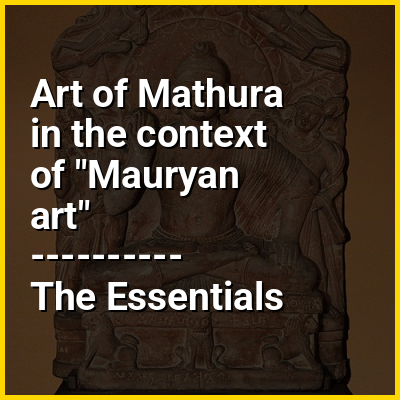
The Art of Mathura refers to a particular school of Indian art, almost entirely surviving in the form of sculpture, starting in the 2nd century BCE, which centered on the city of Mathura, in central northern India, during a period in which Buddhism, Jainism together with Hinduism flourished in India. Mathura "was the first artistic center to produce devotional icons for all the three faiths", and the pre-eminent center of religious artistic expression in India at least until the Gupta period, and was influential throughout the sub-continent.
Chronologically, Mathuran sculpture becomes prominent after Mauryan art, the art of the Mauryan Empire (322 and 185 BCE). It is said to represent a "sharp break" with the previous Mauryan style, either in scale, material or style. Mathura became India's most important artistic production center from the second century BCE, with its highly recognizable red sandstone statues being admired and exported all over India. In particular, it was in Mathura that the distinctive Indian convention of giving sacred figures multiple body parts, especially heads and arms, first became common in art around the 4th century CE, initially exclusively in Hindu figures, as it derived from Vedic texts.