Art of Indonesia in the context of "Wayang beber"

Play Trivia Questions online!

or

Skip to study material about Art of Indonesia in the context of "Wayang beber"

Ad spacer

⭐ Core Definition: Art of Indonesia

It is quite difficult to define Indonesian art, since the country is immensely diverse. The sprawling archipelago nation consists of 17,000 islands. Around 922 of those permanently inhabited, by over 600 ethnic groups, which speak more than 700 living languages.

Indonesia also has experienced a long history, with each period leaves distinctive art. From prehistoric cave paintings and megalithic ancestral statues of Central Sulawesi, tribal wooden carving traditions of Toraja and Asmat people, graceful Hindu-Buddhist art of classical Javanese civilization which produced Borobudur and Prambanan, vivid Balinese paintings and performing arts, Islamic arts of Aceh, to contemporary arts of modern Indonesian artists. Both Indonesian diversity and history add to the complexity of defining and identifying what is Indonesian art.
↓ Menu

>>>PUT SHARE BUTTONS HERE<<<

👉 Art of Indonesia in the context of Wayang beber

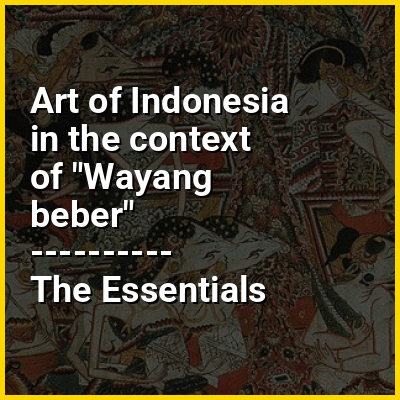
Wayang beber (Javanese: ꦮꦪꦁꦧꦺꦧꦺꦂ, romanized: wayang bèbèr (in the ngoko register)) is an Indonesian wayang performance art whose presentation is manifested on stretched sheets of paper or cloth, with pictures in the stylized wayang accompanied by a narration by a dalang. Wayang beber performances emerged and developed in Java in pre-Islamic times but continued into the Islamic kingdoms (such as the Sultanate of Mataram). The stories shown are taken from the Mahabharata and the Ramayana. After Islam became the main religion in Java, more Panji tales were performed. Wayang beber bears a strong resemblance to narrative in the form of pictorial ballads common at annual fairs in medieval and early modern Europe. They too suffered the same fate—nearly becoming extinct, although there are still groups of artists who support wayang beber in places like Surakarta (Solo) in Central Java.

↓ Explore More Topics
In this Dossier