Arrest of Jesus in the context of "Kiss of Judas"

Play Trivia Questions online!

or

Skip to study material about Arrest of Jesus in the context of "Kiss of Judas"

Ad spacer

⭐ Core Definition: Arrest of Jesus

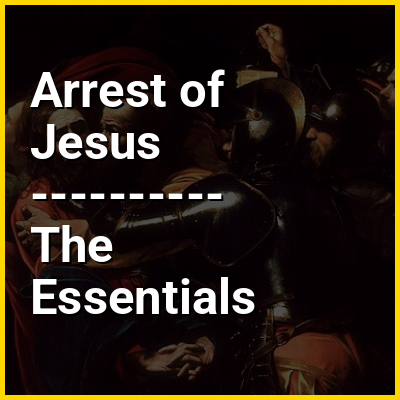
The arrest of Jesus was a pivotal event in Christianity recorded in the canonical gospels. It occurred shortly after the Last Supper (during which Jesus gave his final sermon), and immediately after the kiss of Judas, which is traditionally said to have been an act of betrayal since Judas made a deal with the chief priests to arrest Jesus. The event ultimately led, in the Gospel accounts, to Jesus's crucifixion.

The arrest led immediately to his trial before the Sanhedrin, during which they condemned him to death and handed him to Pontius Pilate the following morning. In Christian theology, the events from the Last Supper until the crucifixion and resurrection of Jesus are referred to as the Passion.

↓ Menu

>>>PUT SHARE BUTTONS HERE<<<

👉 Arrest of Jesus in the context of Kiss of Judas

The kiss of Judas, also known as the Betrayal of Christ, is the act with which Judas identified Jesus to the multitude with swords and clubs who had come from the chief priests and elders of the people to arrest him, according to the Synoptic Gospels. The kiss is given by Judas in the Garden of Gethsemane after the Last Supper and leads directly to the arrest of Jesus by the police force of the Sanhedrin.

Within the life of Jesus in the New Testament, the events of his identification to hostile forces and subsequent execution are directly foreshadowed both when Jesus predicts his betrayal and Jesus predicts his death.

↓ Explore More Topics
In this Dossier

Arrest of Jesus in the context of Crucifixion of Jesus

Jesus was put to death by being nailed on an execution device made by the Romans, commonly named as a cross (Latin: crux). The instrument of crucifixion is taken to be an upright wooden beam to which was added a transverse wooden beam, thus forming a "cruciform" or T-shaped structure. His crucifixion occurred in 1st-century Judaea, most likely in AD 30 or AD 33. The event is described in the four canonical gospels, referred to in the New Testament epistles, and later attested to by other ancient sources. Scholars nearly universally accept the historicity of Jesus' crucifixion, although there is no consensus on the details. According to the canonical gospels, Jesus was arrested and tried by the Sanhedrin, and then sentenced by Pontius Pilate to be scourged, and finally crucified by the Romans.

Jesus was stripped of his clothing and offered vinegar mixed with myrrh or gall (likely posca) to drink. At Golgotha, he was then hung between two convicted thieves and, according to the Gospel of Mark, was crucified at the third hour (9 a.m.), and died by the ninth hour of the day (at around 3:00 p.m.). During this time, the soldiers affixed a sign to the top of the cross stating "Jesus of Nazareth, King of the Jews" which, according to the Gospel of John, was written in three languages (Hebrew, Latin, and Greek). They then divided his garments among themselves and cast lots for his seamless robe, according to the Gospel of John. The Gospel of John also states that, after Jesus' death, one soldier (named in extra-Biblical tradition as Longinus) pierced his side with a spear to be certain that he had died, then blood and water gushed from the wound. The Bible describes seven statements that Jesus made while he was on the cross, as well as several supernatural events that occurred.
↑ Return to Menu

Arrest of Jesus in the context of Passion of Jesus

The Passion (from Latin patior, "to suffer, bear, endure") is the short final period before the death of Jesus, described in the four canonical gospels. It is commemorated in Christianity every year during Holy Week.

The Passion may include, among other events, Jesus's triumphal entry into Jerusalem, his cleansing of the Temple, his anointing, the Last Supper, his agony, his arrest, his trial before the Sanhedrin and his trial before Pontius Pilate, his crucifixion and death, and his burial. Those parts of the four canonical Gospels that describe these events are known as the Passion narratives. In some Christian communities, commemoration of the Passion also includes remembrance of the sorrow of Mary, the mother of Jesus, on the Friday of Sorrows.

↑ Return to Menu

Arrest of Jesus in the context of Sanhedrin trial of Jesus

In the New Testament, the Sanhedrin trial of Jesus refers to the trial of Jesus before the Sanhedrin (a Jewish judicial body) following his arrest in Jerusalem and prior to the trial before Pontius Pilate. It is an incident reported by all three Synoptic Gospels of the New Testament, while the Gospel of John refers to a preliminary inquiry before Annas. The gospel accounts vary on a number of details.

Jesus is generally quiet, does not defend himself, rarely responds to the accusations, and is found guilty of: violating the Sabbath law (by healing on the Sabbath); threatening to destroy the Jewish Temple; practicing sorcery, exorcising people by the power of demons; blasphemy; and claiming to be the Messiah. He is then taken to Pontius Pilate, the governor of Roman Judaea, to be tried for claiming to be the King of the Jews.

↑ Return to Menu

Arrest of Jesus in the context of Agony in the Garden

The Agony in the Garden of Gethsemane is an episode in the life of Jesus, which occurred after the Last Supper and before his betrayal and arrest, all part of the Passion of Jesus leading to his crucifixion and death. This episode is described in the three Synoptic Gospels in the New Testament. According to these accounts, Jesus, accompanied by Peter, John and James, enters the garden of Gethsemane on the Mount of Olives where he experiences great anguish and prays to be delivered from his impending suffering, while also accepting God's will.

This episode is a significant event in Christian tradition, especially in Catholic devotional practices. The agony of Jesus in the Garden is the first (or second) station of the Scriptural Way of the Cross (modern version of the Via Crucis) and the first "sorrowful mystery" of the Dominican Rosary, and it is the inspiration for the Holy Hour devotion in the Eucharistic adoration. It has been a frequent theme in Christian art depicting the life of Jesus.

↑ Return to Menu

Arrest of Jesus in the context of Luke 22

Luke 22 is the twenty-second chapter of the Gospel of Luke in the New Testament of the Christian Bible. It commences in the days just before the Passover or Feast of Unleavened Bread, and records the plot to kill Jesus Christ; the institution of the Lord's Supper; the arrest of Jesus; and his trial before the Sanhedrin.

The book containing this chapter is anonymous, but early Christian tradition generally considers that Luke the Evangelist composed this Gospel as well as the Acts of the Apostles. This chapter initiates this gospel's passion narrative, which continues into chapter 23: while the apocalyptic discourse in Luke 21 "bases all its thought upon the reality of the Kingdom", it also "leads directly into the passion narrative, [which] shows how it was established".

↑ Return to Menu

Arrest of Jesus in the context of Garden of Gethsemane

31°46′46″N 35°14′25″E / 31.779402°N 35.240197°E / 31.779402; 35.240197

Gethsemane (/ɡɛθˈsɛməni/ gheth-SEM-ə-nee) is a garden at the foot of the Mount of Olives in East Jerusalem, where, according to the four Gospels of the New Testament, Jesus Christ underwent the Agony in the Garden and was arrested before his crucifixion. The garden is a place of great resonance in Christianity. There are several small olive groves in church property, all adjacent to each other and identified with biblical Gethsemane.
Cite error: There are <ref group=lower-alpha> tags or {{efn}} templates on this page, but the references will not show without a {{reflist|group=lower-alpha}} template or {{notelist}} template (see the help page).

↑ Return to Menu

Arrest of Jesus in the context of Denial of Peter

The Denial of Peter (or Peter's Denial) refers to three acts of denial of Jesus by the Apostle Peter as described in all four Gospels of the New Testament.

All four Canonical Gospels state that during Jesus's Last Supper with his disciples, he predicted that Peter would deny knowledge of him, stating that Peter would disown him before the rooster crowed the next morning. Following the arrest of Jesus, Peter denied knowing him three times, but after the third denial, he heard the rooster crow and recalled the prediction as Jesus turned to look at him. Peter then began to cry bitterly. This final incident is known as the Repentance of Peter.

↑ Return to Menu