Arkansas Delta in the context of "Crowley's Ridge"

Play Trivia Questions online!

or

Skip to study material about Arkansas Delta in the context of "Crowley's Ridge"


⭐ Core Definition: Arkansas Delta

The Arkansas Delta is one of the six natural regions of the state of Arkansas. Willard B. Gatewood Jr., author of The Arkansas Delta: Land of Paradox, says that rich cotton lands of the Arkansas Delta make that area "The Deepest of the Deep South."

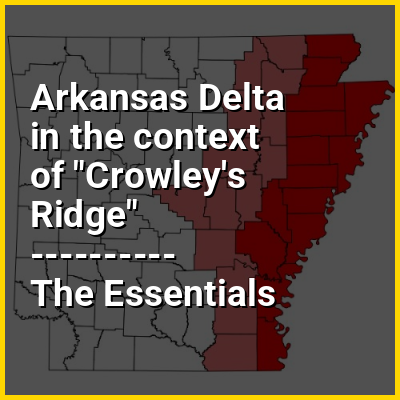
The region runs along the Mississippi River from Eudora north to Blytheville and as far west as Little Rock. It is part of the Mississippi embayment, itself part of the Mississippi River Alluvial Plain. The flat plain is bisected by Crowley's Ridge, a narrow band of rolling hills rising 250 to 500 feet (76 to 152 m) above the flat delta plains. Several towns and cities have been developed along Crowley's Ridge, including Jonesboro. The region's lower western border follows the Arkansas River just outside Little Rock down through Pine Bluff. There the border shifts to Bayou Bartholomew, stretching south to the Arkansas-Louisiana state line.

↓ Menu

In this Dossier

Arkansas Delta in the context of Arkansas

Arkansas (/ˈɑːrkənsɔː/ AR-kən-saw) is a landlocked state in the West South Central region of the Southern United States. It borders Missouri to the north, Tennessee and Mississippi to the east, Louisiana to the south, Texas to the southwest, and Oklahoma to the west. Its name derives from the Osage language, and refers to their relatives, the Quapaw people. The state's diverse geography ranges from the mountainous regions of the Ozark and Ouachita Mountains, which make up the U.S. Interior Highlands, to the densely forested land in the south known as the Arkansas Timberlands, to the eastern lowlands along the Mississippi River and the Arkansas Delta.

Previously part of French Louisiana and the Louisiana Purchase, the Territory of Arkansas was admitted to the Union as the 25th state on June 15, 1836. Much of the Delta had been developed for cotton plantations, and landowners there largely depended on enslaved African Americans' labor. In 1861, Arkansas seceded from the United States and joined the Confederate States of America during the American Civil War. On returning to the Union in 1868, Arkansas continued to suffer economically, due to its overreliance on the large-scale plantation economy. Cotton remained the leading commodity crop, and the cotton market declined. Because farmers and businessmen did not diversify and there was little industrial investment, the state fell behind in economic opportunity. In the late 19th century, the state instituted various Jim Crow laws to disenfranchise and segregate the African-American population. White interests dominated Arkansas's politics, with disenfranchisement of African Americans and refusal to reapportion the legislature; only after the federal legislation passed were more African Americans able to vote. During the civil rights movement of the 1950s and 1960s, Arkansas and particularly Little Rock were major battlegrounds for efforts to integrate schools. Following World War II in the 1940s, Arkansas began to diversify its economy and see prosperity. During the 1960s, the state became the base of the Walmart corporation, the world's largest company by revenue, headquartered in Bentonville.

↑ Return to Menu

Arkansas Delta in the context of Deep South

The Deep South or the Lower South is a cultural and geographic subregion of the Southern United States. The term is used to describe the states which were most economically dependent on plantations and slavery, generally Louisiana, Mississippi, Alabama, Georgia, and South Carolina. East Texas, North Florida, the Arkansas Delta, South Arkansas, West Tennessee, and the southern part of North Carolina are sometimes included as well. Following the end of the American Civil War in 1865, the region experienced significant economic hardship and became a focal point of racial tension during and after the Reconstruction era.

Before 1945, the Deep South was often referred to as the "Cotton States" since cotton was the primary cash crop for economic production. The civil rights movement in the 1950s and 1960s helped usher in a new era, sometimes referred to as the New South. The Deep South is part of the highly religious, socially conservative Bible Belt and currently is politically a stronghold of the Republican Party, after historically being one for the Democratic Party.

↑ Return to Menu

Arkansas Delta in the context of Paragould, Arkansas

Paragould is a city in and the county seat of Greene County, and the 15th-largest city in Arkansas, in the United States. The city is located in northeastern Arkansas on the eastern edge of Crowley's Ridge, a geologic anomaly contained within the Arkansas Delta.

Paragould is the principal city of the Paragould, Arkansas Micropolitan Statistical Area and is also a part of the Jonesboro-Paragould Combined Statistical Area. The population of Paragould was 29,537 as of the 2020 Census, compared to 26,113 at the 2010 census.

↑ Return to Menu

Arkansas Delta in the context of Arkansas Timberlands

The Arkansas Timberlands (sometimes also called Southern Arkansas or Southwest Arkansas) is a region of the U.S. state of Arkansas generally encompassing the area south of the Ouachita Mountains, south of Central Arkansas and west of the Arkansas Delta. With several different definitions in use by various state agencies, the Arkansas Timberlands is essentially a region known for dense pine and cypress forests covering hilly terrain and lining numerous rivers. Modern settlement created a significant logging industry and subsequent clearance agriculture which provided the basis of the local economy until the discovery of petroleum. Local tourism is largely based on the popularity of deer hunting and bass fishing. Attractions there include Marks' Mills Battleground Historical Monument, Jenkins' Ferry Battleground Historical Monument, Overflow National Wildlife Refuge, Felsenthal National Wildlife Refuge, South Arkansas Arboretum, Arkansas Museum of Natural Resources, White Oak Lake State Park, Poison Springs Battleground State Park, Millwood State Park, and Pond Creek National Wildlife Refuge. The Arkansas Timberlands is the birthplace of former president of the United States Bill Clinton.

↑ Return to Menu

Arkansas Delta in the context of South Arkansas

South Arkansas lies within the southernmost portions of Arkansas Gulf Coastal Plain and Delta regions. It encompasses the lower 15 counties of the state.

↑ Return to Menu

Arkansas Delta in the context of Osceola, Arkansas

Osceola is a city in and a dual county seat of Mississippi County, Arkansas, United States. Located along the Mississippi River within the Arkansas Delta, the settlement was founded in 1837 and incorporated in 1853. Occupying an important location on the river, the city's economy grew as steamboat traffic increased. Timber and cotton harvesting would develop, and the city experienced rapid growth and development throughout the early 20th century. The city's economy has since diversified to include a robust industrial sector. The population was 6,976 at the 2020 census, down from 7,757 in 2010.

↑ Return to Menu