Area of a triangle in the context of Coordinates


Area of a triangle in the context of Coordinates

Area of a triangle Study page number 1 of 1

Play TriviaQuestions Online!

or

Skip to study material about Area of a triangle in the context of "Coordinates"


⭐ Core Definition: Area of a triangle

In geometry, calculating the area of a triangle is an elementary problem encountered often in many different situations. The best known and simplest formula is where b is the length of the base of the triangle, and h is the height or altitude of the triangle. The term "base" denotes any side, and "height" denotes the length of a perpendicular from the vertex opposite the base onto the line containing the base. Euclid proved that the area of a triangle is half that of a parallelogram with the same base and height in his book Elements in 300 BCE. In 499 CE Aryabhata, used this illustrated method in the Aryabhatiya (section 2.6).

Although simple, this formula is only useful if the height can be readily found, which is not always the case. For example, the land surveyor of a triangular field might find it relatively easy to measure the length of each side, but relatively difficult to construct a 'height'. Various methods may be used in practice, depending on what is known about the triangle. Other frequently used formulas for the area of a triangle use trigonometry, side lengths (Heron's formula), vectors, coordinates, line integrals, Pick's theorem, or other properties.

↓ Menu
HINT:

In this Dossier

Area of a triangle in the context of Triangular

A triangle is a polygon with three corners and three sides, one of the basic shapes in geometry. The corners, also called vertices, are zero-dimensional points while the sides connecting them, also called edges, are one-dimensional line segments. A triangle has three internal angles, each one bounded by a pair of adjacent edges; the sum of angles of a triangle always equals a straight angle (180 degrees or π radians). The triangle is a plane figure and its interior is a planar region. Sometimes an arbitrary edge is chosen to be the base, in which case the opposite vertex is called the apex; the shortest segment between the base and apex is the height. The area of a triangle equals one-half the product of height and base length.

In Euclidean geometry, any two points determine a unique line segment situated within a unique straight line, and any three points that do not all lie on the same straight line determine a unique triangle situated within a unique flat plane. More generally, four points in three-dimensional Euclidean space determine a solid figure called tetrahedron.

View the full Wikipedia page for Triangular
↑ Return to Menu

Area of a triangle in the context of Height (triangle)

In geometry, an altitude of a triangle is a line segment through a given vertex (called apex) and perpendicular to a line containing the side or edge opposite the apex. This (finite) edge and (infinite) line extension are called, respectively, the base and extended base of the altitude. The point at the intersection of the extended base and the altitude is called the foot of the altitude. The length of the altitude, often simply called "the altitude" or "height", symbol h, is the distance between the foot and the apex. The process of drawing the altitude from a vertex to the foot is known as dropping the altitude at that vertex. It is a special case of orthogonal projection.

Altitudes can be used in the computation of the area of a triangle: one-half of the product of an altitude's length and its base's length (symbol b) equals the triangle's area: A=hb/2. Thus, the longest altitude is perpendicular to the shortest side of the triangle. The altitudes are also related to the sides of the triangle through the trigonometric functions.

View the full Wikipedia page for Height (triangle)
↑ Return to Menu

Area of a triangle in the context of Heron's formula

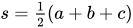
In geometry, Heron's formula (or Hero's formula) gives the area of a triangle in terms of the three side lengths Letting be the semiperimeter of the triangle, , the area is

View the full Wikipedia page for Heron's formula
↑ Return to Menu