Arditi in the context of Blackshirts


Arditi in the context of Blackshirts

⭐ Core Definition: Arditi

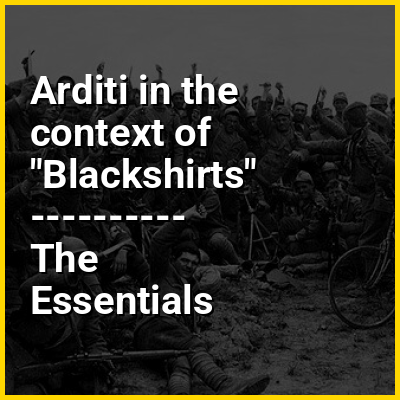
Arditi (from the Italian verb ardire, 'to dare', and translates as "The Daring [Ones]") was the name adopted by a Royal Italian Army elite special force of World War I. They and the opposing German Stormtroopers were the first modern shock troops, and they have been called "the most feared corps by opposing armies".

Reparti d'Assalto ('Assault units') were formed in the summer of 1917 by Colonel Bassi, and were assigned the tactical role of shock troops, breaching enemy defenses in order to prepare the way for a broad infantry advance. The Arditi were not units within infantry divisions, but were considered a separate combat arm.
↓ Menu
HINT:

👉 Arditi in the context of Blackshirts

The Voluntary Militia for National Security (Italian: Milizia Volontaria per la Sicurezza Nazionale, MVSN), commonly called the Blackshirts (Italian: Camicie Nere, CCNN, singular: Camicia Nera) or squadristi (singular: squadrista), was originally the paramilitary wing of the National Fascist Party, known as the Squadrismo, and after 1923 an all-volunteer militia of the Kingdom of Italy under Fascist rule, similar to the SA. Its members were distinguished by their black uniforms (modelled on those of the Arditi, Italy's elite troops of World War I) and their loyalty to Benito Mussolini, the Duce (leader) of Fascism, to whom they swore an oath. The founders of the paramilitary groups were nationalist intellectuals, former army officers and young landowners opposing peasants' and country labourers' unions. Their methods became harsher as Mussolini's power grew, and they used violence and intimidation against Mussolini's opponents. In 1943, following the fall of the Fascist regime, the MVSN was integrated into the Royal Italian Army and disbanded.

↓ Explore More Topics
In this Dossier

Arditi in the context of Proto-fascism

Proto-fascism represents the direct predecessor ideologies and cultural movements that influenced and formed the basis of fascism. The term protofascism is also used in a slightly more general sense to refer to any political movement whose activities make the emergence of fascism more likely.

Proto-fascist movements that preceded fascism featured some of the common characteristics of fascist ideology, such as the scapegoating of ethnic or religious minorities, the glorification of violence, and the promotion of the Führerprinzip, the belief that the party and the state should have a single leader with absolute power, but usually did not exhibit some characteristics of fascism, for example, were less radical or lacked totalitarian ambitions.

View the full Wikipedia page for Proto-fascism
↑ Return to Menu

Arditi in the context of Shock troops

Shock troops, assault troops, or storm troops are special formations created to lead military attacks. They are often better trained and equipped than other military units and are expected to take heavier casualties even in successful operations.

"Shock troop" is a loose translation of the German word Stoßtrupp (literally "thrust squad" or "push squad"). Assault troopers are typically organized for mobility with the intention that they will penetrate enemy defenses and attack into the enemy's vulnerable rear areas. Any specialized, elite unit formed to fight an engagement via overwhelming assault (usually) would be considered shock troops, as opposed to "special forces" or commando-style units (intended mostly for covert operations). However, both types of units could fight behind enemy lines, by surprise if required.
Cite error: There are <ref group=lower-alpha> tags or {{efn}} templates on this page, but the references will not show without a {{reflist|group=lower-alpha}} template or {{notelist}} template (see the help page).

View the full Wikipedia page for Shock troops
↑ Return to Menu