Araucanía Region in the context of "Temuco"

Play Trivia Questions online!

or

Skip to study material about Araucanía Region in the context of "Temuco"

Ad spacer

⭐ Core Definition: Araucanía Region

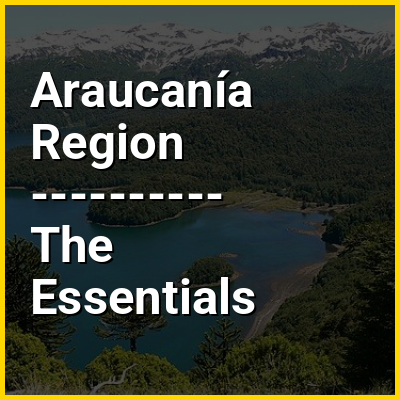
The Araucanía (/ˌærɔːˈkniə/ ARR-aw-KAY-nee-ə), La Araucanía Region (Spanish: Región de La Araucanía pronounced [(ˌ)aɾawkaˈni.a]) is one of Chile's 16 first-order administrative divisions, and comprises two provinces: Malleco in the north and Cautín in the south. Its capital and largest city is Temuco; other important cities include Angol and Villarrica.

Chile did not incorporate the lands of the Araucanía Region until the 1880s, when it occupied the area to end resistance by the indigenous Mapuche by both military and political means. This opened up the area for Chilean and European immigration and settlement.
↓ Menu

>>>PUT SHARE BUTTONS HERE<<<

👉 Araucanía Region in the context of Temuco

Temuco (Spanish pronunciation: [teˈmuko]) is a city and commune, capital of the Cautín Province and of the Araucanía Region in southern Chile. The city is located 670 kilometres (416 miles) south of Santiago. The city grew out from a fort of the same name established in 1881 during Chile's invasion of Araucanía. Temuco lies in the middle of the historic Araucanía, a traditional land of the indigenous Mapuche.

Temuco's central place in Araucanía with easy access to the Andean valleys, lakes and coastal areas makes it a hub for tourism, agricultural, livestock and forestry operations as well as a communication and trade centre for the numerous small towns of Araucanía. Temuco has recently been regarded as a university city as it houses two large universities: University of the Frontier and Temuco Catholic University. Nobel laureates Gabriela Mistral and Pablo Neruda both lived in Temuco for some time.

↓ Explore More Topics
In this Dossier

Araucanía Region in the context of Patagonia

Patagonia (Spanish pronunciation: [pataˈɣonja]) is a geographical region in southern South America that spans parts of Argentina and Chile. It includes the southern portion of the Andes mountain range, featuring lakes, fjords, temperate rainforests, and glaciers in the west, and deserts, tablelands, and steppes toward the east. The region is bounded by the Pacific Ocean to the west, the Atlantic Ocean to the east, and several waterways that connect them, including the Strait of Magellan, the Beagle Channel, and the Drake Passage to the south.

The northern limit of the region is not precisely defined; the Colorado and Barrancas rivers, which run from the Andes to the Atlantic, are commonly considered the northern limit of Argentine Patagonia; on this basis the extent of Patagonia could be defined as the provinces of Neuquén, Río Negro, Chubut and Santa Cruz, together with Patagones Partido in the far south of Buenos Aires Province. The archipelago of Tierra del Fuego is sometimes considered part of Patagonia. Most geographers and historians locate the northern limit of Chilean Patagonia at Huincul Fault, in Araucanía Region.

↑ Return to Menu

Araucanía Region in the context of Southern Chile

Southern Chile is an informal geographic term for any place south of the capital city, Santiago, or south of Biobío River, the mouth of which is Concepción, about 300 kilometres (200 mi) south of Santiago. Generally cities like Temuco are considered to be located in the south despite being relatively close to the geographical center of Chile. This is mainly because mainland Chile ended in La Frontera until the occupation of Araucanía (1861–1883). Similarly, the Southern Chile wine region is close to the geographic center of the country, encompassing wine-growing areas in the Bío Bío Region and Araucanía Region.

Southern Chile may also refer to the Zona Sur region between Biobío and Chacao Channel, which is often also called the Chilean Lake District. It may also refer to the Zona Austral, also called the Extreme South.

↑ Return to Menu

Araucanía Region in the context of Malleco Province

Malleco Province (Spanish: Provincia de Malleco) is one of two provinces in the southern Chilean region of La Araucanía (IX). Its population as of the 2017 census is 205,124, and it covers an area of 13,433.3 km (5,187 sq mi). The provincial capital is the city of Angol.

Malleco Province is known for having the emblematic Malleco Viaduct and the Las Raíces Tunnel, Chile's longest tunnel, which links the eastern part to the rest of the province.

↑ Return to Menu

Araucanía Region in the context of Angol

Angol is a commune and capital city of the Malleco Province in the Araucanía Region of southern Chile. It is located at the foot of the Cordillera de Nahuelbuta and next to the Vergara River, that permitted communications by small boats to the Bío-Bío River and Concepción. This strategic position explains the successive foundations of this city during the Arauco War. It was first founded in 1553 as a "conquistador" fort of Confines, the fort was later destroyed and rebuilt several times and it was not until the Pacification of Araucania in the late 19th century that it was rebuilt with the name of Angol. The city has a current population of approximately 53,000. Within the electoral divisions of Chile, it belongs to the 48th electoral district and the 14th senatorial circumscription.

↑ Return to Menu

Araucanía Region in the context of Villarrica, Chile

Villarrica is a city and commune in southern Chile located on the western shore of Villarrica Lake in the Province of Cautín, Araucanía Region 746 km (464 mi) south of Santiago and close to the Villarrica Volcano ski center to the south east. Residents of Villarrica are known as Villarricences.

Tourism, grain and dairy farming, and forestry are the main economic activities of the community. The climate is mild and humid with the greatest rainfall experienced between May and July (autumn and winter). The dry season is between December and February (Summer).

↑ Return to Menu

Araucanía Region in the context of Galvarino, Chile

Galvarino is a Chilean town and commune (Spanish: comuna), part of Cautín Province, in the Araucanía Region.

The town, named for the Mapuche warrior Galvarino, was founded on April 22, 1882 within the frame of the occupation of Araucanía by general Gregorio Urrutia, next to river Quillem as a fort of 2,500 m (26,910 sq ft). Its population come eminently from original Mapuche indigenous people. The area was colonized fundamentally by Swiss colonizers. The main economic activity is forestal activity, shown as great amount of the territory dedicated to production of forestal trees, like eucalyptus and pines.

↑ Return to Menu