Appliqué in the context of "Epimanikia"

Play Trivia Questions online!

or

Skip to study material about Appliqué in the context of "Epimanikia"


👉 Appliqué in the context of Epimanikia

Epimanikia (Medieval Greek: ἐπιμανίκια; singular epimanikion (ἐπιμανίκιον)), also known as Epimanika (ἐπιμάνικα; singular epimanikon (ἐπιμάνικον)), are liturgical vestments of the Eastern Orthodox Church and Eastern Catholic Churches. They are cuffs (Russian: нарука́вницы, по́ручи, нарука́вники - narukávnitsy, póruchi, narukávniki) made of thickened fabric, usually brocade, that lace onto the wrists of a bishop, priest, or deacon. There is usually a cross embroidered or appliquéd to the center.

Bishops and priests attach the epimanikia to the sleeves of the sticharion. Since the deacon wears a more elaborate sticharion as an outer garment, its large winged sleeves are not bound by epimanikia; rather he wears the epimanikia underneath, tied to his endorrason (inner cassock) (Russian: подрясник, podryasnik)

↓ Explore More Topics
In this Dossier

Appliqué in the context of Epitrachelion

The epitrachelion (Ancient Greek: ἐπιτραχήλιον "around the neck"; Slavic: Епитрахи́ль - Epitrakhíl’; often called simply a stole in casual English-language usage) is the liturgical vestment worn by priests and bishops of the Orthodox Church and Eastern Catholic Churches as the symbol of their priesthood, corresponding to the Western stole. It is essentially the orarion adapted for priests and bishops, worn around the neck with two ends of equal length hanging down in front of the clergyman's body (more or less to the ankle) and with the two adjacent sides sewn or buttoned together up the center, leaving enough space through which to place the head. In practice, the epitrachelion is made to be worn only this way, tailored to lie flat around the neck, and is never actually unfastened. The portion hanging down in front is sometimes even a solid piece of fabric. It is usually made of brocade with seven embroidered or appliquéd crosses, one at the back of the neck and three down each side. The epitrachelion is the only required vestment whenever a priest is conducting an Orthodox service; without it, he is unable to perform the service.

↑ Return to Menu

Appliqué in the context of Thanka

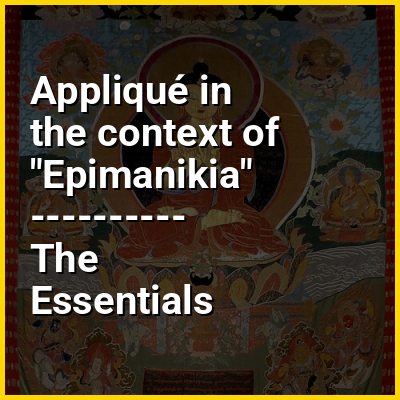
A thangka painting (Nepali pronunciation: [ˈt̪ʰaŋka]; Tibetan: ཐང་ཀ་; Nepal Bhasa: पौभा) is a Tibetan Buddhist painting on cotton, silk appliqué, usually depicting a Buddhist deity, scene, or mandala. Thangkas are traditionally kept unframed and rolled up when not on display, mounted on a textile backing somewhat in the style of Chinese scroll paintings, with a further silk cover on the front. So treated, thangkas can last a long time, but because of their delicate nature, they have to be kept in dry places where moisture will not affect the quality of the silk. Most thangkas are relatively small, comparable in size to a western half-length portrait, but some are extremely large, several metres in each dimension; these were designed to be displayed, typically for very brief periods on a monastery wall, as part of religious festivals. Most thangkas were intended for personal meditation or instruction of monastic students. They often have elaborate compositions including many very small figures. A central deity is often surrounded by other identified figures in a symmetrical composition. Narrative scenes are less common, but do appear.

Thangka serve as important teaching tools depicting the life of the Buddha, various influential lamas and other deities and bodhisattvas. One subject is the Wheel of Life (Bhavachakra), which is a visual representation of the Abhidharma teachings (Art of Enlightenment). The term may sometimes be used of works in other media than painting, including reliefs in metal and woodblock prints. Today, printed reproductions at poster size of painted thangka are commonly used for devotional as well as decorative purposes. Many thangkas were produced in sets, though they have often subsequently become separated.

↑ Return to Menu