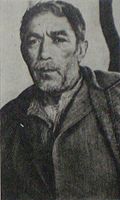
Anthony Quinn in the context of "The Hunchback of Notre Dame (1956 film)"

Play Trivia Questions online!

or

Skip to study material about Anthony Quinn in the context of "The Hunchback of Notre Dame (1956 film)"


⭐ Core Definition: Anthony Quinn

Manuel Antonio Rodolfo Quinn Oaxaca (April 21, 1915 – June 3, 2001), known as Anthony Quinn, was an American actor. He was known for his portrayal of earthy, passionate characters "marked by a brutal and elemental virility" in over 100 film, television and stage roles between 1936 and 2002. He was a two-time Academy Award winner, and was also nominated for five Golden Globe Awards, two BAFTA Awards and a Tony Award.

Quinn was born in Chihuahua City, Mexico, and was raised in El Paso, Texas and East Los Angeles. After stints as a boxer and an architect, he made his film debut in the Cecil B. DeMille Western The Plainsman in 1936. Initially typecast as a "heavy" and playing other minor parts as well, he was gradually cast in more substantial parts, including co-starring roles in Blood and Sand (1941) and The Ox-Bow Incident (1943). He won his first Oscar, for Best Supporting Actor, for his portrayal of Eufemio Zapata in Viva Zapata! (1952), becoming the first Mexican-born performer to win an Academy Award. He received his second Oscar in 1957 for Lust for Life.

↓ Menu

👉 Anthony Quinn in the context of The Hunchback of Notre Dame (1956 film)

The Hunchback of Notre Dame (in French Notre-Dame de Paris) is a 1956 French-Italian CinemaScope drama horror film version of Victor Hugo's 1831 novel, directed by Jean Delannoy and produced by Raymond Hakim and Robert Hakim. It stars American actor Anthony Quinn and Italian actress Gina Lollobrigida. The film is the first version of the novel to be made in color.

In the tradition of many sword and sandal spectacles, Quinn and Lollobrigida are the only two actors in the film who actually speak in English; the rest of the cast is made up of French actors who have had their voices dubbed into English. In the French version both Quinn and Lollobrigida speak French.

↓ Explore More Topics
In this Dossier

Anthony Quinn in the context of The Hunchback of Notre-Dame

The Hunchback of Notre-Dame (French: Notre-Dame de Paris, lit.'Our Lady of Paris', originally titled Notre-Dame de Paris. 1482) is a French Gothic novel by Victor Hugo, published in 1831. The title refers to the Notre-Dame Cathedral, which features prominently throughout the novel. It focuses on the unfortunate story of Quasimodo, the Romani street dancer Esmeralda, and Quasimodo's guardian the Archdeacon Claude Frollo in 15th-century Paris. All its elements—the Renaissance setting, impossible love affairs and marginalised characters—make the work a model of the literary themes of Romanticism.

The novel is considered a classic of French literature and has been adapted repeatedly for film, stage and television. Some prominent examples include a 1923 silent film with Lon Chaney, a 1939 sound film with Charles Laughton, a 1956 film with Anthony Quinn, and a 1996 Disney animated film with Tom Hulce.

↑ Return to Menu

Anthony Quinn in the context of Stavros, Chania

Stavros (Greek: Σταυρός, Stavrós) is a village and beach in the Akrotiri district of the city of Chania, Crete, Greece and had a population of 543 (2021). It is part of the community Kounoupidiana. The beach was the location where in 1964 Michael Cacoyannis filmed the famous beach dancing scene in the movie Zorba the Greek with Anthony Quinn.

35°35′17″N 24°05′28″E / 35.588°N 24.091°E / 35.588; 24.091

↑ Return to Menu

Anthony Quinn in the context of Jungle Fever

Jungle Fever is a 1991 American romantic drama film written, produced and directed by Spike Lee. Starring Lee, Wesley Snipes, Annabella Sciorra, Ossie Davis, Ruby Dee, Samuel L. Jackson, Lonette McKee, John Turturro, Frank Vincent, Tim Robbins, Brad Dourif, Giancarlo Esposito, Debi Mazar, Michael Imperioli, and Anthony Quinn, with Halle Berry and Queen Latifah in their film debuts, Jungle Fever explores the beginning and end of an extramarital interracial relationship against the urban backdrop of the streets of New York City in the early 1990s. The film is dedicated to Yusef Hawkins, who died on August 23, 1989.

Jungle Fever premiered in the 44th Cannes Film Festival on May 16, 1991, and was released in the United States on June 7, 1991, by Universal Pictures. The film received positive reviews, with particular praise for Samuel L. Jackson's performance, and was also commercially successful.

↑ Return to Menu

Anthony Quinn in the context of Quasimodo

Quasimodo (/ˌkwɒzɪˈmd/ KWOZ-im-OH-doh, UK also /ˌkwɔːz-/ KWAWZ-; from Quasimodo Sunday) is the titular protagonist of the French novel The Hunchback of Notre-Dame (1831) by Victor Hugo. Born with numerous deformities, most notably a hunched back, Quasimodo serves as the bell-ringer for Notre Dame cathedral in fifteenth century Paris. Although his appearance causes others to treat him cruelly, he ultimately finds sanctuary in an unlikely love that is fulfilled only in death.

The role of Quasimodo has been played by many actors in film adaptations, including Lon Chaney (1923), Charles Laughton (1939), Anthony Quinn (1956), and Anthony Hopkins (1982). In addition, he was voiced by Tom Hulce in a Disney animated feature (1996); was parodied by Steve Lemme in the comedy Quasi (2023); and most recently was portrayed by Angelo Del Vecchio in a revival of the French-language musical Notre Dame de Paris.

↑ Return to Menu