Angria in the context of Royal Frankish Annals


Angria in the context of Royal Frankish Annals

⭐ Core Definition: Angria

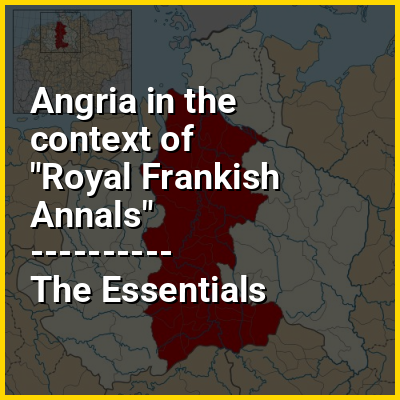
Angria or Angaria (German: Engern [ˈɛŋɐn] ) is a historical region in the present-day German states of Lower Saxony and North Rhine-Westphalia. The chronicler Widukind of Corvey in his Res gestae saxonicae sive annalium libri tres denoted it as the central region of the medieval Duchy of Saxony lying along the middle reaches of the Weser river between Westphalia and Eastphalia. Its name was derived from the Germanic Angrivarii tribe which had joined the Saxon tribal confederation, and it was centered on the town of Minden, see of a bishopric since 803.

The Angrivarii lands were conquered by Charlemagne during the Saxon Wars; according to the Royal Frankish Annals, the Angrian commanders concluded a separate peace agreement with the Carolingian Empire near Bückeburg in 775.
↓ Menu
HINT:

In this Dossier

Angria in the context of Old Saxony

Old Saxony was the homeland of the Saxons who fought the Frankish empire during the Early Middle Ages, until they conquered it and converted it into a Carolingian stem duchy in the 8th century, the Duchy of Saxony. Contemporary authors such as Bede and the author of the Ravenna Cosmography used the term "Old Saxons" to distinguish them from the Saxons living in Britain, also known as Anglo-Saxons, who they believed had migrated from Old Saxony. Roman sources as far back as the fourth century had described these continental Saxons as northern neighbours of the Franks, who lived near the Lower Rhine. They do not appear to have been politically unified, although they sometimes worked together to fight the Franks. Bede described them as ruled by "satraps".

Old Saxony, like the later duchy of Saxony, included the inland regions later known as Eastphalia, Westphalia and Angria (or Angaria), between the Rhine and Elbe rivers. They possibly also already lived in Nordalbingia, north of the mouth of the Elbe. There is a single uncertain report of a smaller Saxon tribe living in this region in the second century, and this may represent the origin of their name. During their wars with the Frankish empire, the Saxons were described as living north of the Thuringians, as far east as the Elbe. By the time of the Carolingians, most of the North Sea coast between the Rhine and Elbe was inhabited not by the Saxons, but by the medieval Frisians, who were seen as distinct from the Saxons.

View the full Wikipedia page for Old Saxony
↑ Return to Menu

Angria in the context of Saxon Wars

The Saxon Wars were 32 years of campaigns and insurrections from 772, when Charlemagne first entered Saxony with the intent to conquer, to 804 when the last rebellion of tribesmen was defeated. In all, 18 campaigns were fought, primarily in what is now northern Germany. They resulted in the incorporation of Saxony into the Frankish realm and their forcible conversion from Germanic paganism to Christianity.

The Saxons were divided into four subgroups in four regions. Nearest to the Frankish kingdom of Austrasia was Westphalia, and farthest was Eastphalia. In between the two kingdoms was Engria (or Engern), and to the north at the base of the Jutland peninsula was Nordalbingia. Despite repeated setbacks, the Saxons resisted steadfastly, returning to raid Charlemagne's domains as soon as he turned his attention elsewhere. Their main leader Widukind was a resilient and resourceful opponent, but he was defeated and baptized in 785.

View the full Wikipedia page for Saxon Wars
↑ Return to Menu

Angria in the context of Eastphalia

Eastphalia (German: Ostfalen [ɔstˈfaːlən] ; Eastphalian: Oostfalen) is a historical region in northern Germany, encompassing the eastern Gaue (shires) of the historic stem duchy of Saxony, roughly confined by the River Leine in the west and the Elbe and Saale in the east. The territory corresponds with modern southeastern Lower Saxony, western Saxony-Anhalt, and northern Thuringia. Together with Westphalia, Angria, and Nordalbingia, it was one of the four main Saxon administrative regions.

View the full Wikipedia page for Eastphalia
↑ Return to Menu

Angria in the context of Nordalbingia

Nordalbingia (German: Nordelbingen) (also Northern Albingia) was one of the four administrative regions of the medieval Duchy of Saxony, the others being Angria, Eastphalia, and Westphalia. The region's name is based on the Latin name Alba for the Elbe River and refers to an area predominantly located north of the Lower Elbe, roughly corresponding with the present-day Holstein region. Situated in what is now Northern Germany, this is the earliest known dominion of the Saxons.

View the full Wikipedia page for Nordalbingia
↑ Return to Menu