Andreas Karlstadt in the context of Thomas Müntzer


Andreas Karlstadt in the context of Thomas Müntzer

⭐ Core Definition: Andreas Karlstadt

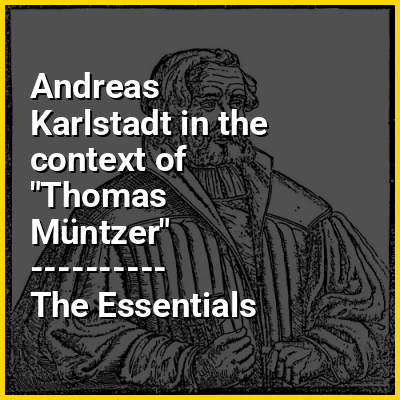
Andreas Rudolph Bodenstein von Karlstadt (1486 – 24 December 1541), better known as Andreas Karlstadt, Andreas Carlstadt or Karolostadt, in Latin, Carolstadius, or simply as Andreas Bodenstein, was a German Protestant theologian, University of Wittenberg chancellor, a contemporary of Martin Luther and a reformer of the early Reformation.

Karlstadt became a close associate of Martin Luther and one of the earliest Protestant Reformers. After Frederick III, Elector of Saxony concealed Luther at the Wartburg (1521–1522), Karlstadt and Thomas Müntzer started the first iconoclastic movement in Wittenberg and preached theology that was viewed as Anabaptist, but Karlstadt and Müntzer never regarded themselves as Anabaptists.
↓ Menu
HINT:

In this Dossier

Andreas Karlstadt in the context of Protestant Reformers

Protestant Reformers were theologians whose careers, works and actions brought about the Protestant Reformation of the 16th century.

In the context of the Reformation, Martin Luther was the first reformer, sharing his views publicly in 1517, followed by Andreas Karlstadt and Philip Melanchthon at Wittenberg, who promptly joined the new movement. In 1519, Huldrych Zwingli became the first reformer to express a form of the Reformed tradition.

View the full Wikipedia page for Protestant Reformers
↑ Return to Menu

Andreas Karlstadt in the context of Exsurge Domine

Exsurge Domine (Latin for 'Arise, O Lord') is a papal bull promulgated on 15 June 1520 by Pope Leo X written in response to Martin Luther's Ninety-five Theses, which opposed the views of the Catholic Church. The bull censured forty-one teachings found in Luther's writings Ninety-five theses and other writings. The bull also threatened Luther and his colleagues—one being Andreas Karlstadt—with excommunication unless they recanted their teachings sixty days after the publication of the bull in the Electorate of Saxony—now Saxony, Germany—and its neighboring regions.

Both theologians refused to recant, and Luther responded instead by composing polemical tracts rebuking the papacy and publicly burning a copy of Exsurge Domine on 10 December 1520 at the Elster Gate in Wittenberg. As a result, Pope Leo X promulgated the papal bull Decet Romanum Pontificem on 3 January 1521, excommunicating both theologians.

View the full Wikipedia page for Exsurge Domine
↑ Return to Menu

Andreas Karlstadt in the context of Radical Reformation

The Radical Reformation represented a response to perceived corruption both in the Catholic Church and in the expanding Magisterial Protestant movement led by Martin Luther and many others. Starting in Germany and Switzerland in the 16th century, the Radical Reformation gave birth to many radical Protestant groups throughout Europe. The term covers Radical Reformers like Thomas Müntzer and Andreas Karlstadt, the Zwickau prophets, and Anabaptist groups like the Hutterites and the Mennonites.

In Germany, Switzerland and Austria, a majority sympathized with the Radical Reformation despite intense persecution. Although the surviving proportion of the European population that rebelled against Catholic, Lutheran and Reformed Churches was small, Radical Reformers wrote profusely, and the literature on the Radical Reformation is disproportionately large, partly as a result of the proliferation of the Radical Reformation teachings in the United States.

View the full Wikipedia page for Radical Reformation
↑ Return to Menu