The American frontier, also known as the Old West, and popularly known as the Wild West, encompasses the geography, history, folklore, and culture associated with the forward wave of American expansion in mainland North America that began with European colonial settlements in the early 17th century and ended with the admission of the last few contiguous western territories as states in 1912. This era of massive migration and settlement was particularly encouraged by President Thomas Jefferson following the Louisiana Purchase, giving rise to the expansionist attitude known as "manifest destiny" and historians' "Frontier Thesis". The legends, historical events and folklore of the American frontier, known as the frontier myth, have embedded themselves into United States culture so much so that the Old West, and the Western genre of media specifically, has become one of the defining features of American national identity.
>>>PUT SHARE BUTTONS HERE<<<
👉 American Old West in the context of First transcontinental railroad
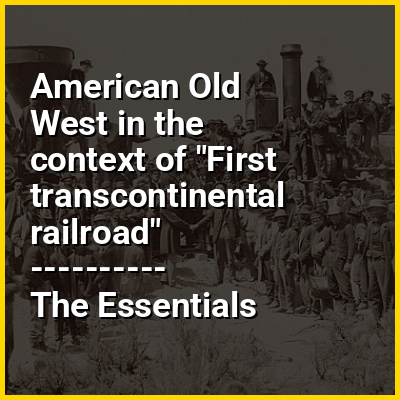
America's first transcontinental railroad (known originally as the "Pacific Railroad" and later as the "Overland Route") was a 1,911-mile (3,075 km) continuous railroad line built between 1863 and 1869 that connected the existing eastern U.S. rail network at Council Bluffs, Iowa, with the Pacific coast at the Oakland Long Wharf on San Francisco Bay. The rail line was built by three private companies over public lands provided by extensive U.S. land grants. Building was financed by both state and U.S. government subsidy bonds as well as by company-issued mortgage bonds. The Western Pacific Railroad Company built 132 miles (212 km) of track from the road's western terminus at Alameda/Oakland to Sacramento, California. The Central Pacific Railroad Company of California (CPRR) constructed 690 miles (1,110 km) east from Sacramento to Promontory Summit, Utah Territory. The Union Pacific Railroad (UPRR) built 1,085 miles (1,746 km) from the road's eastern terminus at the Missouri River settlements of Council Bluffs and Omaha, Nebraska, westward to Promontory Summit.
The railroad opened for through traffic between Sacramento and Omaha on May 10, 1869, when CPRR President Leland Stanford ceremonially tapped the gold "Last Spike" (later often referred to as the "Golden Spike") with a silver hammer at Promontory Summit. In the following six months, the last leg from Sacramento to San Francisco Bay was completed. The resulting coast-to-coast railroad connection revolutionized the settlement and economy of the American West. It brought the western states and territories into alignment with the northern Union states and made transporting passengers and goods coast-to-coast considerably quicker, safer and less expensive.
- ⭐ Core Definition: American Old West
- 👉 American Old West in the context of First transcontinental railroad
- American Old West in the context of Charles Marion Russell
- American Old West in the context of Douglas MacArthur
- American Old West in the context of Blueberry (comics)
- American Old West in the context of Tex Willer
- American Old West in the context of C. M. Russell Museum Complex
- American Old West in the context of Pacific Slope
- American Old West in the context of Nocturne (painting)
- American Old West in the context of Butch Cassidy
American Old West in the context of Charles Marion Russell
Charles Marion Russell (March 19, 1864 – October 24, 1926), also known as C. M. Russell, Charlie Russell, and "Kid" Russell, was an American artist of the American Old West. He created more than 2,000 paintings of cowboys, Native Americans, and landscapes set in the western United States and in Alberta, Canada, in addition to bronze sculptures. He is known as "the cowboy artist" and was also a storyteller and author. He became an advocate for Native Americans in the west, supporting the bid by landless Chippewa to have a reservation established for them in Montana. In 1916, Congress passed legislation to create the Rocky Boy Reservation.
The C. M. Russell Museum Complex in Great Falls, Montana houses more than 2,000 Russell artworks, personal objects, and artifacts. Other major collections are held at the Montana Historical Society in Helena, Montana, the Buffalo Bill Center of the West in Cody, Wyoming, the Amon Carter Museum of American Art in Fort Worth, Texas, and the Sid Richardson Museum in Fort Worth. His 1912 mural Lewis and Clark Meeting Indians at Ross' Hole hangs in the House chambers of the Montana Capitol in Helena, and his 1918 painting Piegans sold for $5.6 million at a 2005 auction. In 1955, he was inducted into the Hall of Great Westerners of the National Cowboy & Western Heritage Museum in Oklahoma City, Oklahoma.
American Old West in the context of Douglas MacArthur
Douglas MacArthur (26 January 1880 – 5 April 1964) was an American general who served as a top commander during World War II and the Korean War, achieving the rank of General of the Army. He served with distinction in World War I; as chief of staff of the United States Army from 1930 to 1935; as Supreme Commander, Southwest Pacific Area, from 1942 to 1945 during WWII; as Supreme Commander for the Allied Powers overseeing the occupation of Japan from 1945 to 1951; and as head of the United Nations Command in the Korean War from 1950 to 1951. MacArthur was nominated for the Medal of Honor three times, and awarded it for his WWII service in the Philippines. He is one of only five people to hold the rank of General of the Army, and the only person to hold the rank of Field Marshal in the Philippine Army.
MacArthur, the son of Medal of Honor recipient Arthur MacArthur Jr., was raised on Army posts in the Old West. He was valedictorian of the West Texas Military Academy, and First Captain at the U.S. Military Academy at West Point, where he graduated first in his class in 1903. During the 1914 U.S. occupation of Veracruz, he conducted a reconnaissance mission for which he was nominated for the Medal of Honor. In 1917, he was promoted from major to colonel and became chief of staff of the 42nd (Rainbow) Division. On the Western Front during World War I, he rose to the rank of brigadier general, was again nominated for a Medal of Honor, and was awarded the Distinguished Service Cross twice and the Silver Star seven times. From 1919 to 1922, MacArthur served as Superintendent of the U.S. Military Academy, where he initiated a series of reforms. His next posting was in the Philippines, where in 1924 he was instrumental in quelling the Philippine Scout Mutiny. In 1925, MacArthur became the Army's youngest major general at the age of 45, and in 1930 was appointed Chief of Staff of the U.S. Army. He was involved in the controversial expulsion of the Bonus Army protesters in Washington, D.C., in 1932, and organized the Civilian Conservation Corps. In 1935, MacArthur was appointed Military Advisor to the Commonwealth of the Philippines. He retired from the Army in 1937, but continued as an advisor and as a Field Marshal in the Philippine Army from 1936.
American Old West in the context of Blueberry (comics)
Blueberry is a Western comic series created in the Franco-Belgian bandes dessinées (BD) tradition by the Belgian scriptwriter Jean-Michel Charlier and French comics artist Jean "Mœbius" Giraud. It chronicles the adventures of Mike Steve Donovan alias Blueberry on his travels through the American Old West. Blueberry is an atypical western hero; he is not a wandering lawman who brings evil-doers to justice, nor a handsome cowboy who "rides into town, saves the ranch, becomes the new sheriff and marries the schoolmarm". In any situation, he sees what he thinks needs doing, and he does it.
The series spawned out of the 1963 Fort Navajo comics series, originally intended as an ensemble narrative, but which quickly gravitated around the breakout character "Blueberry" as the main and central character after the first two stories, causing the series to continue under his name later on. The older stories, released under the Fort Navajo moniker, were ultimately reissued under the name Blueberry as well in later reprint runs. Two spin-off, or rather, sub-series, La Jeunesse de Blueberry (Young Blueberry) and Marshal Blueberry, were created pursuant the main series reaching its peak in popularity in the early 1980s.
American Old West in the context of Tex Willer
Tex Willer is the main fictional character of the Italian comics series Tex, created by writer Gian Luigi Bonelli and illustrator Aurelio Galleppini, and first published in Italy on 30 September 1948. The series is among the most popular Italian comics, with translations into numerous languages around the world. The fan base in Brazil is especially large, but it is also very popular in Finland, Norway, Greece, Turkey, Croatia, France, India, Serbia, Bosnia, Israel and Spain. Issues have also been published in the United Kingdom and the United States.
The Tex series is an Italian-made interpretation of the American Old West, inspired by the classical characters and stories of old American Western movies, and occasionally by American history. Galleppini also took inspiration from Sardinia, where he grew up.
American Old West in the context of C. M. Russell Museum Complex
C. M. Russell Museum Complex is an art museum located in the city of Great Falls, Montana, in the United States. The museum's primary function is to display the artwork of Great Falls "cowboy artist" Charles Marion Russell, for whom the museum is named. The museum also displays illustrated letters by Russell, work materials used by him, and other items which help visitors understand the life and working habits of Russell. In addition, the museum displays original 19th, 20th, and 21st century art depicting the American Old West and the flora, fauna, and landscapes of the American West. In 2009, the Wall Street Journal called the institution "one of America's premier Western art museums." Located on the museum property is Russell's log cabin studio, as well as his two-story wood-frame home. The house and log cabin studio were designated a National Historic Landmark in 1965, and added to the National Register of Historic Places in 1966. In 1976, the listing boundaries were amended to account for moving the house.
Beginning in 1969, the museum co-hosted the C. M. Russell Auction of Original Western Art—an auction of 19th, 20th, and 21st century art of the American West whose proceeds benefit the museum. The auction has received media attention in Australia, Canada, France, Germany, Japan, New Zealand, the United Kingdom, and the United States. In 2010, the two co-hosts parted ways, and the C. M. Russell Museum inaugurated a new auction, "The Russell."
American Old West in the context of Pacific Slope
The Pacific Slope describes geographic regions in North American, Central American, and South American countries that are west of the continental divide and slope down to the Pacific Ocean. In North America, the Rocky Mountains mark the eastern border of the Pacific Slope. In Central and South America, the region is much narrower, confined by the Sierra Madre Occidental in Central America, and by the Andes in South America. The phrase is still used today mostly for scientific purposes to refer to regions inhabited by specific species.
It was and is still occasionally used to describe the region in North America during the 19th century and the expansion of the Old West. It includes the states and territories west of the continental divide that runs down the Rocky Mountains in North America. This included the territories and the states that emerged from them, including California, Oregon Territory, Washington Territory, Nevada Territory, Idaho Territory, Colorado Territory, and Utah Territory. The region is drained by the Columbia, Sacramento, San Joaquin and Colorado River systems. In the United States, the Pacific-slope flycatcher takes its name from the region it inhabits.
American Old West in the context of Nocturne (painting)
The depiction of night in paintings is common in Western art. Paintings that feature a night scene as the theme may be religious or history paintings, genre scenes, portraits, landscapes, or other subject types. Some artworks involve religious or fantasy topics using the quality of dim night light to create mysterious atmospheres. The source of illumination in a night scene—whether it is the moon or an artificial light source—may be depicted directly, or it may be implied by the character and coloration of the light that reflects from the subjects depicted. They are sometimes called nocturnes, or night-pieces, such as Rembrandt's The Night Watch, or the German Romantic Caspar David Friedrich's Two Men Contemplating the Moon of 1819.
In America, James Abbott McNeill Whistler titled works as nocturnes to identify those paintings with a "dreamy, pensive mood" by applying the musical term, and likewise also titled (and retitled) works using other music expressions, such as a "symphony", "harmony", "study" or "arrangement", to emphasize the tonal qualities and the composition and to de-emphasize the narrative content. The use of the term "nocturne" can be associated with the Tonalist movement of the American of the late 19th century and early 20th century which is "characterized by soft, diffused light, muted tones and hazy outlined objects, all of which imbue the works with a strong sense of mood." Along with winter scenes, nocturnes were a common Tonalist theme. Frederic Remington used the term as well for his nocturne scenes of the American Old West.
American Old West in the context of Butch Cassidy
Robert LeRoy Parker (April 13, 1866 – November 7, 1908), better known as Butch Cassidy, was an American train and bank robber and the leader of a gang of criminal outlaws known as the "Wild Bunch" in the Old West.
Parker engaged in criminal activity for more than a decade at the end of the 19th century and the early 20th century, but the pressures of being pursued by law enforcement, notably the Pinkerton detective agency, forced him to flee the United States. He fled with his accomplice Harry Longabaugh, known as the "Sundance Kid", and Longabaugh's girlfriend Etta Place. The trio traveled first to Argentina and then to Bolivia, where Parker and Longabaugh are believed to have been killed in a shootout with the Bolivian Army in November 1908; the exact circumstances of their fate are unclear.