Aegium in the context of "Aigio"

Play Trivia Questions online!

or

Skip to study material about Aegium in the context of "Aigio"

Ad spacer

⭐ Core Definition: Aegium

Aegium or Aigion (Ancient Greek: Αἴγιον), or Aegeium or Aigeion (Αἴγειον), was a town and polis (city-state) of ancient Achaea, and one of the twelve Achaean cities. It was situated upon the coast west of the river Selinus, 30 stadia from Rhypae, and 40 stadia from Helice.

The city stood between two promontories in the corner of a bay, which formed the best harbour in Achaea next to that of Patrae. It is said to have been formed out of a union of seven or eight villages. It was already mentioned in the Homeric Catalogue of Ships in the Iliad. When the neighbouring city of Helice sank into the sea following an earthquake in 373 BCE, Aegium annexed its territory and became the chief city of the Achaean League. When the League dissolved later in the same century, however, Aegium came for some time under Macedonian rule.
↓ Menu

>>>PUT SHARE BUTTONS HERE<<<

👉 Aegium in the context of Aigio

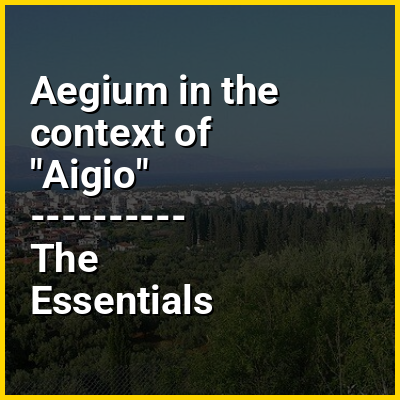
Aigio, also written as Aeghion, Aegion, Aegio, Egio (Greek: Αίγιο, romanizedAígio, pronounced [ˈeʝio]; Latin: Aegium), is a town and a former municipality in Achaea, West Greece, on the Peloponnese. Since the 2011 local government reform, it is part of the municipality Aigialeia, of which it is the seat and a municipal unit.

Aigio is the second largest city in Achaea after Patras. The municipal unit has an area of 151.101 km. It has a population of around 26,000 while the municipality has about 49,000 inhabitants. Aigio is a port town on the Gulf of Corinth, and takes its name from the ancient city of Aegium.

↓ Explore More Topics
In this Dossier

Aegium in the context of Ceryneia

Ceryneia or Keryneia (Ancient Greek: Κερύνεια, also Cerynia or Kerynia (Κερυνία), Ceraunia or Keraunia (Κεραυνία), Cerauneia or Kerauneia (Κεραύνεια), Caryneia or Karyneia (Καρύνεια), was a town and polis (city-state) of ancient Achaea. It was not originally one of the 12 Achaean cities, though it afterwards became so, succeeding to the place of Aegae. Its population was increased by a large body of Mycenaeans, when the latter abandoned their city to the Argives in 468 BCE. Ceryneia is mentioned as a member of the Achaean League on its revival in c. 280 BCE; and one of its citizens, Marcus, was chosen in 255 BCE as the first sole General of the League. In the time of Strabo, Ceryneia was dependent upon Aegium. It was situated inland upon a lofty height, west of the river Cerynites (Bokhusia), and a little south of Helice. Theophrastus stated that the wine of Ceryneia produced abortion.

The place is celebrated in Greek mythology as the location of the Ceryneian Hind, the capture of which was one of the Labours of Hercules.

↑ Return to Menu