Administrative divisions of the Yuan dynasty in the context of "Guangxi"

Play Trivia Questions online!

or

Skip to study material about Administrative divisions of the Yuan dynasty in the context of "Guangxi"


⭐ Core Definition: Administrative divisions of the Yuan dynasty

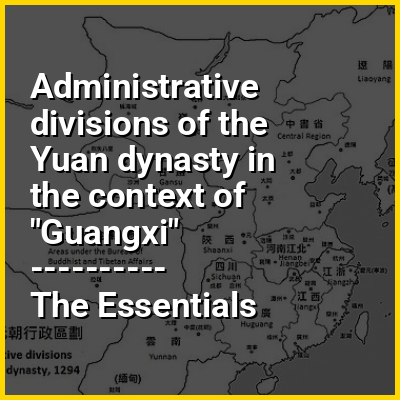
The Yuan dynasty was a Mongol-led imperial Chinese dynasty. During its existence, its territory was divided into the Central Region (腹裏) governed by the Central Secretariat (Zhongshu Sheng) and places under control of various provinces (行省) or Branch Secretariats (行中書省), as well as the region under the Bureau of Buddhist and Tibetan Affairs (Xuanzheng Yuan). In addition, the Yuan emperors held nominal suzerainty over the western Mongol khanates, but in reality none of them were governed by the Yuan dynasty due to the division of the Mongol Empire.

↓ Menu

👉 Administrative divisions of the Yuan dynasty in the context of Guangxi

Guangxi, officially the Guangxi Zhuang Autonomous Region, is an autonomous region of the People's Republic of China, located in South China and bordering Vietnam (Tuyên Quang, Cao Bằng, Lạng Sơn, and Quảng Ninh Provinces) and the Gulf of Tonkin. Formerly a province, Guangxi became an autonomous region in 1958. Its current capital is Nanning.

Guangxi's location, in mountainous terrain in the far south of China, has placed it on the frontier of Chinese civilization throughout much of Chinese history. The current name "Guang" means "expanse" and has been associated with the region since the creation of Guang Prefecture in 226 AD. It was given provincial level status during the Yuan dynasty, but even into the 20th century, it was considered an open, wild territory. The abbreviation of the region (Chinese: ; Hanyu pinyin: Guì; Zhuang: Gvei) comes from the name of the city of Guilin, the provincial capital during both the Ming and Qing dynasties.

↓ Explore More Topics
In this Dossier

Administrative divisions of the Yuan dynasty in the context of Tibet under Yuan rule

Tibet under Yuan rule refers to the Mongol-led Yuan dynasty's rule over Tibet from approximately 1270 to 1354. During the Yuan dynasty, Tibet was administered by an organization that was structurally, militarily and administratively subordinate to the Yuan court. Tibet was conquered by the Mongols led by a general titled doord darkhan in 1240 and Mongol rule was established after Sakya Pandita obtained power over Tibet through the Mongols in 1244. This period and administration has been called the Sakya dynasty (Tibetan: ས་སྐྱ་, Wylie: sa skya, Chinese: 薩迦王朝; pinyin: Sàjiā Wángcháo) after the favored Sakya school of Tibetan Buddhism.

The region retained a degree of political autonomy under the Sakya lama, who was the de jure head of Tibet and a spiritual leader of the Mongol Empire under the priest and patron relationship. However, administrative and military rule of Tibet remained under the auspices of the Yuan government agency known as the Bureau of Buddhist and Tibetan Affairs (Xuanzheng Yuan), a top-level administrative department separate from other Yuan provinces, but still under the administration of the Yuan dynasty. Tibet retained nominal power over religious and political affairs, while the Yuan dynasty managed a structural and administrative rule over the region, reinforced by the rare military intervention. This existed as a "diarchic structure" under the Yuan emperor, with power primarily in favor of the Mongols. One of the department's purposes was to select a dpon-chen, the de facto administrator and imperial representative in Tibet, usually appointed by the lama and confirmed by the Yuan emperor in Dadu (modern-day Beijing).

↑ Return to Menu