Act of Independence of Lithuania in the context of Lithuanian–Soviet War


Act of Independence of Lithuania in the context of Lithuanian–Soviet War

⭐ Core Definition: Act of Independence of Lithuania

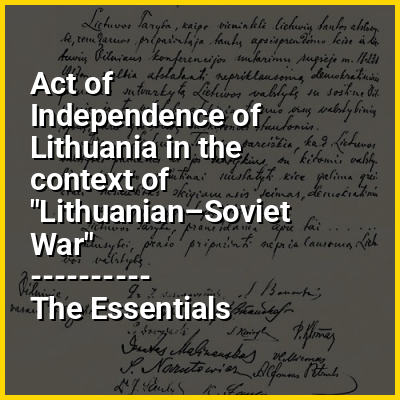
The Act of Independence of Lithuania (Lithuanian: Lietuvos Nepriklausomybės Aktas) or the Act of February 16th, also the Lithuanian Resolution on Independence (Lithuanian: Lietuvos Nepriklausomybės Nutarimas), was signed by the Council of Lithuania on February 16, 1918, proclaiming independence from Russia and the restoration of an independent State of Lithuania, governed by democratic principles, with Vilnius as its capital. The Act was signed by all twenty representatives of the Council, which was chaired by Jonas Basanavičius. The Act of February 16 was the result of a series of resolutions on the issue, including one issued by the Vilnius Conference and the Act of January 8. The path to the Act was long and complex because the German Empire exerted pressure on the Council to form an alliance. The Council had to carefully maneuver between the Germans, whose troops were present in Lithuania, and the demands of the Lithuanian people.

The immediate effects of the announcement of Lithuania's re-establishment of independence were limited. Publication of the Act was prohibited by the German authorities, and the text was distributed and printed illegally. The work of the Council was hindered, and Germans remained in control over Lithuania. The situation changed only when Germany lost World War I in the fall of 1918. In November 1918 the first Cabinet of Lithuania was formed, and the Council of Lithuania gained control over the territory of Lithuania. Independent Lithuania, although it would soon be battling the Wars of Independence, became a reality.
↓ Menu
HINT:

👉 Act of Independence of Lithuania in the context of Lithuanian–Soviet War

The Lithuanian–Soviet War or Lithuanian–Bolshevik War (Lithuanian: karas su bolševikais) was fought between newly independent Lithuania and the Russian Socialist Federative Soviet Republic in the aftermath of World War I. It was part of the larger Soviet westward offensive of 1918–1919. The offensive followed the retreat of German troops and sought to establish Soviet republics in Ukraine, Belarus, Lithuania, Latvia, Estonia, and Poland, and to link up with the German Revolution. By the end of December 1918, Soviet forces reached Lithuanian borders. Largely unopposed, they occupied one town after another and by the end of January 1919, they controlled about two thirds of the Lithuanian territory. In February, the Soviet advance was stopped by Lithuanian and German volunteers, who prevented the Soviets from capturing Kaunas, the temporary capital of Lithuania. From April 1919, the Lithuanian war went parallel with the Polish–Soviet War. Poland had territorial claims over Lithuania, especially the Vilnius Region; these tensions spilt over into the Polish–Lithuanian War.

British-Polish historian Norman Davies summarized the situation: "the German army was supporting the Lithuanian nationalists, the Soviets were supporting the Lithuanian communists and the Polish Army was fighting them all." In mid-May, the Lithuanian army, now commanded by General Silvestras Žukauskas, began an offensive against the Soviets in Northeastern Lithuania. By mid-June, the Lithuanians reached the Latvian border and cornered the Soviets among lakes and hills near Zarasai, where the Soviets held out until the end of August 1919. The Soviets and Lithuanians, separated by the Daugava River, maintained their fronts until the Battle of Daugavpils in January 1920. As early as September 1919, the Soviets offered to negotiate a peace treaty, but talks began only in May 1920. The Soviet–Lithuanian Peace Treaty was signed on July 12, 1920. Soviet Russia fully recognized independent Lithuania.

↓ Explore More Topics
In this Dossier

Act of Independence of Lithuania in the context of Vilnius Region

Vilnius Region is the territory in present-day Lithuania and Belarus that was originally inhabited by ethnic Baltic tribes and was a part of Lithuania proper, but came under East Slavic and Polish cultural influences over time.

The territory included Vilnius, the historical capital of the Grand Duchy of Lithuania. Lithuania, after declaring independence from the Russian Empire, claimed the Vilnius Region based on this historical legacy. Poland argued for the right of self-determination of the local Polish-speaking population. As a result, throughout the interwar period the control over the area was disputed between Poland and Lithuania. The Soviet Union recognized it as part of Lithuania in the Soviet–Lithuanian Peace Treaty, but in 1920 it was seized by Poland and became part of the short-lived puppet state of Central Lithuania, and was subsequently incorporated into the Second Polish Republic.

View the full Wikipedia page for Vilnius Region
↑ Return to Menu

Act of Independence of Lithuania in the context of Kingdom of Lithuania (1918)

The Kingdom of Lithuania was an attempt to establish an independent constitutional Lithuanian monarchy in February 1918. It was created towards the end of World War I when Lithuanian-speaking lands were under military occupation by the German Empire. The state was officially dissolved in November 1918.

The Council of Lithuania declared Lithuania's independence on 16 February 1918, but the council was unable to form a government, police, or other state institutions due to the continued presence of German troops. The Germans presented various proposals to incorporate Lithuania into the German Empire, particularly Prussia. The Lithuanians resisted this idea and hoped to preserve their independence by creating a separate constitutional monarchy.

View the full Wikipedia page for Kingdom of Lithuania (1918)
↑ Return to Menu

Act of Independence of Lithuania in the context of Polish–Lithuanian War

The Polish–Lithuanian War was an undeclared war fought in the aftermath of World War I between newly independent Lithuania and Poland, with fighting mainly in the Vilnius and Suwałki regions, which was part of the Lithuanian Wars of Independence and lasted from May 1919 to 29 November 1920. From the spring of 1920 onward, the conflict happened alongside the wider Polish–Soviet War and was affected by its progress. It was subject to unsuccessful international mediation at the Conference of Ambassadors and the League of Nations.

After World War I, the military and political situation in the region was chaotic, as multiple countries, notably Lithuania, Poland, and Soviet Russia, vied with each other over control of overlapping areas. The Polish–Lithuanian conflict was centered on Vilnius, which the Council of Lithuania declared the capital of the restored Lithuanian state. Control of Vilnius was transferred from Germans to Poles on January 2, 1919, but the Polish paramilitary lost the city to the Bolsheviks on January 5. The Polish Army seized Vilnius again on April 19, 1919 and came in contact with the Lithuanian Army fighting in the Lithuanian–Soviet War. Despite the antagonism over Vilnius, the Lithuanian and Polish armies sometimes cooperated when fighting against a common enemy, the Bolsheviks. As Lithuanian–Polish relations worsened, the Entente drew two demarcation lines in hopes to stall further hostilities. The lines did not please either side and were ignored. The first clashes between Polish and Lithuanian soldiers occurred on April 26 and May 8, 1919, near Vievis. With the Polish coup against the Lithuanian government failing in August 1919, the front stabilized until the summer of 1920.

View the full Wikipedia page for Polish–Lithuanian War
↑ Return to Menu

Act of Independence of Lithuania in the context of Lithuanian National Revival

The Lithuanian National Revival, alternatively the Lithuanian National Awakening or Lithuanian nationalism (Lithuanian: Lietuvių tautinis atgimimas), was a period of the history of Lithuania in the 19th century, when a major part of Lithuanian-inhabited areas belonged to the Russian Empire (the Russian partition of the Polish–Lithuanian Commonwealth). It was expressed by the rise of self-determination of the Lithuanians that led to the formation of the modern Lithuanian nation and culminated in the re-establishment of an independent Lithuanian state. The most active participants of the national revival included Vincas Kudirka and Jonas Basanavičius. The period largely corresponded to the rise of romantic nationalism and other national revivals of 19th-century Europe.

The revival was predated by a short period of the early 19th century known as the "Samogitian revival" led by students of Vilnius University, including Simonas Daukantas and Simonas Stanevičius. The most recent Lithuanian national revival may be linked to the late 20th century developments also known as the Singing Revolution.

View the full Wikipedia page for Lithuanian National Revival
↑ Return to Menu