Abortion in the United States in the context of "Beginning of pregnancy controversy"

Play Trivia Questions online!

or

Skip to study material about Abortion in the United States in the context of "Beginning of pregnancy controversy"


⭐ Core Definition: Abortion in the United States

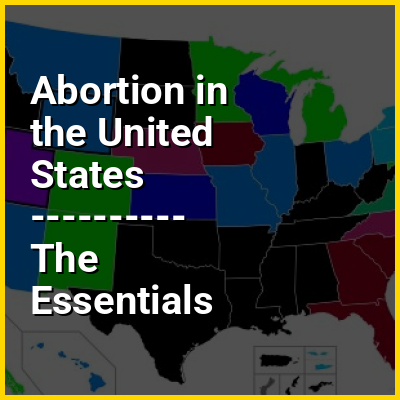
In the United States, abortion is a divisive issue in politics and culture wars. Prior to the mid-19th century, English common law formed the basis of abortion law in the colonies and the early Republic.

Connecticut was the first state to regulate abortion in 1821; it outlawed abortion after quickening, the moment in pregnancy when the pregnant woman starts to feel the fetus's movement in the uterus, and forbade the use of poisons to induce one post-quickening. Many states subsequently passed various laws on abortion until the Supreme Court of the United States decisions of Roe v. Wade and Doe v. Bolton decriminalized abortion nationwide in 1973. The Roe decision imposed a federally mandated uniform framework for state legislation on the subject. It also established a minimal period during which abortion is legal, with more or fewer restrictions throughout the pregnancy.
↓ Menu

👉 Abortion in the United States in the context of Beginning of pregnancy controversy

Controversy over the beginning of pregnancy occurs in different contexts, particularly as it is discussed within the debate of abortion in the United States. Because an abortion is defined as ending an established pregnancy, rather than as destroying a fertilized egg, depending on when pregnancy is considered to begin, some methods of birth control as well as some methods of infertility treatment might be classified as causing abortions.

The controversy is not primarily a scientific issue, since knowledge of human reproduction and development has become very refined; the linguistic questions remain debated for other reasons. The issue poses larger social, legal, medical, religious, philosophical, and political ramifications because some people, such as Concerned Women for America, identify the beginning of a pregnancy as the beginning of an individual human being's life. Many of these arguments are related to the anti-abortion movement. In this way of thinking, if the pregnancy has not yet begun, then stopping the process is not abortion and therefore can contain none of the moral issues associated with abortion, but if it is a pregnancy, then stopping it is a morally significant act.

↓ Explore More Topics
In this Dossier

Abortion in the United States in the context of Judicial interpretation

Judicial interpretation is the way in which the judiciary construes the law, particularly constitutional documents, legislation and frequently used vocabulary. This is an important issue in some common law jurisdictions such as the United States, Australia and Canada, because the supreme courts of those nations can overturn laws made by their legislatures via a process called judicial review.

For example, the United States Supreme Court has decided such topics as the legality of slavery as in the Dred Scott decision, and desegregation as in the Brown v Board of Education decision, and abortion rights as in the Roe v Wade decision. As a result, how justices interpret the constitution, and the ways in which they approach this task has a political aspect. Terms describing types of judicial interpretation can be ambiguous; for example, the term judicial conservatism can vary in meaning depending on what is trying to be "conserved". One can look at judicial interpretation along a continuum from judicial restraint to judicial activism, with different viewpoints along the continuum.

↑ Return to Menu

Abortion in the United States in the context of United States anti-abortion movement

The United States anti-abortion movement, also called the pro-life movement or right-to-life movement, is a movement in the United States that opposes induced abortion and advocates for the protection of fetuses. Advocates support legal prohibition or restriction on ethical, moral, or religious grounds, arguing that human life begins at conception and that the human zygote, embryo, or fetus is a person and therefore has a right to life. The anti-abortion movement includes a variety of organizations, with no single centralized decision-making body. There are diverse arguments and rationales for the anti-abortion stance. Some allow for some permissible abortions, including therapeutic abortions, in exceptional circumstances such as incest, rape, severe fetal defects, or when the woman's health is at risk.

Before the Supreme Court 1973 decisions in Roe v. Wade and Doe v. Bolton, anti-abortion views predominated and found expression in state laws which prohibited or restricted abortions in a variety of ways. (See Abortion in the United States.) The anti-abortion movement became politically active and dedicated to the reversal of the Roe v. Wade decision, which struck down most state laws restricting abortion in the first trimester of pregnancy.In the United States, the movement is associated with several Christian religious groups, especially the Catholic Church and Evangelical churches, and is frequently, but not exclusively, allied with the Republican Party. The movement is also supported by secular organizations (such as Secular Pro-Life) and non-mainstream anti-abortion feminists. The movement has campaigned to reverse Roe v. Wade and to promote legislative changes or constitutional amendments, such as the Human Life Amendment, that prohibit or at least broadly restrict abortion.

↑ Return to Menu

Abortion in the United States in the context of Catholic Church and abortion in the United States

The Catholic Church and abortion in the United States deals with the views and activities of the Catholic Church in the United States in relation to the abortion debate. The Catholic Church opposes abortion and has campaigned against abortion in the United States, both saying that it is immoral and making statements and taking actions in opposition to its classification as legal.

A majority Catholics in the United States disagree with the official position promulgated by the Church, with 59% of Catholics supporting legal abortion in all or most cases. This upward trend in Catholic support for legal abortion aligns with a broader shift in American society. The gap between Catholic clergy and laity views is even more pronounced among Catholics of color, with 73% supporting the right to have an abortion. There is a distinction between practicing Catholics and non-practicing Catholics on the issue; practicing Catholics, are far more likely to be anti-abortion, while non-practicing Catholics are more likely to be in favor of abortion legalization.

↑ Return to Menu

Abortion in the United States in the context of Abortion laws in U.S. states

The legality of abortion in the United States and the various restrictions imposed on the procedure vary significantly, depending on the laws of each state or other jurisdiction, although there is no uniform federal law. Some states prohibit abortion at all stages of pregnancy, with few exceptions; others permit it up to a certain point in a woman's pregnancy, while some allow abortion throughout a woman's pregnancy. In states where abortion is legal, several classes of restrictions on the procedure may exist, such as parental consent or notification laws, requirements that patients be shown an ultrasound before obtaining an abortion, mandatory waiting periods, and counseling requirements.

From 1973 to 2022, Supreme Court rulings in Roe v. Wade (1973) and Planned Parenthood v. Casey (1992) created, and maintained, federal protections for a pregnant woman's right to get an abortion, ensuring that states could not ban abortion prior to the point at which a fetus may be deemed viable. However, Roe and Casey were overturned by Dobbs v. Jackson Women's Health Organization (2022), and states may now impose any regulation on abortion, provided it satisfies rational basis review and does not otherwise conflict with federal law. Prior to the Court's decision in Dobbs, many states enacted trigger laws to ban abortion, should Roe be overturned. Additionally, several states either have enacted or are in the process of enacting stricter abortion laws following Dobbs, and some have resumed enforcement of laws in effect prior to 1973. While such laws are no longer considered to violate the United States Constitution, they continue to face some legal challenges in state courts.

↑ Return to Menu

Abortion in the United States in the context of Taxpayer March on Washington

The Taxpayer March on Washington (also known as the 9/12 Tea Party) was a Tea Party protest march from Freedom Plaza to the United States Capitol held on September 12, 2009, in Washington, D.C. The event coincided with similar protests organized in various cities across the nation. The protesters rallied against what they consider big government, the dismantling of free market capitalism, abortion, and President Barack Obama's proposals on health care reform, taxation, and federal spending, among other issues.

The lead organizer of the event was Brendan Steinhauser, who was serving as the Director of Federal and State Campaigns for FreedomWorks. Organizers of the event included the 9-12 Project, FreedomWorks, the National Taxpayers Union, The Heartland Institute, Americans for Tax Reform, Tea Party Patriots, ResistNet and Americans for Prosperity. The event was also promoted by Fox News commentator Glenn Beck as a symbol of what he called "national unity" following the eight-year anniversary of the September 11 attacks. The march is the largest gathering of fiscal conservatives ever held in Washington, D.C., and was the largest demonstration against President Obama's administration.

↑ Return to Menu