Abdulaziz in the context of "Mehmed Emin Âli Pasha"

Play Trivia Questions online!

or

Skip to study material about Abdulaziz in the context of "Mehmed Emin Âli Pasha"


⭐ Core Definition: Abdulaziz

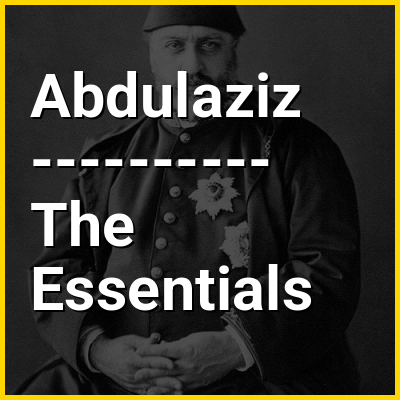
Abdulaziz (Ottoman Turkish: عبد العزيز, romanizedʿAbdü'l-ʿAzîz; Turkish: Abdülaziz; 8 February 1830 – 4 June 1876) was the sultan of the Ottoman Empire from 25 June 1861 to 30 May 1876, when he was overthrown in a government coup. He was a son of Sultan Mahmud II and succeeded his brother Abdulmejid I in 1861.

Abdulaziz's reign began during the Ottoman Empire's resurgence following the Crimean War and two decades of the Tanzimat reforms, though it was now reliant on European capital. The decade after his ascension was dominated by the duo of Fuad Pasha and Aali Pasha, who accelerated reorganization of the Empire. The Vilayet Law was promulgated, Western codes were applied to more aspects of Ottoman law, and the millets were restructured. The issue of Tanzimat dualism continued to plague the empire, however.
↓ Menu

In this Dossier

Abdulaziz in the context of Tanzimat

The Tanzimat (Ottoman Turkish: تنظيمات, Turkish: Tanzimât, lit. 'Reorganization') was a period of reforms in the Ottoman Empire that began with the Edict of Gülhane of 1839 and ended with the First Constitutional Era in 1876. Driven by reformist statesmen such as Mustafa Reşid Pasha, Mehmed Emin Âli Pasha, and Fuad Pasha, under Sultans Abdul Mejid and Abdul Aziz, the reforms sought to reverse the empire's decline by modernizing legal, military, and administrative systems while promoting Ottomanism (equality for all subjects). Though secular courts, modern education, and infrastructure like railways, were introduced, the reforms faced resistance from conservative clerics, exacerbated ethnic tensions in the Balkans, and saddled the empire with crippling foreign debt. The Tanzimat’s legacy remains contested: some historians credit it with establishing a powerful national government, while others argue it accelerated imperial fragmentation.

Different functions of government received reform, were completely reorganized, or started from scratch. Among institutions that received significant attention throughout this period included legislative functions, trade policy, secularization and codification of the legal system, crackdowns on the slave trade, education, property law, law enforcement, and the military. Ottoman statesmen also worked with reformers of the many confessional communities of the empire, millets, to codify — and in some cases democratize — their confessional governments.

↑ Return to Menu

Abdulaziz in the context of First Constitutional Era

The First Constitutional Era (Ottoman Turkish: مشروطيت; Turkish: Birinci Meşrutiyet Devri) was a period of constitutional monarchy in the Ottoman Empire from 23 December 1876 until 14 February 1878. It began with the promulgation of the Ottoman constitution, written by members of the Young Ottomans. The Young Ottomans were dissatisfied by the Tanzimat and pushed for a constitutional government similar to that in Europe. The constitutional period started with the dethroning of Sultan Abdul Aziz. After Murad V's ephemeral reign, Abdul Hamid II took his place as Sultan. The era ended with the suspension of the Ottoman Parliament and the constitution by Sultan Abdul Hamid II, with which he restored absolute monarchy.

The first constitutional era did not include a party system. At the time, the Ottoman Parliament (known as the General Assembly of the Ottoman Empire) was seen as the voice of the people but not as a venue for the formation of political parties and organizations. The elections for the Parliament were held in accordance with the provisional electoral regulations. The General Assembly of the Ottoman Empire was composed in two houses. The lower house of the bicameral legislature was the Chamber of Deputies, while the upper house was the Senate, or Chamber of Notables. The initial selection of deputies was made by administrative councils in the provinces (also called Meclis-i Umumi).

↑ Return to Menu

Abdulaziz in the context of Constitution of the Ottoman Empire

The Constitution of the Ottoman Empire (Ottoman Turkish: قانون أساسي, romanizedKānûn-ı Esâsî, lit.'Basic law'; French: Constitution ottomane) was in effect from 1876 to 1878 in a period known as the First Constitutional Era, and from 1908 to 1922 in the Second Constitutional Era. The first and only constitution of the Ottoman Empire, it was written by members of the Young Ottomans, particularly Midhat Pasha, during the reign of Sultan Abdul Hamid II (r. 1876–1909). After Abdul Hamid's political downfall in the 31 March Incident, the Constitution was amended to transfer more power from the sultan and the appointed Senate to the popularly-elected lower house: the Chamber of Deputies.

In the course of their studies in Europe, some members of the new Ottoman elite concluded that the secret of Europe's success rested not only with its technical achievements but also with its political organizations. Moreover, the process of reform itself had imbued a small segment of the elite with the belief that constitutional government would be a desirable check on autocracy and provide it with a better opportunity to influence policy. Sultan Abdulaziz's chaotic rule led to his deposition in 1876 and, after a few troubled months, to the proclamation of an Ottoman constitution that the new sultan, Abdul Hamid II, pledged to uphold.

↑ Return to Menu

Abdulaziz in the context of Midhat Pasha

Ahmed Şefik Midhat Pasha (Ottoman Turkish: احمد شفيق مدحت پاشا, romanizedAḥmed Şefīḳ Midḥat Pāşā; 1822 – 26 April 1883) was an Ottoman politician, reformist, and statesman. He was the author of the Constitution of the Ottoman Empire.

Midhat was born in Istanbul and educated from a private medrese. In July 1872, he was appointed grand vizier by Abdulaziz (r. 1861–1876), though was removed in August. During the First Constitutional Era, in 1876, he co-founded the Ottoman Parliament. Midhat was noted as a kingmaker and leading Ottoman democrat. He was part of a governing elite which recognized the crisis the Empire was in and considered reform to be a dire need. Midhat was reportedly killed in al-Ta'if.

↑ Return to Menu

Abdulaziz in the context of 1876 Ottoman coup d'état

On 30 May 1876, a bloodless military coup d'état occurred in the Ottoman capital of Istanbul, which resulted in the dethronement of the Ottoman Sultan Abdulaziz, and subsequently, the appointment of Murad V as the Sultan. The Ottoman Empire would be dominated by a constitutional committee chaired by Midhat Pasha for the next two years, a period known as the First Constitutional Era.

↑ Return to Menu

Abdulaziz in the context of Murad V

Murad V (Ottoman Turkish: مراد خامس, romanizedMurâd-ı ḫâmis; Turkish: V. Murad; 21 September 1840 – 29 August 1904) was the sultan of the Ottoman Empire from 30 May to 31 August 1876. The son of Abdulmejid I, he supported the conversion of the government to a constitutional monarchy. His uncle Abdulaziz had succeeded Abdulmejid to the throne and had attempted to name his own son as heir to the throne, which spurred Murad to participate in Abdulaziz's overthrow. But his own frail physical and mental health made his reign unstable, and Murad V was deposed in favor of his half-brother Abdul Hamid II after only 93 days.

↑ Return to Menu

Abdulaziz in the context of Bulgarian Exarchate

The Bulgarian Exarchate (Bulgarian: Българска екзархия, romanizedBalgarska ekzarhiya; Turkish: Bulgar Eksarhlığı) was the official name of the Bulgarian Orthodox Church before its autocephaly was recognized by the Ecumenical See in 1945 and the Bulgarian Patriarchate was restored in 1953.

The Exarchate (a de facto autocephaly) was unilaterally (without the blessing of the Ecumenical Patriarch) decreed by the Ottoman Empire on May 23 [O.S. May 11] 1872, in the Bulgarian church in Constantinople in pursuance of the March 12 [O.S. February 28] 1870 firman of Sultan Abdulaziz.

↑ Return to Menu