A Vindication of the Rights of Woman in the context of "Socialist feminism"

Play Trivia Questions online!

or

Skip to study material about A Vindication of the Rights of Woman in the context of "Socialist feminism"

Ad spacer

⭐ Core Definition: A Vindication of the Rights of Woman

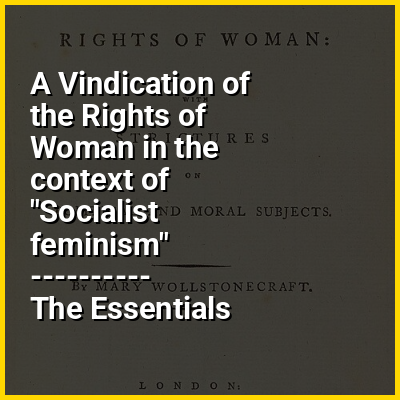
A Vindication of the Rights of Woman: with Strictures on Political and Moral Subjects, is a 1792 feminist essay written by British philosopher and women's rights advocate Mary Wollstonecraft (1759–1797), and is one of the earliest works of feminist philosophy.

In this essay, Wollstonecraft responds to those educational and political theorists of the eighteenth century who did not believe women should receive a rational education. She argues that women ought to have an education commensurate with their position in society, claiming that women are essential to the nation because they educate its children and because they could be "companions" to their husbands, rather than mere wives. Instead of viewing women as ornaments to society or property to be traded in marriage, Wollstonecraft maintains that they are human beings deserving of the same fundamental rights as men.

↓ Menu

>>>PUT SHARE BUTTONS HERE<<<

👉 A Vindication of the Rights of Woman in the context of Socialist feminism

Socialist feminism rose in the 1960s and 1970s as an offshoot of the feminist movement and New Left that focuses upon the interconnectivity of the patriarchy and capitalism. However, the ways in which women's private, domestic, and public roles in society has been conceptualized, or thought about, can be traced back to Mary Wollstonecraft's A Vindication of the Rights of Woman (1792) and William Thompson's utopian socialist work in the 19th century. Ideas about overcoming the patriarchy by coming together in female groups to talk about personal problems stem from Carol Hanisch. This was done in an essay in 1969 which later coined the term 'the personal is political.' This was also the time that second wave feminism started to surface which is really when socialist feminism kicked off. Socialist feminists argue that liberation can only be achieved by working to end both the economic and cultural sources of women's oppression.

Socialist feminism is a two-pronged theory that broadens Marxist feminism's argument for the role of capitalism in the oppression of women and radical feminism's theory of the role of gender and the patriarchy. Socialist feminists reject radical feminism's main claim that patriarchy is the only, or primary, source of oppression of women. Rather, Socialist feminists assert that women are oppressed due to their financial dependence on males. Women are subjects to male domination within capitalism due to an uneven balance in wealth. They see economic dependence as the driving force of women's subjugation to men. Further, Socialist feminists see women's liberation as a necessary part of a larger quest for social, economic, and political justice. Socialist feminists attempted to integrate the fight for women's liberation with the struggle against other oppressive systems based on race, class, sexual orientation, or economic status.
↓ Explore More Topics
In this Dossier

A Vindication of the Rights of Woman in the context of Mary Wollstonecraft

Mary Wollstonecraft (/ˈwʊlstənkræft/, also UK: /-krɑːft/; 27 April 1759 – 10 September 1797) was an English writer and philosopher best known for her advocacy of women's rights. Until the late twentieth century, Wollstonecraft's life, which encompassed several unconventional (at the time) personal relationships, received more attention than her writing. Wollstonecraft is regarded as one of the founding feminist philosophers, and feminists often cite both her life and her works as important influences.

During her brief career she wrote novels, treatises, a travel narrative, a history of the French Revolution, a conduct book, and a children's book. Wollstonecraft is best known for A Vindication of the Rights of Woman (1792), in which she argues that women are not naturally inferior to men but appeared to be only because they lack education. She suggests that both men and women should be treated as rational beings and imagines a social order founded on reason.

↑ Return to Menu